

Viksit Bharat 2047 has emerged as India’s defining long-term development objective. The ambition is not simply to make India one of the world’s largest economies, but to transform it into a developed, high-income economy by the centenary of Independence.
Much of the discussion around Viksit Bharat has understandably focused on what India must improve: manufacturing, infrastructure, employment, productivity, investment, agriculture, technology, human capital and exports. What remains less developed is the quantification of the destination.
If India is to become a high-income economy, how large must its economy become? More importantly, how much of that economy should come from agriculture and other primary activities, how much from manufacturing and other secondary activities, and how much from services?
This article attempts to fill that gap.
Rather than forecasting India’s GDP mechanically, it constructs three scenarios of sectoral pathways Conservative, Base and Ambitious for a roughly $30–30.5 trillion economy in 2047. It then calculates the scale to which the primary, secondary and tertiary sectors would have to expand and the compound annual growth rates required to reach those levels.
The purpose is not to prescribe a single rigid structure for India in 2047. It is to give policymakers a measurable framework for answering a more operational question:
Where is India today, where does it need to reach by 2047, and which parts of the economy need the greatest transformation?
Why Approximately $30 Trillion?
The starting point comes from the World Bank’s India Country Economic Memorandum: Becoming a High-Income Economy in a Generation.
The World Bank estimates that for India to qualify as a high-income economy by 2047, its GNI per capita under the Atlas method would need to reach approximately US$20,000. This is not today’s high-income threshold projected unchanged into the future. The World Bank assumes that the income-classification threshold itself will increase over time. India therefore has to chase a moving target.
The World Bank further estimates that India would need to sustain approximately 7.8% average annual real economic growth over the next 22 years to achieve high-income status. It also identifies higher investment, productivity, labour-force participation, job creation, technology adoption and structural transformation as critical requirements.
How does $20,000 per capita translate into aggregate economic size?
If India’s population around 2047 is approximately 1.5 billion:
US$20,000 × 1.5 billion people = US$30 trillion
The $30 trillion figure is therefore not an arbitrary headline target. It is an approximate bridge between India’s population scale and the income level associated with the World Bank’s projected high-income threshold.
Strictly speaking, this calculation produces approximately $30 trillion of GNI, not GDP. GNI and GDP are not identical, and the World Bank’s income classification uses Atlas-method GNI per capita rather than market-exchange-rate GDP per capita. Nevertheless, given the relatively close relationship between India’s aggregate GDP and GNI, a $30–30.5 trillion economy provides a useful policy benchmark for analysing the productive capacity that Viksit Bharat may require.
Where India Stands: The MoSPI Baseline
The sectoral baseline is derived from the Ministry of Statistics and Programme Implementation’s National Accounts estimates.
MoSPI’s FY2024-25 annual estimates provide the base structure for this analysis. Under the estimates available in the national accounts series used for the initial calculations, nominal GDP for FY2024-25 was ₹330.68 lakh crore and nominal GVA was ₹300.22 lakh crore. Real GDP stood at ₹187.97 lakh crore.
MoSPI subsequently introduced a new GDP series with 2022-23 as the base year, replacing the earlier 2011-12 series. Under the rebased First Revised Estimates, FY2024-25 nominal GDP is ₹318.07 lakh crore and nominal GVA ₹288.54 lakh crore. This rebasing incorporates updated data sources and methodological improvements.
This distinction matters for future updates of the model, but it does not alter the central purpose of the exercise: estimating the structural transformation required between the present economy and 2047.
MoSPI defines the broad sectors as follows: the primary sector comprises agriculture, livestock, forestry, fishing, mining and quarrying; the secondary sector comprises manufacturing, electricity, gas, water and other utilities, and construction; and the tertiary sector comprises services.
In FY2024-25, real GVA growth was estimated at 4.9% for primary activities, 8.0% for secondary activities and 7.9% for tertiary activities under the subsequently rebased series.
The central challenge is therefore not merely maintaining India’s present sectoral structure while making every sector larger. Viksit Bharat requires deciding which sectors must grow faster than the economy as a whole.
Why Primary-Sector Contribution is equally important
Traditional structural-transformation models often assume that as countries become richer, agriculture and other primary activities fall sharply as a share of output while services expand.
India’s 2047 circumstances warrant a more nuanced approach.
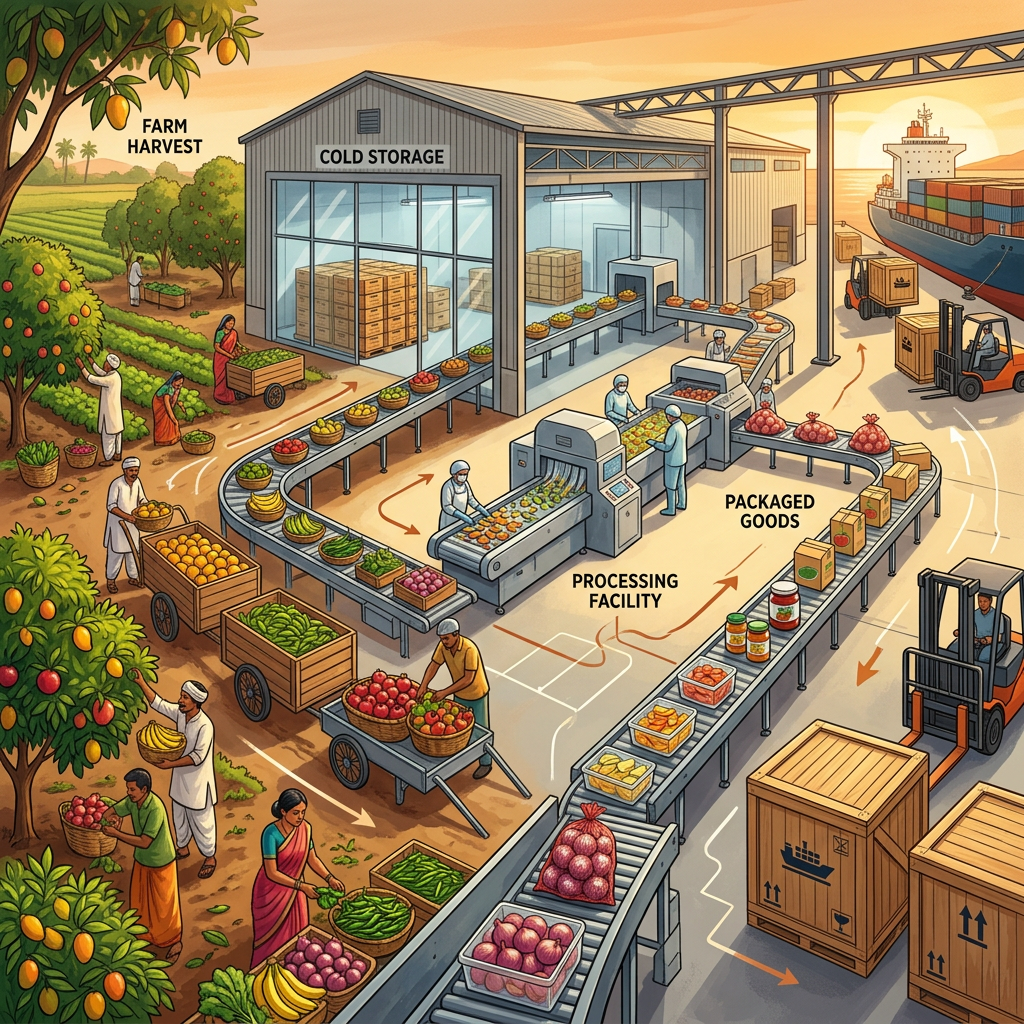
Agriculture must support food and nutritional security for a population approaching 1.5 billion while simultaneously moving towards higher productivity, precision agriculture, horticulture, livestock, dairy, fisheries, biotechnology and higher-value production.
At the same time, automation, electrification, renewable energy, batteries, semiconductors, defence, aerospace, robotics and advanced manufacturing will sharply increase strategic demand for critical minerals and other natural resources.
The primary sector can therefore become substantially larger in absolute value even if fewer workers are required per unit of output.
The objective should not be to reduce primary-sector production. It should be to transform low-productivity primary activity into high-productivity, technology-intensive agriculture and resource production.
There is an equally important statistical distinction. Mining a mineral belongs to the primary sector, but refining it, converting it into advanced materials and using those materials to manufacture batteries, magnets, electronics or vehicles largely creates value in the secondary sector.
For Viksit Bharat, therefore, the preferred value chain is:
Resource extraction → processing → advanced materials → components → finished manufacturing → recycling
This is why the secondary sector becomes central to the proposed scenarios.
Three Possible Structures for a $30.5 Trillion Viksit Bharat
Assuming approximately $27.6 trillion of GVA, with the balance between GVA and GDP represented by net product taxes, three structural scenarios are constructed.

These are not official Government of India or World Bank forecasts. They are policy scenarios developed in this analysis to quantify alternative productive structures capable of supporting approximately the same $30.5 trillion economy.
Scenario I: Conservative — 14:38:48
The Conservative scenario assumes that India’s development trajectory continues to be relatively services-intensive.
Primary activities contribute 14% of GVA, secondary activities 38%, and tertiary activities 48%.
This translates into approximately:
- $3.86 trillion primary economy
- $10.49 trillion secondary economy
- $13.25 trillion tertiary economy
This should not be interpreted as neglecting agriculture or mining. The primary economy would still become several times larger in absolute terms. Agriculture would have to generate considerably greater value through productivity, diversification and technology.
The principal characteristic of this scenario is that services remain India’s largest economic engine, while industrialisation accelerates substantially without overtaking services.
It is arguably the least disruptive structural transition of the three.
Scenario II: Base — 16:42:42
The Base scenario represents a more balanced productive structure and is the central scenario proposed by this analysis.
Primary activities contribute 16%, secondary activities 42%, and tertiary activities 42% of GVA.
That gives India approximately:
- $4.42 trillion primary economy
- $11.59 trillion secondary economy
- $11.59 trillion tertiary economy
The significance is the emergence of two almost equally powerful economic engines: production and services.
India would retain a very large agricultural and resource economy while substantially deepening manufacturing, construction, utilities, mineral processing and advanced industrial capabilities.
This scenario is particularly relevant for strategic autonomy. A high-income India would not merely consume advanced technologies or provide services around them; it would increasingly produce the materials, machinery, infrastructure, energy systems and manufactured products on which those technologies depend.
Scenario III: Ambitious — 18:44:38
The Ambitious scenario represents India as a resource-secure industrial and technological powerhouse.
Primary activities maintain an 18% GVA share, close to their present broad importance, while secondary activities rise to 44%. Services account for 38%.
The resulting economy comprises approximately:
- $4.97 trillion primary economy
- $12.14 trillion secondary economy
- $10.49 trillion tertiary economy
This does not mean services shrink. Their absolute output would still multiply several times.
Rather, primary and secondary activities grow much faster, reflecting a deliberate national strategy around food security, critical minerals, manufacturing, infrastructure, energy, advanced materials and technological production.
This is the most difficult scenario because the industrial transformation required is unprecedented in scale.
How Fast Must Each Sector Grow?
Using the approximate sectoral starting values employed in the model and projecting them over roughly 22 years to 2047 gives the following required nominal US-dollar CAGRs.

Important: these are nominal US-dollar CAGRs, not real GDP growth rates. They should therefore not be compared directly with the World Bank’s 7.8% real-growth requirement. Inflation, exchange-rate movements and changes in relative prices influence nominal dollar values.
Nevertheless, the table identifies something that aggregate GDP targets conceal.
The Biggest Challenge is the Secondary Sector
Across all three scenarios, the secondary sector requires the fastest expansion.
Even in the Conservative scenario, secondary GVA must become approximately 11.6 times larger. In the Base scenario, it needs to expand about 12.8 times, requiring approximately 12.3% nominal-dollar annual growth. In the Ambitious scenario, it becomes approximately 13.4 times larger.
This is the central policy finding of the analysis.
India’s challenge is not simply achieving 7–8% aggregate real GDP growth. It is creating conditions under which manufacturing, infrastructure, utilities, construction and downstream resource processing consistently grow faster than much of the rest of the economy.
This requires an industrial policy agenda encompassing semiconductors, electronics, machinery, robotics, EVs, batteries, defence, aerospace, pharmaceuticals, chemicals, biotechnology, renewable-energy equipment, steel, specialty alloys, advanced materials and food processing.
The World Bank itself identifies structural transformation, technology adoption, investment, job creation and greater participation in global value chains as critical elements of India’s high-income transition. It estimates that total investment would need to rise from around 33.5% of GDP to about 40% by 2035, alongside substantially higher labour-force participation and productivity.
From a GDP Target to Sectoral Accountability
The value of sectoral quantification is that it changes the policy question.
Instead of asking only:
“Is India growing at 7.8%?”
policymakers can additionally ask:
- Is primary-sector output moving towards a $4–5 trillion scale?
- Is the secondary economy moving towards $10.5–12 trillion?
- Can manufacturing and downstream resource processing grow fast enough to support that transformation?
- Are services expanding alongside, rather than substituting for, India’s productive capacity?
These questions can subsequently be translated into five-year and state-level milestones.
The Base scenario, for example, implies a 2047 destination of approximately $4.4 trillion primary + $11.6 trillion secondary + $11.6 trillion tertiary GVA.
Once the destination is quantified, government can work backwards to establish 2030, 2035, 2040 and 2045 sectoral milestones and identify persistent gaps.
What Viksit Bharat Should Measure
The principal contribution of this analysis is therefore not another GDP forecast. It is a proposed sectoral destination framework.
A $30 trillion economy can have very different underlying structures. India could remain predominantly services-led; it could develop a balanced productive economy; or it could become a resource-secure industrial powerhouse.
The three pathways can be summarised as:

The 16:42:42 Base scenario offers a useful central benchmark—not because 16%, 42% and 42% are predetermined optimal shares, but because the scenario forces policymakers to confront the magnitude of transformation required in each part of the economy.
The Policy Question for 2047
Viksit Bharat cannot ultimately be measured by the size of GDP alone.
The World Bank’s analysis shows the scale of the macroeconomic challenge: India needs approximately $20,000 Atlas-method GNI per capita by 2047 under its projected high-income threshold and an average real growth rate of approximately 7.8% over the coming two decades.
This article takes the next step.
If approximately $30 trillion represents the scale of national income associated with that objective for a population around 1.5 billion, then India needs to ask which sectors will produce it.
The analysis suggests a plausible range by 2047 of approximately $3.9–5.0 trillion from primary activities, $10.5–12.1 trillion from secondary activities and $10.5–13.3 trillion from tertiary activities, depending on the development pathway India chooses.
The most demanding transformation is clearly industrial.
Agriculture and mining must become more productive and technologically sophisticated. Services must continue scaling globally. But the difference between a large economy and a genuinely productive, strategically capable high-income economy may ultimately depend on India’s ability to convert its resources, labour, technology and capital into a dramatically larger secondary sector.
The next stage of Viksit Bharat policy should therefore move from stating what India wants to become to quantifying what every major part of the economy must become by 2047.
That is how a national aspiration becomes a measurable economic strategy.
Author

Make Tatvita one of your preferred sources
See more insights from Tatvita Analysts in your Google Search results.

Leave a Reply