
July 2026
-

How Leading Companies Use AI to Improve Workforce Productivity Without Job Cuts
Artificial intelligence can help employees draft, analyse, code, search and solve problems faster. But for business and HR leaders, the more important question is not whether AI can automate tasks. It is whether those efficiencies translate into measurable workforce productivity without making headcount reduction the default strategy. The evidence suggests that AI can produce meaningful…
-

How Israel Built Its Defence Economy with Innovation and Self-Reliance?
When people think about a country’s defence sector, they usually picture soldiers, fighter jets, missiles, and military operations. However, defence is not only about protecting national borders. It is also an important part of a country’s economy. The field of defence economics examines how governments invest in defence, develop domestic industries, encourage technological innovation, create…
-

Indian Pharmaceutical Sector: Market Research Report
How are India’s leading pharmaceutical companies preparing for the next phase of global healthcare growth? India’s pharmaceutical industry is undergoing one of its most significant transformations in recent years. While some companies are investing aggressively in specialty medicines, biologics and global manufacturing, others are reshaping their businesses through acquisitions, capacity expansion and portfolio diversification. Yet…
-

Building India’s Future: Leveraging the Demographic Dividend
India is at an important stage of its development. With a population of over 1.4 billion, it is the world’s most populous country and one of the youngest major economies. Around 68% of the population is in the working-age group (15–64 years), and the median age is about 28 years, giving India a significant demographic…
-

The Quantum Shield: Defence Systems, Military Infrastructure, & The Geopolitical Arms Race
The first phase of the global quantum threat revolves around adversaries passively hoarding our digital secrets in dark archives. But the quantum arms race has a much darker, far more aggressive side. If stealing encrypted data today to read it tomorrow is an intelligence crisis, the weaponisation of quantum computers represents an active, kinetic military…
-

GST and MSMEs in India: Impact on Small Businesses
Micro, Small and Medium Enterprises (MSMEs) are often described as the backbone of the Indian economy. They contribute significantly to employment, manufacturing, exports, and regional development while providing opportunities for entrepreneurship across urban and rural India. Because of their large presence and economic importance, any major policy reform affecting businesses has a direct impact on…
-

Is India Preparing a Future-Ready Workforce?
In the age of technology and competition in the global economy, the talent quality of a nation’s human resources is crucial for its productivity and economic growth. Employers are looking for practical, technical, and digital skills rather than theoretical knowledge acquired in formal learning contexts. Consequently, skill education and vocational training have become central to…
-
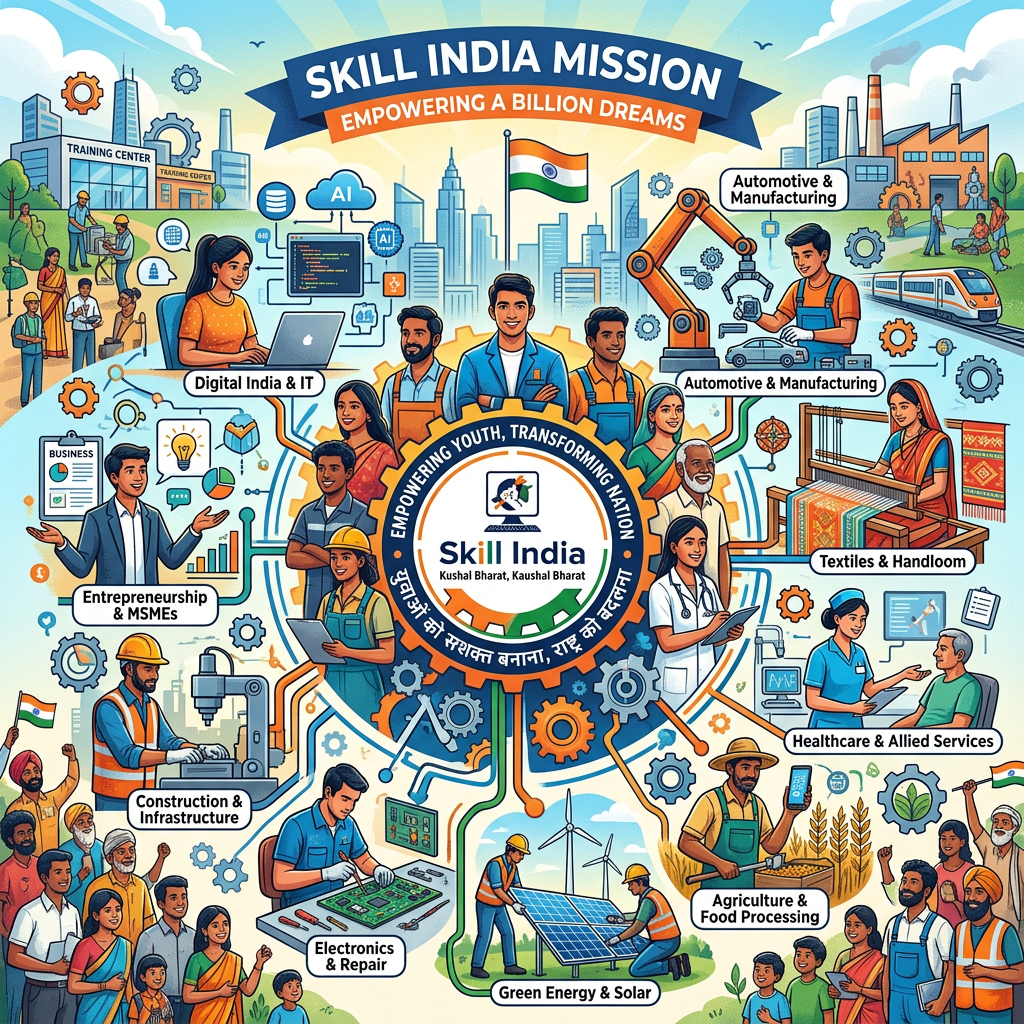
Counting Certificates, Not Jobs: Measuring a Decade of Skill India
On 18 December 2025, India’s Comptroller and Auditor General tabled Report No. 20 of 2025 in Parliament. It covered all three phases of the Pradhan Mantri Kaushal Vikas Yojana (PMKVY) from July 2015 to March 2022: a combined outlay of Rs. 14,450 crore and a reporting record that successive governments had cited as evidence of…
-

The ROI of Employee Upskilling: Does Training Improve Business Performance?
For years, employee training has been in the same budget category as office candy and partying: discretionary, and a first cut when times get tough. Now, that is being challenged with actual data and it’s not working out. Organisations successfully building talent, not just attracting it, are the ones which are being reshaped by automation,…
-

Germany’s Approach of Skills over Degrees for Changing Job Dynamics
In most countries, a sixteen year old finishing school either continues studying or faces the real job market. He only has two choices, continue studying or drop out and hope for the best. In Germany, to address this issue, there is a third entirely different (well respected) path, which school dropouts actually choose, something which…