
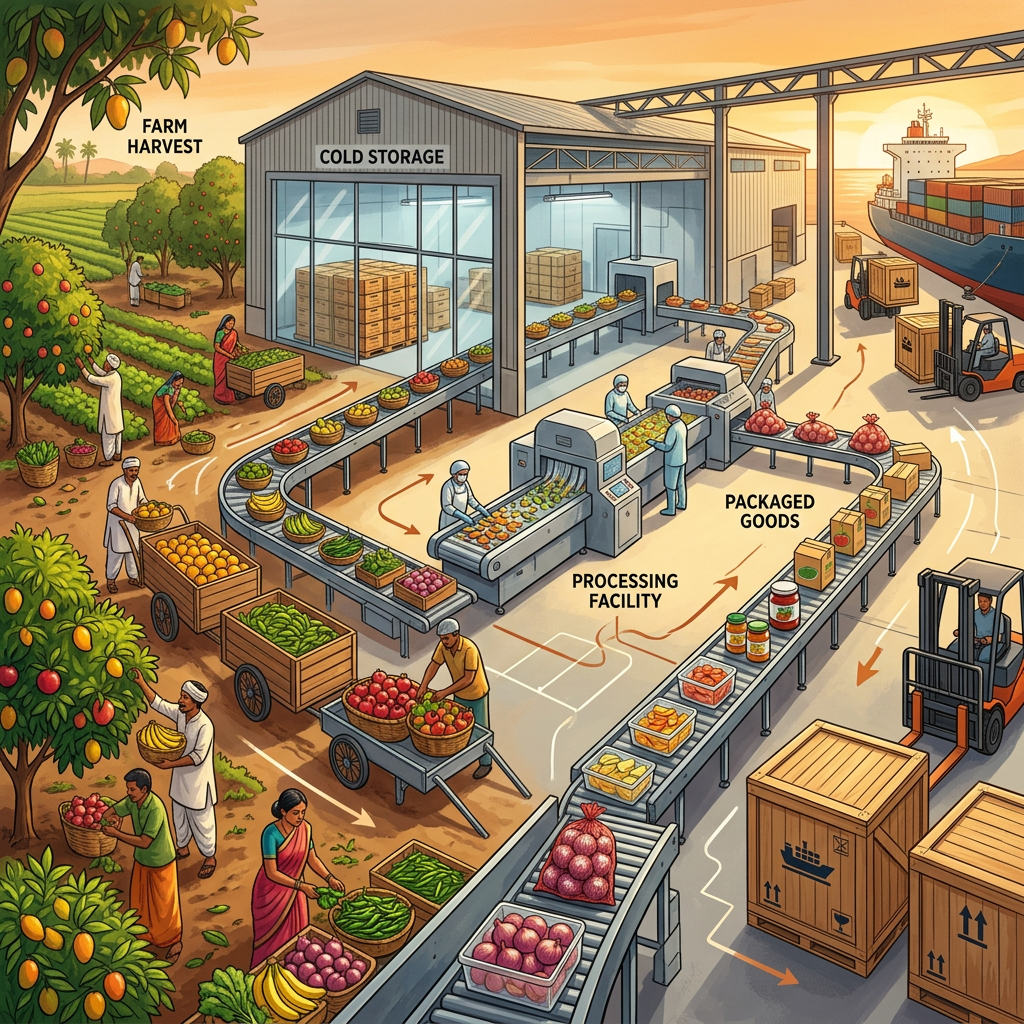
A market analysis of where India’s food-processing industry can convert post-harvest losses into value-added products, stronger supply chains and scalable businesses
Food loss is normally discussed as a sustainability problem. For India’s food-processing industry, it is also an economic inefficiency and a potential source of value creation.
The opportunity is substantial but uneven. The latest nationwide post-harvest-loss assessment cited by India’s Ministry of Food Processing Industries (MoFPI) estimates losses of 6.02–15.05% for fruits, 4.87–11.61% for vegetables and 8.76% for marine fisheries, compared with only 0.87% for milk. Processing cannot eliminate every loss, but preservation, cold chains, grading, freezing, drying, pulping and other value-addition technologies can extend shelf life and create alternative markets for suitable produce.
India already has a significant food-processing base. The sector accounted for 22.96 lakh workers in registered industry and 46.57 lakh in the unincorporated sector in 2022-23. Processed value-added products covered by APEDA generated US$8.22 billion of exports in FY2024-25, up from US$6.01 billion in FY2021-22.
Yet opportunity does not automatically mean attractive economics. Fragmented sourcing, perishability, cold-chain dependence, food-safety requirements, working-capital needs, buyer power and price-sensitive consumers can weaken margins.
Using Porter’s Five Forces, SWOT analysis and a Food Loss-to-Value Opportunity Matrix, Tatvita finds that the strongest opportunities are not necessarily in processing the largest-volume commodities. They emerge where four conditions intersect:
High perishability + Processing feasibility + Market demand + Value realisation.
The strategic question for businesses is therefore not simply “Should we enter food processing?”
It is:
Where in the food value chain can processing convert a measurable loss into a product customers will pay for at economics that remain viable after sourcing, processing, logistics and distribution costs?
India’s Food Loss is Also Lost Economic Value
Globally, 13.4% of food is estimated to be lost between production and retail, according to FAO’s latest 2026 update. Another 19% of food available to consumers is wasted at retail, food-service and household levels according to UNEP’s estimates. Food loss and waste are also estimated to account for 8–10% of global greenhouse-gas emissions.
India’s problem varies sharply by commodity.
MoFPI’s latest published nationwide assessment, undertaken by NABCONS across 292 districts and 15 agro-climatic zones, measured losses at multiple stages including harvesting, sorting, drying, packaging, transportation and storage.

These differences matter commercially.
A tonne of tomatoes that deteriorates before reaching a consumer is not merely wasted food. It represents wasted land, water, fertiliser, labour, transport and working capital.
But processing changes the economic question.
Could part of the produce that has limited shelf life in fresh form instead become puree, paste, sauce, dehydrated ingredients, frozen products or another marketable product—provided it meets applicable quality and safety requirements?
That is where loss reduction and value addition intersect.
MoFPI explicitly identifies higher levels of processing with reducing wastage, increasing value addition, improving farmer returns, employment and exports.
The opportunity, however, should not be exaggerated: food that has already become unsafe or unsuitable cannot simply be converted into processed food. The commercially relevant opportunity lies in preventing deterioration before loss occurs and creating viable alternative uses for suitable produce.
The Market is Already Moving Towards Value Addition
Both supply and demand support India’s food-processing opportunity.
The sector grew at an average annual rate of approximately 6.55% during the nine years ending 2023-24, compared with about 4.43% for agriculture and allied activities at constant 2011-12 prices.
Exports also show increasing value addition.
APEDA reports that processed value-added products increased from US$6.01 billion in FY2021-22 to US$8.22 billion in FY2024-25. Their share of total APEDA-product exports rose from 24.27% to 28.67% over the same period.
Some categories expanded particularly strongly between FY2021-22 and FY2024-25:
Processed vegetables: +67.7%
Miscellaneous preparations: +48.6%
Cereal preparations: +43.2%
Pulses: +125.1%
For FY2025-26, APEDA reports approximately US$8.03 billion in processed-food exports, including US$1.49 billion of miscellaneous preparations, US$1.01 billion of cereal preparations and US$932 million of processed vegetables.
This suggests something important.
India’s competitive advantage does not have to end with producing agricultural commodities.
It can increasingly extend to:
Produce → Preserve → Process → Brand → Export
The further a commercially viable business can move along that chain, the greater the potential to capture value rather than exporting or selling primarily undifferentiated produce.
Porter’s Five Forces: How Attractive is Food Processing?
A growing market is not necessarily a profitable market.
Porter’s Five Forces helps separate market opportunity from industry economics.

Rivalry: High
Food processing is not one homogeneous industry. It spans staples, dairy, fruits and vegetables, meat, seafood, snacks, ready-to-eat products, ingredients and beverages.
At smaller scales, barriers to starting certain processing activities can be relatively modest.
Building a scalable branded business is different.
The processor must compete simultaneously on price, taste, quality, safety, shelf life, distribution and brand recognition.
This means market growth alone cannot protect margins.
Supplier Power: Moderate to High
India’s agricultural abundance is an advantage, but procurement can be complex.
A processor may need consistent volumes, varieties, maturity levels, size, residue compliance and quality specifications. Agricultural production, however, is seasonal and geographically dispersed.
When processors cannot secure predictable raw-material quality and volumes, capacity utilisation and unit economics can deteriorate.
Backward linkages, FPO relationships, procurement clusters and contract-based sourcing can therefore become competitive capabilities, not merely supply arrangements.
Buyer Power: High
Modern retail, institutional buyers, distributors, export customers and consumers all exert pressure.
A B2B processor supplying puree or frozen vegetables may face concentrated buyers demanding consistent specifications and prices.
A branded consumer company faces a different problem: it must spend on distribution and brand creation before achieving pricing power.
The processor therefore needs either:
cost advantage, differentiated product, dependable quality, proprietary sourcing, brand strength or market access.
Without one of these, processing risks becoming another commodity business.
Substitution: High
Processed foods compete not only with other processed brands but frequently with fresh food and home preparation.
Processing therefore needs to provide a clear reason for purchase:
Convenience | Shelf life | Safety | Nutrition | Availability | Taste | Portability
The stronger the consumer problem being solved, the stronger the product proposition.
New Entry: Moderate
India’s food-processing structure remains highly fragmented. A recent MoFPI study notes that more than 98% of units were in the unregistered segment according to the cited NSS benchmark, while larger and medium enterprises represented a small share of units but generated the majority of production value.
Entering is therefore easier than scaling competitively.
That distinction is critical for entrepreneurs.
SWOT Analysis: India’s Structural Position
Strengths
India possesses a broad agricultural production base across fruits, vegetables, grains, dairy, spices, fisheries and livestock. It also combines this supply with a large domestic consumer market and growing processed-food exports.
Government support includes infrastructure, cold-chain and processing programmes under PM Kisan SAMPADA Yojana. At the same time, the food-processing PLI has an approved outlay of ₹10,900 crore and aims to strengthen processing capacity, brands and exports.
Weaknesses
The industry’s strength in agricultural production is partly offset by fragmentation.
The business may have to coordinate farmers, aggregators, storage operators, transporters, processors, distributors and retailers while maintaining quality across the chain.
Perishable products magnify execution risk because inventory loses value with time.
Infrastructure therefore matters differently in food processing than in many manufacturing industries: delay can literally destroy the input.
Opportunities
The clearest opportunities emerge where high post-harvest losses overlap with processing feasibility.
Fruits and vegetables stand out because losses can reach double-digit percentages for some commodities. India’s processed-fruit, juice and nut exports alone reached approximately US$663 million in FY2025-26.
Additional opportunities include frozen foods, dehydration, ready-to-cook products, ingredient processing, marine processing, packaging innovation and by-product utilisation.
Export markets provide another route where processing converts agricultural production into higher-value tradable products.
Threats
Food businesses face agricultural-price volatility, climate and weather risk, contamination and recall risk, changing consumer preferences, regulatory requirements and export-market standards.
Margins can also be compressed when raw-material prices rise faster than processors can pass costs to consumers.
The principal threat is therefore not insufficient demand alone.
It is losing control of unit economics across a complex value chain.
Tatvita Food Loss-to-Value Opportunity Matrix
Food loss percentages alone should not determine where businesses invest.
Tatvita therefore evaluates processing opportunities through four dimensions:
Loss intensity → Processing feasibility → Market depth → Value-addition potential

This reveals an important strategic distinction:
The best food-processing opportunity is not necessarily the commodity with the largest production or the largest loss. It is the commodity where preventable loss can be converted into a product with sufficient demand and margin.
Where Could Businesses Actually Create Value?
Three business models deserve particular attention.
1. Process Near the Source
Perishability means distance is an economic variable.
Locating primary processing, pre-cooling, grading, pulping, freezing or dehydration closer to production clusters can reduce the time between harvest and preservation.
The competitive advantage becomes speed from harvest to stabilisation.
2. Convert Grade Variability into Multiple Markets
Fresh retail often values appearance, size and uniformity.
Processing can create another market for suitable produce that does not meet premium fresh-retail specifications but remains safe and fit for processing.
Instead of relying on one output market, processors can build multiple pathways:
Premium fresh → Standard fresh → Processing → Ingredients/by-products
This is not simply waste management. It is yield optimisation.
3. Build B2B Before Building a Consumer Brand
Not every processor needs to launch another packaged-food brand.
Supplying puree, concentrates, dehydrated ingredients, frozen produce or semi-processed products to restaurants, food manufacturers, exporters and institutional buyers may reduce the marketing and distribution burden associated with consumer brands.
For some entrepreneurs, the more attractive opportunity may therefore be inside the food-processing value chain rather than on the supermarket shelf.
The Investment Decision: Five Questions Before Entering
A food-processing opportunity should pass five tests.
First: Is there a measurable raw-material problem?
How much suitable produce is seasonally available, and where does economic loss occur?
Second: Can processing technically preserve or increase its value?
Not every commodity needs processing, and not every processing method creates commercially desirable output.
Third: Who will buy the processed product?
A processing plant without a defined market merely transforms perishable inventory into slower-moving inventory.
Fourth: Do the unit economics work?
Calculate:
Raw material + collection + processing + energy + packaging + storage + logistics + distribution + compliance + financing
against realistic selling prices and capacity utilisation.
Fifth: Can the business control quality at scale?
Food processing ultimately sells trust. One safety or quality failure can destroy value accumulated over years.
Tatvita Action Framework: LOSS → VALUE
For businesses evaluating this market, Tatvita proposes a six-stage pathway:
L — Locate the Loss
Identify the commodity, geography, season and stage where loss occurs.
O — Observe the Market
Determine who will buy the output, at what specification, volume and price.
S — Stabilise the Product
Choose the preservation or processing technology that extends commercially usable life without compromising safety or quality.
S — Secure the Supply Chain
Build procurement, cold chain, testing, logistics and supplier relationships before adding large processing capacity.
V — Validate the Economics
Test margins at realistic raw-material prices, capacity utilisation, wastage, energy costs and selling prices.
VALUE — Add Value Before Adding Scale
Scale only after proving that processing creates greater economic value than the complete cost of transformation.
That last condition is crucial.
Reducing food loss is socially desirable. Processing it is commercially desirable only when value created exceeds value consumed in doing so.
What International Food Loss Day Should Mean for Business
The food-loss debate often begins with tonnes.
Businesses should begin with value.
How much usable agricultural output loses value before reaching its optimal market?
How much can be preserved?
How much can be redirected?
How much can be transformed?
And how much will customers actually pay for that transformation?
India’s food-processing industry already demonstrates significant scale: registered and unincorporated food processing together accounted for nearly 69.5 lakh workers in 2022-23, while value-added processed exports continue to represent an important part of India’s agricultural export basket.
Policy support is also substantial. PM Kisan SAMPADA covers cold chains, processing capacity, agro-processing clusters, food-safety infrastructure and Operation Greens, while the PLI programme explicitly targets larger processing capacity and globally competitive Indian food brands.
But these conditions do not make every processing investment attractive.
The winners are more likely to be businesses that solve a specific inefficiency better than competitors.
Key Takeaways
1. Food loss represents potential economic value—but only part of that loss is commercially recoverable through processing.
2. Fruits and vegetables offer a particularly strong loss-reduction case. India’s latest assessment estimates losses reaching 15.05% for fruits and 11.61% for vegetables.
3. Market growth does not guarantee profitability. Supplier fragmentation, buyer power, substitutes, perishability and distribution make food processing operationally demanding.
4. India’s opportunity is increasingly in value addition. APEDA processed value-added exports increased from US$6.01 billion in FY2021-22 to US$8.22 billion in FY2024-25.
5. Businesses should select opportunities at the intersection of loss, processability, demand and economics not simply chase commodities with high production volumes.
Food becomes waste when the value chain cannot preserve its economic value long enough to reach the next buyer. Food processing can change that equation but only when preservation creates more value than it costs.
– Tatvita Insight
Author

Make Tatvita one of your preferred sources
See more insights from Tatvita Analysts in your Google Search results.


Leave a Reply