
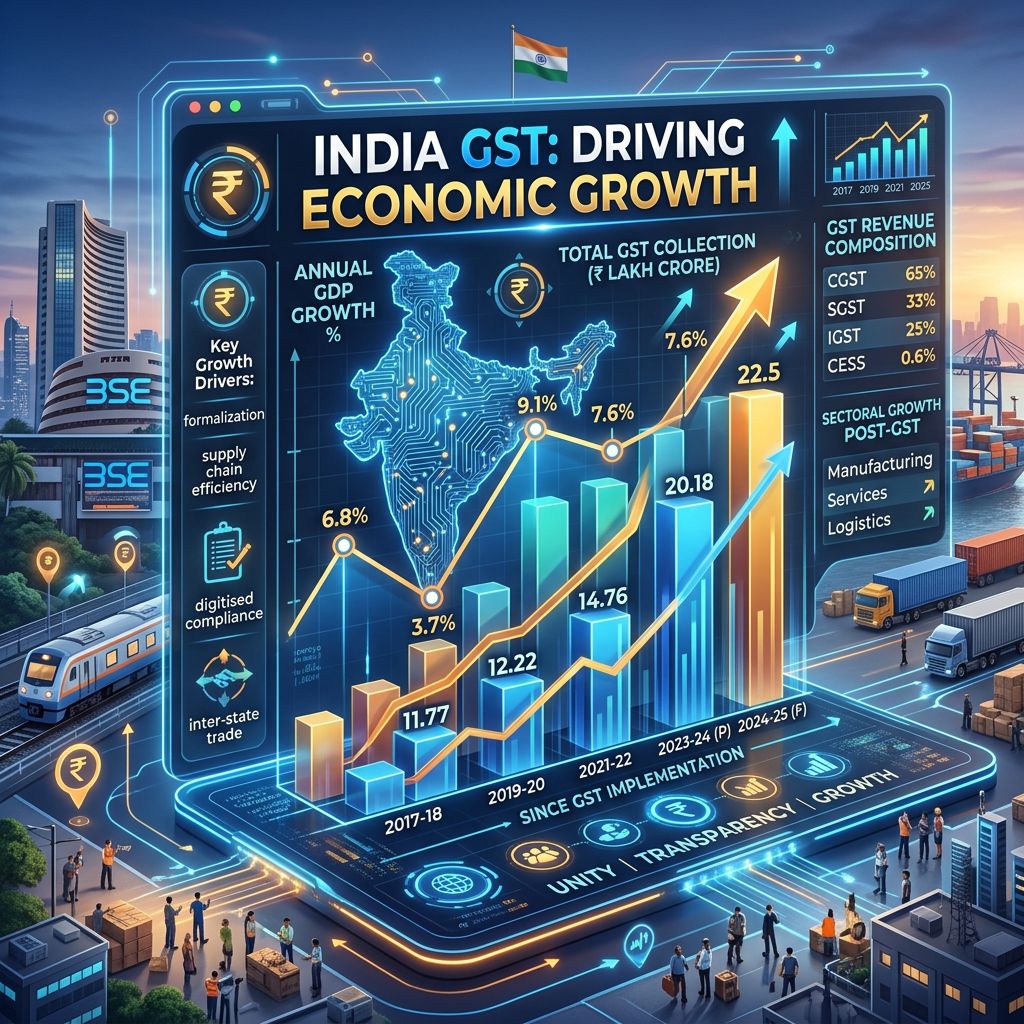
When the Goods and Services Tax (GST) was introduced in July 2017, it was not merely a tax reform. It was an attempt to reorganise India’s economic architecture. The reform aimed to replace multiple indirect taxes with a unified tax system, reduce cascading, create a common national market, improve transparency, and strengthen Centre–State fiscal coordination.

Nine years later, the question is no longer whether GST has survived. The more important question is: what does GST data reveal about India’s economic transformation?
The answer lies not only in collections but in the entire GST ecosystem: registrations, return filing, invoices, e-way bills, revenue growth, settlements, and state-wise performance. These indicators together show how India’s economy has become more formal, more digital, more trackable, and more integrated.
To evaluate this transformation, GST performance can be assessed through five pillars: Tax Base, Compliance, Revenue, Economic Activity, and Federal Stability. Each pillar captures a different part of the GST system.
GST Health Index: Five-Pillar Framework

This score indicates that GST has moved beyond its implementation phase. It has become a high-frequency economic information system.
Pillar 1: Tax Base Expansion
The first test of GST is whether it expanded India’s formal tax base. The registration data shows that active GST taxpayers reached approximately 1.65 crore by May 2026. Uttar Pradesh had the largest number of active registrations, followed by Maharashtra, Gujarat, Tamil Nadu, and Karnataka.

This is important because GST registrations are not just tax records. They are evidence of formal economic participation. More registered taxpayers mean more firms entering the invoice-based economy. The rise of Uttar Pradesh is especially significant. It suggests that GST is not only consolidating mature industrial states but also widening formalisation in large consumption-driven states.
However, registration alone is not enough. A strong GST system also requires low cancellation ratios and sustained net additions. In the long term, the health of the tax base should be measured by active taxpayers, net additions, cancellations, and revocations together.
Pillar 2: Compliance Maturity
The second pillar is compliance. GST depends on regular filing of GSTR-1 and GSTR-3B. GSTR-1 reflects outward supply reporting, while GSTR-3B reflects tax liability and payment. When both improve, it shows that businesses are not merely registered but actively participating in the compliance cycle.
The analysed data shows strong filing performance.

This is one of the strongest indicators of GST maturity. In the early years, GST compliance was affected by portal issues, unfamiliar processes, and frequent rule changes. By 2026, the system has become more stable. Businesses have adjusted to digital filing, invoice reporting, and system-generated notices.
DRC self-compliance is particularly important. It shows that many taxpayers respond to mismatch notices without full litigation or enforcement proceedings. This reflects the shift from manual tax administration to data-driven compliance management.
The implication is clear: GST has created a behaviour change. Businesses now know that invoice reporting, return filing, and tax payment are linked. This has reduced the space for informal transactions.
Pillar 3: Revenue Performance
GST revenue is the most visible indicator of the reform. Annual gross GST collections increased from approximately ₹7.19 lakh crore in 2017–18 to around ₹23.32 lakh crore in 2025–26.

The revenue story has three phases. The first phase, from 2017 to 2019, was transition and stabilisation. The second phase, 2020–21, was disrupted by the pandemic. The third phase, from 2021–22 onward, shows structural strengthening.
The moderation in growth after 2023–24 should not be interpreted negatively. As the base becomes larger, extremely high growth rates naturally reduce. What matters more is that GST collections have remained consistently above the pre-pandemic level.
Tax buoyancy should ideally be calculated by comparing GST growth with nominal GDP growth. Since the uploaded dataset does not include GDP series, this article uses collection growth as a revenue-strength proxy. For a final report, nominal GDP data should be added to calculate formal GST buoyancy.
Pillar 4: Economic Activity
GST is now one of India’s most useful economic pulse indicators. E-way bills, invoices, and e-invoicing reflect real economic activity before annual GDP data becomes available.
The e-way bill data is especially revealing. Total e-way bills increased from about 6.01 crore in July 2018 to about 17.84 crore in May 2026.

This shows that GST has become deeply integrated with India’s logistics system. Movement of goods is now recorded digitally, making the economy more visible. E-way bills can be used to detect demand recovery, supply-chain disruption, interstate trade intensity, and seasonal movement.
Invoice data adds another layer. It shows that business activity is highly concentrated among larger taxpayers. Taxpayers above ₹500 crore turnover generate thousands of invoices per month, while very small taxpayers generate very few invoices. This reveals the dual structure of India’s economy: a very large base of small businesses and a concentrated core of high-volume formal enterprises.
E-invoicing strengthens this further. As more businesses enter e-invoicing, GST moves from post-facto reporting to near real-time transaction visibility.
Pillar 5: Federal Stability
GST is also a federal finance system. It affects how revenue is shared between the Centre and the States. The IGST settlement data shows the importance of the settlement mechanism in sustaining state finances.

This shows that the settlement mechanism has become much larger and more central to India’s fiscal federalism. States do not only depend on SGST collected within their jurisdiction; they also depend on IGST settlement arising from interstate trade and consumption.
This is why GST should not be evaluated only by gross collection. A state-wise GST analysis must include domestic collection, SGST share, IGST settlement, refund trends, and volatility. Some states may appear weaker in domestic collections but benefit significantly through settlement flows.
What GST Reveals About India’s Economy
Nine years of GST data reveal five deeper transformations.
First, India’s formal tax base has widened. More than 1.65 crore active taxpayers indicate that the GST system has pulled a large number of businesses into formal reporting.
Second, compliance has matured. Filing rates above 90% show that GST is now embedded in regular business behaviour.
Third, revenue has become more stable. GST collections have crossed the transition phase and now behave like a macroeconomic indicator.
Fourth, logistics have become more visible. E-way bills provide a real-time view of goods movement across India.
Fifth, federal fiscal flows have become more data-driven. IGST settlement is now central to understanding state-level GST performance.
Policy Implications
The next phase should not focus only on increasing collections. GST 2.0 should focus on simplification, predictability, and better use of data.
Rate rationalisation is necessary because multiple slabs create classification disputes. Faster refunds are important for exporters and inverted-duty sectors. Improved return design can reduce compliance burden. GSTAT operationalisation can reduce litigation. State-level dashboards can improve transparency.
Most importantly, GST data should be used as an economic intelligence tool. Monthly GST collections, e-way bills, return filing, invoices, and settlements can together form a GST Economic Pulse Index. Such an index can help governments, businesses, investors, banks, and researchers understand the direction of the economy in near real time.
Conclusion
Nine years of GST show that India has not merely introduced a new tax. It has built a digital economic infrastructure. GST now records who is participating in the formal economy, how frequently they transact, how goods move, how businesses comply, how revenue grows, and how states receive fiscal flows.
The reform is not complete. Rate complexity, refund delays, litigation, petroleum exclusion, and compliance costs remain important concerns. But the evidence shows that GST has fundamentally changed how India’s economy is measured and governed.
GST should therefore be understood not only as a tax system but as India’s economic pulse.
Author

Make Tatvita one of your preferred sources
See more insights from Tatvita Analysts in your Google Search results.



Leave a Reply