
Across the world, Micro, Small and Medium Enterprises (MSMEs) form the backbone of economic activity. In India alone, MSMEs contribute nearly 30% of GDP, around 45% of exports, and support employment for millions across manufacturing, services, logistics, retail and digital sectors.
Yet despite their importance, the single largest reason MSMEs fail is rarely poor products or lack of customers. The real problem is cash flow disruption.
An MSME can be profitable on paper and still collapse operationally because:
- payments are delayed,
- inventory is locked,
- receivables rise faster than collections,
- input costs increase suddenly,
- or working capital cycles become unstable.
The problem has become even more severe after:
- the COVID-19 pandemic,
- the Russia-Ukraine War,
- inflationary commodity cycles,
- rising logistics costs,
- and geopolitical supply-chain disruptions.
India’s Economic Survey 2025–26 estimated that approximately ₹8.1 lakh crore remains stuck in delayed MSME payments, severely affecting liquidity and working capital cycles.
This article analyses:
- why cash flow management is the real survival engine for MSMEs,
- how global MSMEs manage liquidity shocks,
- which industries face the highest cash stress,
- and what practical strategies businesses can adopt to improve resilience.
Understanding Cash Flow: The Difference Between Profit and Survival
One of the biggest misconceptions among small businesses is equating profit with liquidity.
A business may:
- generate sales,
- record profits,
- and still face insolvency.
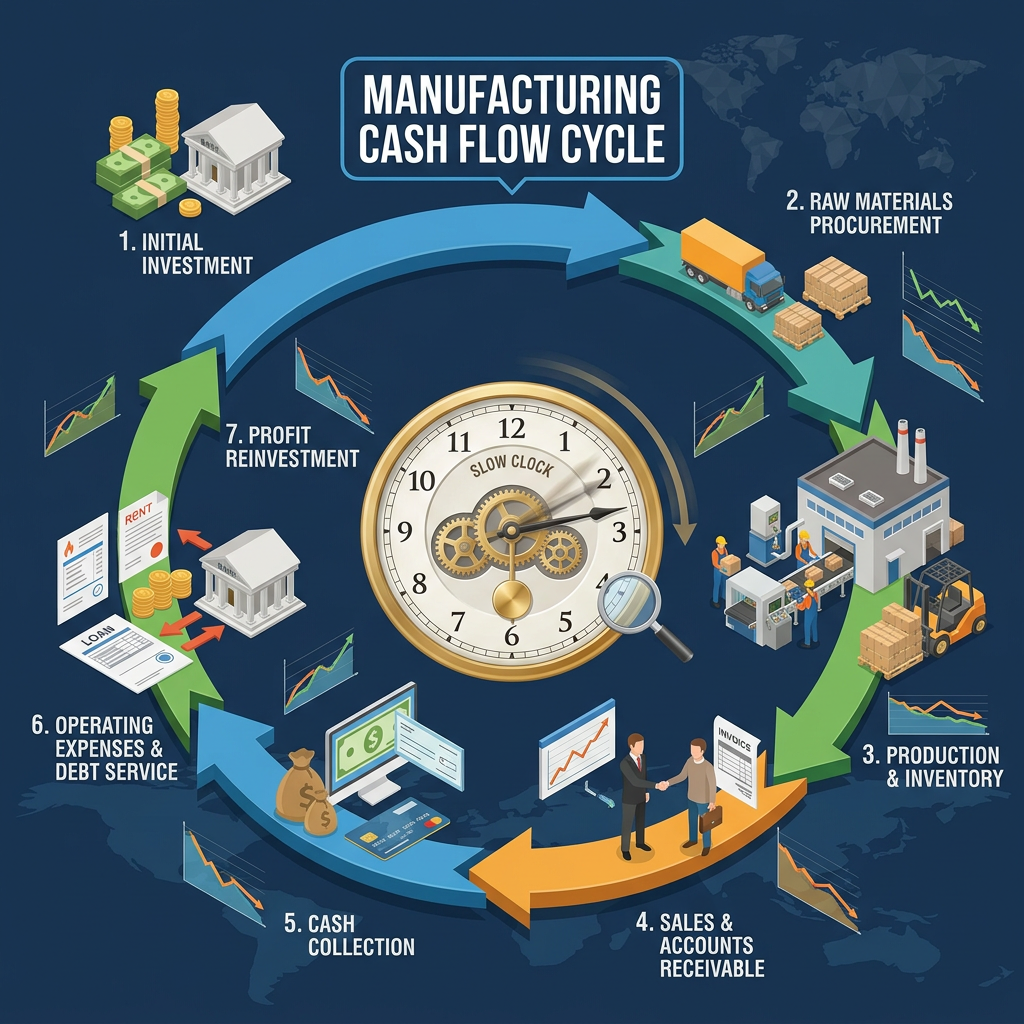
This happens because cash flow depends on timing.

The longer the delay between:
- production,
- invoicing,
- and actual payment collection,
The greater the working capital pressure.
This is why cash flow management is fundamentally about:
“survival timing, not merely accounting profitability.”
Why MSMEs Are More Vulnerable Than Large Corporations
Large corporations usually possess:
- stronger balance sheets,
- diversified financing access,
- higher bargaining power,
- and reserve liquidity.
MSMEs operate very differently.
Table 1: Structural Weaknesses of MSMEs

Small firms often pay suppliers immediately while receiving payments after 60–120 days.
This creates a structural liquidity mismatch.
The Delayed Payment Crisis in India
India’s MSME ecosystem faces one of the world’s largest delayed-payment challenges. The persistence of delayed payments remains a critical challenge for the MSME sector, with an estimated Rs 8.1 lakh crore locked in delayed payments, impacting working capital and restricting growth, according to the Economic Survey 2025-26.
Table 2: Contribution of MSMEs in India

The implications are severe:
- working capital shortages,
- salary delays,
- vendor defaults,
- production disruptions,
- and shutdown risks.
This problem becomes more dangerous during geopolitical or inflationary shocks when:
- raw material prices rise,
- fuel costs increase,
- shipping becomes expensive,
- and receivables remain blocked.
Recent reports from India’s MSME pharmaceutical sector highlighted shutdown risks due to delayed government payments combined with rising import costs.
Why Cash Flow Problems Intensify During Wars and Economic Crises
Global crises expose weak liquidity structures.

The key issue is timing mismatch:
- costs rise immediately,
- revenues arrive later,
- receivables slow further.
MSMEs therefore become highly vulnerable during:
- wars,
- inflation cycles,
- pandemics,
- commodity shocks,
- and global supply disruptions.
Industries Most Vulnerable to Cash Flow Disruptions
Some industries face structurally higher working-capital pressure.
Table 3: MSME Industries with High Cash Flow Vulnerability

Manufacturing MSMEs are particularly exposed because they:
- purchase raw materials upfront,
- maintain inventory,
- and often receive delayed payments from large buyers.
Global Best Practices in MSME Cash Flow Management
Countries with strong MSME ecosystems focus heavily on liquidity efficiency rather than only credit expansion.
1. Germany: Supplier Payment Discipline
Germany’s Mittelstand companies operate with strict payment culture.
Key features:
- contractual payment enforcement,
- low invoice delays,
- supply-chain financing systems,
- strong banking integration.
Result:
- lower working-capital stress,
- higher industrial stability,
- and long-term SME sustainability.
The lesson:
Cash discipline itself becomes an industrial policy advantage.
2. Japan: Relationship Banking Model
Japan’s SME financing system relies heavily on relationship banking.
Banks:
- understand business cycles,
- provide flexible working-capital support,
- and focus on continuity rather than only collateral.
This reduces:
- sudden liquidity collapses,
- and credit-access volatility.
3. Singapore: Digital Cash Flow Ecosystem
Singapore integrates MSMEs into:
- digital invoicing,
- e-payments,
- trade finance,
- and supply-chain financing platforms.
This reduces:
- invoice delays,
- transaction frictions,
- and working-capital inefficiencies.
4. United States: Invoice Financing and Credit Flexibility
US SMEs frequently use:
- receivables financing,
- factoring,
- revolving credit lines,
- and fintech-based working-capital solutions.
This allows businesses to unlock cash before customer payment cycles are completed.
The Most Important Lesson: Cash Flow Is Operational Strategy
Globally successful MSMEs do not treat cash flow as an accounting function.
They treat it as:
- operational planning,
- risk management,
- and strategic resilience.
Why Many MSMEs Mismanage Cash Flow
The problem is often not only external.
Several internal practices worsen liquidity stress.
Common MSME Cash Flow Mistakes
- Over-expansion without reserves
- Excess inventory accumulation
- Weak receivable follow-up
- Dependence on one large client
- Mixing business and personal finances
- Underpricing products for growth
Many MSMEs focus aggressively on sales growth while ignoring working-capital efficiency.
Growth without liquidity discipline often becomes financially destructive.
Practical Cash Flow Strategies MSMEs Can Implement
This is where cash flow management becomes actionable.
1. Reduce Customer Concentration Risk
Overdependence on one large buyer increases delayed-payment vulnerability.
A diversified client base improves:
- negotiating power,
- payment stability,
- and resilience.
2. Shorten Receivable Cycles
Businesses should:
- incentivise early payment,
- digitise invoicing,
- automate reminders,
- and negotiate shorter cycles.
Even reducing payment periods from 90 days to 45 days significantly improves liquidity.
3. Improve Inventory Turnover
Excess inventory locks cash unnecessarily.
Modern MSMEs increasingly use:
- demand forecasting,
- digital inventory systems,
- and lean manufacturing approaches.
4. Maintain Emergency Liquidity Buffers
One of the biggest global best practices is maintaining reserve liquidity.
Businesses should ideally hold:
- 3–6 months of operating expenses,
- especially in volatile sectors.
5. Use Technology for Financial Visibility
Digital dashboards now allow MSMEs to track:
- receivables,
- payables,
- inventory cycles,
- and real-time liquidity.
Cash visibility improves decision-making speed.
Constructive Policy Recommendations
Cash flow resilience is not only a business issue. It is also a policy issue.
For Governments
Priority Areas:
- strict delayed-payment enforcement,
- faster dispute resolution,
- expansion of invoice financing platforms,
- MSME-specific liquidity support systems,
- and digital payment integration.
Improving payment discipline may help MSMEs more than subsidies alone.
For Financial Institutions
Banks should move beyond:
- collateral-heavy lending,
- and adopt cash-flow-based lending models.
Relationship banking and invoice-based financing systems are critical.
For MSMEs
Businesses must:
- prioritise liquidity planning,
- monitor cash cycles weekly,
- and integrate financial resilience into operations.
Cash flow management should become:
- a leadership function,
- not merely an accounting exercise.
Conclusion
MSMEs are central to employment, exports, manufacturing and local economic growth across the world. Yet the biggest threat to MSME survival is often not competition or demand decline, but liquidity disruption.
The recent global crises—from pandemics to wars—have shown how quickly:
- energy shocks,
- delayed payments,
- supply-chain disruptions,
- and inflation
can destabilise small businesses.
The lesson from global best practices is clear:
sustainable MSMEs are built not only on sales growth, but on disciplined cash-flow architecture.
In the coming decade, MSME resilience will increasingly depend on:
- payment efficiency,
- inventory discipline,
- financial visibility,
- diversified customers,
- and liquidity reserves.
Because in business:
revenue creates optimism, but cash flow determines survival.
The Real Future of MSMEs Depends on Liquidity Intelligence
– Tatvita Insight
The next decade will likely be more volatile than the previous one.
MSMEs will increasingly face:
- geopolitical disruptions,
- supply-chain fragmentation,
- energy-price shocks,
- technological transitions,
- and financing uncertainty.
In such an environment:
survival will depend less on size and more on liquidity intelligence.
The strongest MSMEs will not necessarily be:
- the largest,
- or the fastest-growing,
but those capable of:
- managing working capital efficiently,
- maintaining flexibility,
- and adapting quickly to disruptions.






Leave a Reply