
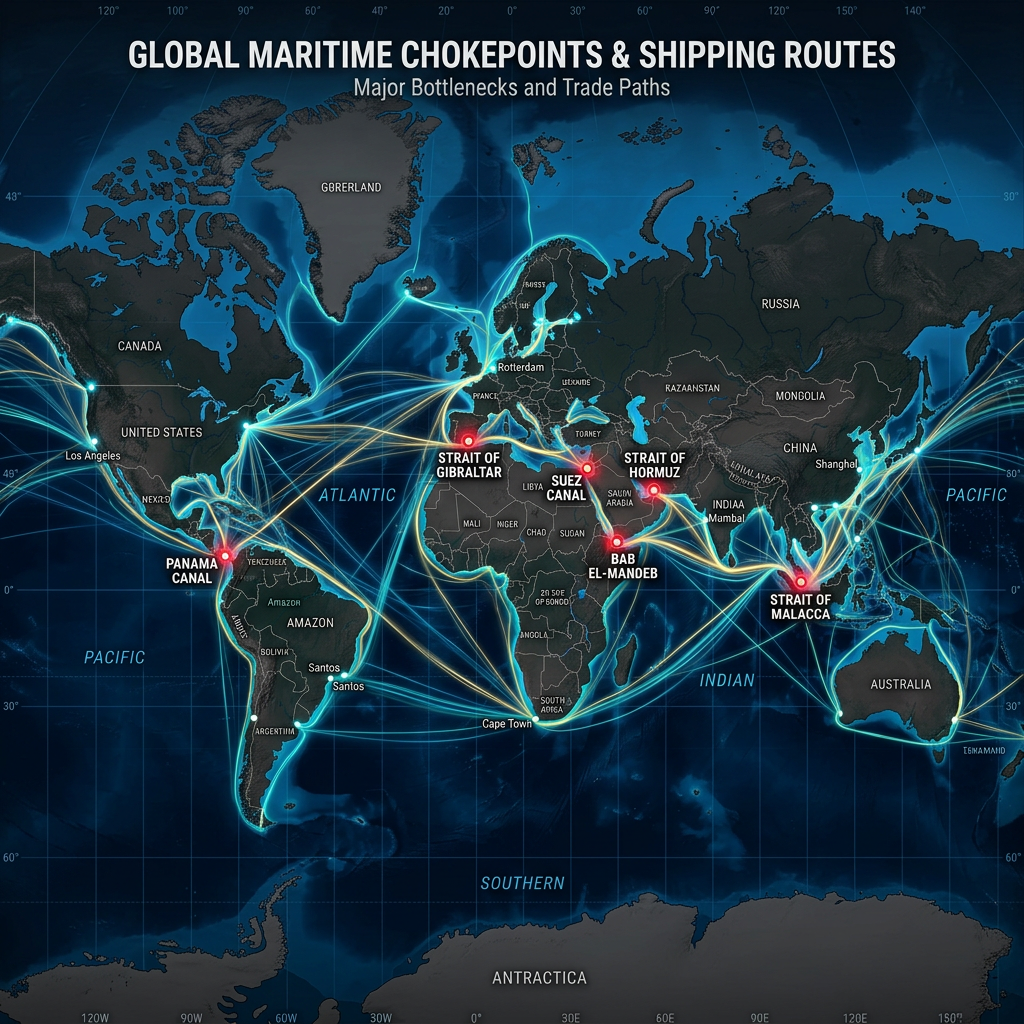
More than 80% of global goods by volume, roughly 12,720 million tons as of 2024, are transported by sea (UNCTAD, 2025). That movement is not evenly distributed across open ocean; it is funnelled through a handful of narrow maritime passages. These are the world’s chokepoints, and they are where economic power is made and unmade. A 2025 study in Nature Communications estimates USD 192 billion in global trade is exposed annually to disruption at 24 major chokepoints, with economic losses, from delays, rerouting, and insurance, totalling USD 14.1 billion per year. UNCTAD Secretary-General Rebeca Grynspan noted in 2025 that “not since the closure of the Suez Canal in 1967 have we witnessed such sustained disruption to the arteries of global commerce.”
1. The Geography of Dependency
What distinguishes a chokepoint from a standard logistics node is the absence of a cost-equivalent alternative. Rerouting around the Suez Canal via the Cape of Good Hope adds 4,000 miles and 10–14 days to Asia-Europe voyages. The structural consequence is visible in UNCTAD data: average voyage distances grew from 4,831 miles in 2018 to 5,245 miles in 2024, while seaborne trade in ton-miles grew 5.9%, nearly three times the growth in cargo volume. Disrupted chokepoints do not destroy trade; they inflate its cost, and that inflation travels far beyond the geography of the original disruption.

Sources: UNCTAD Review of Maritime Transport 2025; U.S. EIA; ANDAMAN PARTNERS Analysis; Nature Communications (2025).
Maritime Chokepoints in the Middle East

2. The Red Sea Crisis: Cost Asymmetry in Practice
The Houthi campaign in the Red Sea and Bab el-Mandeb Strait, over 190 recorded attacks by October 2024, represents the most disruptive sustained chokepoint event in a generation. Container tonnage crossing the Suez Canal fell 82% in early 2024. Freight rates on the Shanghai-to-Northern Europe route tripled from USD 2,200 to USD 8,400 per TEU between November 2023 and July 2024, and remained 80% above the 2023 baseline through October 2025 (Coface, 2025). J.P. Morgan Research estimated the disruption added 0.7 percentage points to global core goods inflation in the first half of 2024 alone.
The deeper insight is structural: rerouting a single containership around Africa adds USD 1 million in fuel and at least 10 transit days (Maersk). The capacity absorbed by longer voyages reduced effective global container shipping capacity by approximately 9%, requiring 25–30% more vessel deployments to maintain service frequency (BCG, 2024). European automakers including Tesla and Volvo Car announced temporary production halts as just-in-time components failed to arrive. Crucially, the disruption was not confined to affected routes, freight rates on Shanghai–West Africa lanes jumped 137%, and Shanghai–South America rates more than doubled, as diverted vessel capacity tightened global supply (UNCTAD, 2024).
The Baker Institute for Public Policy coined a precise description: the Houthi campaign amounted to “non-state sanctions.” A USD 20,000 drone imposed trade costs equivalent to a targeted sanctions regime, without the legal or diplomatic architecture of one. This is a fundamental recalibration of the economics of coercion.
3. The Hormuz Paradox: Geography, Conflict, and the 2026 Iran Crisis
The Strait of Hormuz channels the exports of five of the world’s ten largest oil producers, Saudi Arabia, Iraq, the UAE, Kuwait, and Iran, with over 42,000 vessel transits in 2024 carrying approximately 20–21 million barrels of petroleum liquids per day, representing nearly 20% of global supply (EIA, 2025). No other waterway on earth carries a comparable concentration of energy risk.
The Hormuz Paradox lies in the fact that Iran, the state most capable of threatening the strait’s stability, is simultaneously one of its primary users. A full closure would devastate Iran’s own oil revenues. Yet the credible threat of disruption is itself economically valuable to Tehran: it creates a permanent geopolitical risk premium embedded in global energy prices, effectively transferring wealth toward all oil exporters. This is geographic rent, economic return derived not from productive capacity, but from positional leverage.
The 2026 Iran-US-Israel conflict, centred on Operation Epic Fury and the subsequent April 2026 ceasefire, pushed this dynamic from theoretical to operational. Strikes on Iranian territory and retaliatory threats against Gulf infrastructure produced a “gray-zone disruption” in which the Strait was not fully closed, but no longer secure. The mere proximity of conflict was sufficient to spike insurance premiums, divert tanker traffic, and amplify global oil price volatility. GCC economies, Qatar, Bahrain, the UAE, absorbed collateral damage through expatriate flight, investment withdrawal, and desalination infrastructure vulnerability. The conflict demonstrated that Hormuz does not need to be blocked to fulfil its role as an economic weapon; uncertainty alone is sufficient.
The Malacca Strait And China

The Malacca Strait compounds the picture from the other direction. Handling over 23 million barrels of oil per day and 23.7% of all global seaborne trade, it is the principal conduit for China’s energy imports, over 80% of which transit this single passage. Beijing’s dependence on Malacca is the primary driver of its Belt and Road investments: CPEC, Gwadar Port, and overland pipeline corridors are multi-decade, trillion-dollar hedges against a geography problem that no domestic policy can solve.
4. Panama and the Climate-Induced Chokepoint

Not all chokepoints are threatened by adversaries. The Panama Canal, handling USD 600 billion in cargo annually, demonstrated in 2023–2024 that climate risk can produce economically equivalent disruption to deliberate blockade. An El Niño-driven drought reduced Gatun Lake levels sufficiently for the Panama Canal Authority to impose progressive draft restrictions; daily transits fell below 10,000 in 2024, a 42% decline from 2023 (ANDAMAN PARTNERS, 2025). U.S. grain and LNG exports to Asia were disproportionately affected. Unlike conflict-driven disruptions, the drought offered no military solution and no diplomatic resolution, it had to be absorbed by every participant in the supply chain.
This formalises a category the strategic literature has been slow to recognise: the climate-induced supply shock. As global temperatures rise and hydrological variability increases, freshwater-dependent maritime infrastructure will face chronic, compounding pressure. The IMF projects that small island developing states could see consumer price increases of up to 0.9% from sustained maritime chokepoint disruptions, with processed food costs rising 1.3%, borne disproportionately by populations furthest from the political decisions that created the conditions for disruption.
Conclusion: The True Cost of Geographic Dependency
The disruptions of 2023–2026 have collectively exposed a fundamental miscalculation embedded in the architecture of globalisation: that a trading system built for efficiency rather than resilience is structurally exposed to a small number of geographic vulnerabilities. The Houthi campaign in the Red Sea, the El Niño drought at Panama, and the 2026 Iran-US-Israel conflict around Hormuz have, in combination, produced what UNCTAD identifies as the most sustained disruption to global maritime trade since 1967. Three separate threats, non-state actors, climate variability, and great-power-adjacent conflict, converged simultaneously on the world’s three most critical chokepoints.
For policymakers, the lesson is structural: strategic reserve buildups, alternative corridor investment, port diversification, and multilateral maritime security governance are not enhancements to trade policy, they are its foundation. The 2026 Iran conflict in particular underlines that Hormuz can function as an economic weapon without being physically closed. Gray-zone disruption, uncertainty without blockade, is sufficient to reprice insurance, redirect tankers, and destabilise oil markets. Deterrence without institutional governance leaves a USD 20-trillion exposure unmanaged.
For businesses and investors, the repricing is already structural. Average voyage hauls have grown from 4,831 to 5,245 miles in six years. Asia-Europe freight rates remain elevated well above pre-crisis baselines. Supply chain configurations are being rebuilt around chokepoint risk in ways that will persist long after specific conflicts resolve. Distance, as UNCTAD observed, is no longer merely geography. It is geoeconomics, and the world is only beginning to price it correctly.
Author

Make Tatvita one of your preferred sources
See more insights from Tatvita Analysts in your Google Search results.


Leave a Reply