
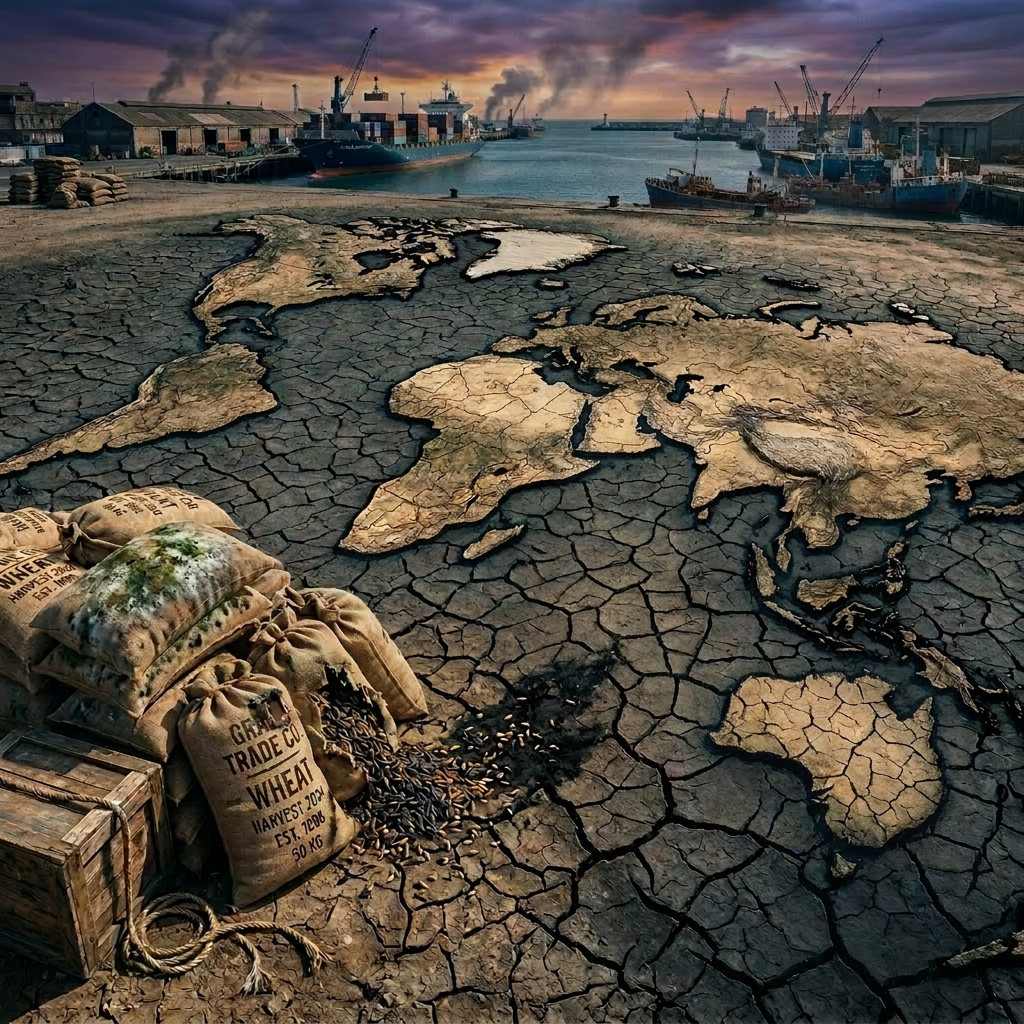
Wars are not fought only with weapons, but also with grains. They are fought by cutting off the fertilizer a farmer needs, by blocking the port through which food travels, by pulling the farmland from him and handing him a rifle. The battlefield makes the headlines. The food crisis that follows makes the noise of famine, quietly, months later, thousands of kilometres away.
This is not a new story. It is, in fact, the oldest economic consequence of war. And right now, in 2026, with a conflict raging in the Middle East on top of an unresolved war in Ukraine, the world is living through this story again.
The question for India, a country which resides 1.4 billion people, the world’s second largest wheat producer, and simultaneously one its most fertilizer-dependent agricultural economies, is not whether this crisis will touch it, IT ALREADY HAS! The real question is, how deep does it go?
To understand what is happening today, it helps to go back in the winter of 1942. Germany has been at war for 3 years. Hitler, haunted by the memory of the mass starvation that had broken German morale in World War I, had built his entire eastern military strategy around a single resource: the grain fields of Ukraine. Control Ukraine’s black soil, feed Germany, win the war. The plan also had a name: The Hunger Plan.
The Hunger Plan, it did not work. In two years that Germany occupied most of Ukraine, the grain extracted supplemented German domestic production by just 14 percent, far below what Nazi planners had projected. The men who had farmed Germany’s own fields were now soldiers. By its agricultural sector running. Rationing, which had quietly begun in 1937, two years before the war officially started, grew tighter every year.
The Hunger Plan was killing millions across occupied Europe. Historian Timothy Snyder, in Bloodlands: Europe Between Hitler and Stalin (2010), estimates that 4.2 million Soviet citizens were starved to death in German-occupied territories between 1941 and 1944. In Poland, three million Poles faced starvation. The Dutch-endured the “Hunger-Winter” of 1944-45 surviving on tulip bulbs after Germany blocked food supplies. Across Europe and Asia combined, starvation and related illness killed approximately 20 million people during the war, roughly the same number as soldiers killed in battle.

Germany’s food supply collapsed too. Not in 1939, not in 1941, but eventually. By the war’s final months, the food system had broken down entirely. Rationing did not end with Germany’s defeat in 1945; it still continued. Hundreds of thousands Germans died in the hungry winter of 1946-47. West Germany only ended food rationing in 1950. East Germany continued until May 29, 1958.
The lesson is not that the aggressor deserves to starve. The lesson is that the food system is a web, not a warehouse. When you tear the web in one corner, the entire structure eventually collapses. No one wins a food war.
Moving ahead, after eight years. On February 24, 2022, Russia invaded Ukraine. Within weeks, the world rediscovered just how much it had been eating food grown in the same black soil Hitler once coveted.
Russia and Ukraine together accounted for nearly 30% of global wheat exports. Between 2017 and 2021, they supplied approximately 274 million metric tonnes of wheat to the world. A total of 36 countries concentrated in Africa, the Middle East and South Asia imported more than half of their wheat from these two nations. Egypt, the world’s largest wheat importer, received between 25% and 50% of its wheat from Ukraine alone.
When the invasion halted Ukraine exports and Western sanctions complicated Russian trade, the price shock was immediate. Wheat prices rose by roughly two-third in the weeks following the invasion. Palm oil jumped by the same amount. Fertilizer prices more than doubled. Food price inflation above 5% was recorded in over 89% of low-income countries simultaneously.
The international community scrambled. The UN-Brokered Black Sea Grain Initiative was a diplomatic Band-Aid on a structural wound. While it reduced the 2022 wheat price spike by approximately 13%, Russia’s withdrawal in mid-2023 sent prices soaring again.
But the more important economic insight from 2022 was not about price spikes, it was about the lag. Fertilizer prices doubled in early 2022, but the crop planted using less fertilizer was only harvested months later. This meant the full agricultural damage showed up in 2023 and 2024, well after the initial headlines faded. Wars don’t just damage the year’s harvest; they sabotage the next two years.
The Middle East conflict that escalated in early 2026 is a different kind of food shock. It does not primarily involve a grain-exporting country going to war. It involves the world’s most critical maritime chokepoint, the Strait of Hormuz, being functionally impaired.
Everyday in 2025, approximately 20 million barrels of crude oil moved through the strait. More importantly for the dinner table, up to 30% of global fertilizer exports transit this narrow waterway. The Gulf countries account for 36% of global urea exports between 2023 and 2025.
Table 1: Commodity Volatility 2026 (Feb-May)

Since hostilities disrupted shipping through the strait earlier this year, the cascade has unfolded with mathematical precision: first energy, then fertilizer, then food.
- Energy: Brent crude jumped more than 15% in the first days of the conflict reaching $115 per barrel.
- Input costs: Natural gas is the primary feedstock for nitrogen fertilizer. European natural gas jumped over 50%, raising the cost of producing ammonia by 65% in weeks.
- The Price Tag: Urea prices surged nearly 46% between February and March 2026.
World bank Chief Economist INdermit Gill describes the mechanism as “cumulative waves.” Fertilizer prices are projected to rise 31% overall in 2026. This is particularly dangerous because the escalation occurred just as the spring planting season began in the Northern Hemisphere. Farmers are making decisions now, reducing application rates or switching to less fertilizer-intensive crops that will result in weaker yields in late 2026 and tighter grain supplies through 2027.
India has a tendency to view itself as largely insulated. It is the world’s largest rice exporter and second-largest wheat producer. Its Public Distribution System (PDS) provides subsidized food to over 800 million people. These are real strengths, but they are incomplete shields.
The most direct exposure for India is Fertilizer. India is one of the world’s largest importers of urea, sourcing a major part of it from the Gulf. The government has prioritized natural gas for domestic fertilizer plants and maintained a robust inventory of 61.51 LMT of urea. Although the global price spike cannot be ignored forever.
The second exposure is the Fertilizer Subsidy. India’s government absorbs the price shock to protect the farmers. However, every rupee spent on escalating subsidy bill similar to the surge seen in 2022 is a rupee not spent on rural development, irrigation, or education. The “kitchen Table Crisis” in India is often a fiscal crisis in disguise.
The third exposure is Edile Oils. India imports roughly 90% of its sunflower oil from Ukraine and Russia. The 2022 war triggered an immediate spike. Now, with the Middle East conflict adding pressure to palm oil and soya bean oil markets, Indian households, particularly lower-income ones who spend a disproportionate share of income on food are being impacted again.
When India banned non-Basmati white rice exports in 2023 to protect domestic prices, global rice prices rose nearly 20%. India’s defence measures protect its own citizens but send shockwaves throughout the global system. This demonstrates a core truth of 2026: India is no longer a spectator in global food economics; it is a pillar whose domestic stability is tied to global volatility.
In 2019, before COVID and the Ukraine war, approximately 135 million people globally were experiencing acute food insecurity. By 2024, that number reached 295 million. As of May 2026, some projections suggest that it could hit 363 million if fertilizer disruptions persist.
Table 2: People in Acute Food Insecurity

Conflict remains the single largest driver of hunger, affecting 140 million of those people. This nit just a humanitarian statistic; it is an economic indicator. Acute hunger concentrates in countries experiencing currency depreciation and debt distress, the cascading effects of sustained coming price shocks. The economic and humanitarian are the same crisis, dominated in different currencies.
The food on the Indian plate: the cooking oil, the wheat flour, the rice is produced through a system that connects fields in Ukraine, refineries in Qatar and ports in the Persian Gulf. That system has been disrupted twice in four years.
Germany in 1942 tried to solve its food problem by force and failed. Russia in 2022 disrupted a grain corridor and triggered a global crisis. The Middle East in 2026 has disrupted the fertilizer corridor and triggered a global crisis. The Middle East in 2026 has disrupted the fertilizer corridor. India stands at the intersection of these forces, not as a victim, but as a deeply integrated player whose kitchen tables are governed by the economics of distant battlefields.
Understanding this connection is not alarmism. It is a prerequisite for survival in the 21st century. The grocery bill is the ultimate economic obituary of a war fought thousands of miles away.
Author

Make Tatvita one of your preferred sources
See more insights from Tatvita Analysts in your Google Search results.


Leave a Reply