
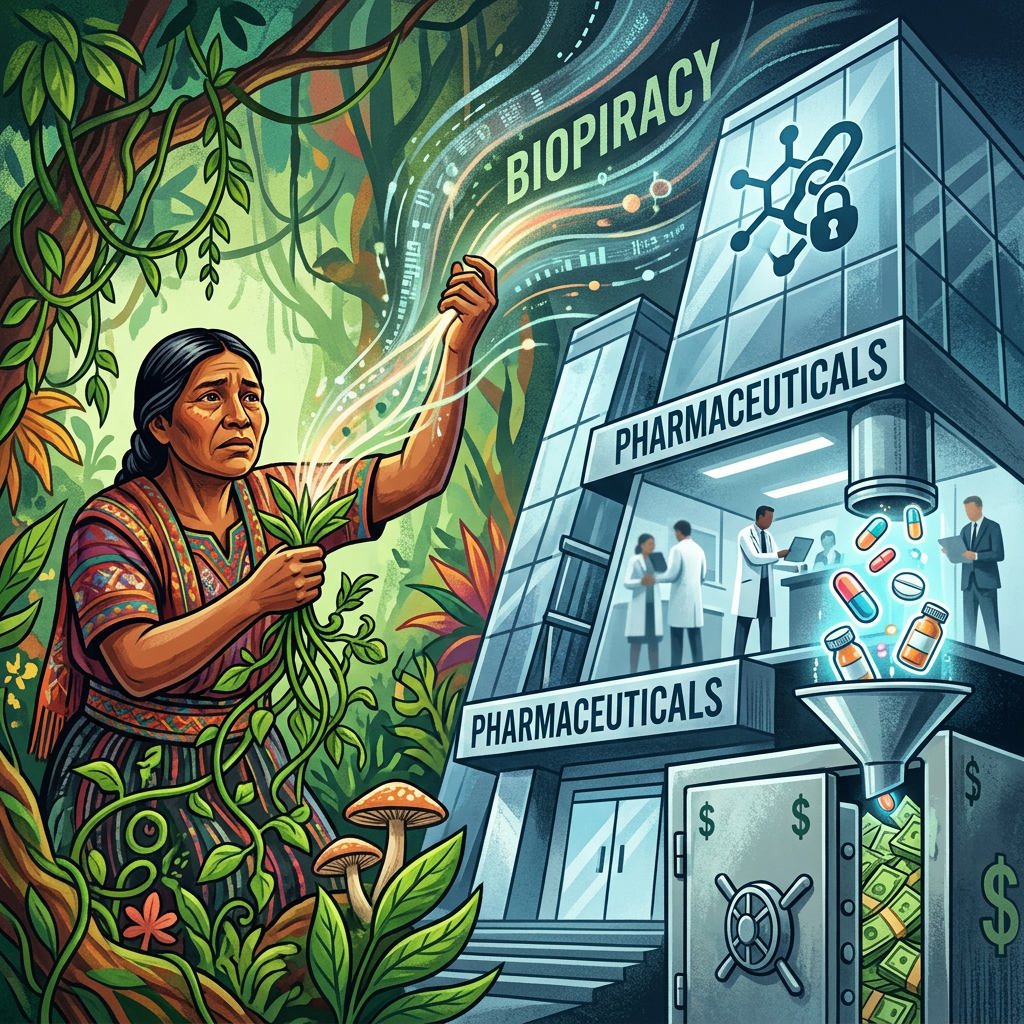
The use of piracy as a word for copyright infringement or unauthorised copying of resources (which will end up in profit) started in the 17th century. Over two centuries later, the founder of the ETC Group coined the word “biopiracy” to describe the corporate theft of physical biological resources and traditional knowledge from the Global South. But as the global bioeconomy has evolved, the methods of this theft have fundamentally shifted.
We have crossed a threshold where the enclosure of nature no longer requires pulling seeds from the soil. According to ongoing analyses by the ETC Group and the Convention on Biological Diversity (CBD), we have entered the era of “dematerialization.” The geopolitical battlefield has moved away from the agricultural fields governed by physical treaties and into the sterile, high-stakes environments of pharmaceutical laboratories and industrial bioreactors.
By reducing physical biodiversity into downloadable Digital Sequence Information (DSI), Western biotechnology corporations can now bypass international borders and physical farms entirely. In doing so, they have effectively neutralised the Nagoya Protocol—a landmark international treaty built strictly to govern tangible biological matter, rendering it powerless against digital data. This is the true engine of Biopiracy 2.0. Whether bioengineers are programming microscopic cells to artificially brew agricultural exports in vats or pharmaceutical giants are monopolising human pathogen data for exclusive vaccine development, the new frontier of extraction requires only a server and a lab. The theft of nature has not stopped; it has simply become invisible.
Synthesising Nature: Engineered Microbes and the Threat to Export Economies
The technological engine driving this new era of extraction is precision fermentation. Unlike traditional agricultural biotechnology, which edits the genetic code of an existing crop in a field, synthetic biology bypasses the farm entirely. According to extensive reports published by the international watchdog ETC Group, bio-engineers are now utilising downloaded Digital Sequence Information (DSI) to engage in de novo synthesis—building entirely new genetic pathways from scratch. They insert this digital code into engineered microbes, such as yeast or E. coli, and place them in massive industrial bioreactors. The microbes are programmed to act as living factories, artificially brewing high-value agricultural compounds.

The geopolitical devastation of this technology is perhaps most visible in the case of Stevia. For centuries, the indigenous Guaraní people of Paraguay cultivated the Stevia rebaudiana plant, discovering and utilizing its intensely sweet properties. However, as biodiversity advocates have documented, Western biotechnology firms did not need to physically harvest the plant or sign a benefit-sharing agreement to exploit it. Instead, they downloaded the genetic pathway responsible for the plant’s sweetness. By engineering microbes to excrete steviol glycosides in laboratories, corporations successfully patented the sweetening compounds. They commercialized the genetic value of Stevia while entirely cutting the Guaraní people out of the supply chain.
This same digital erasure is actively threatening the global vanilla market. True vanilla cultivation is an incredibly labor-intensive process that forms the economic backbone for tens of thousands of traditional farmers, primarily in Madagascar. Today, synthetic biology companies have successfully programmed yeast to excrete vanillin. As highlighted in working group discussions at the UN Convention on Biological Diversity (CBD), these companies aggressively market their lab-grown vanillin as a “sustainable” and “clean” alternative because it does not require land or traditional farming.
Yet, this corporate definition of sustainability ignores the socio-economic reality of the Global South. For researchers monitoring the bioeconomy, these lab-grown alternatives represent a direct threat to traditional export economies. When a Western corporation can artificially synthesize agricultural goods in a sterile vat in California or Europe, it does more than just bypass international benefit-sharing laws. It actively bankrupts the developing nations and traditional farmers who stewarded the original physical resources for generations.
The Pathogen Paradox: Open Science and Vaccine Inequity
While the agricultural sector faces an economic crisis due to precision fermentation, the pharmaceutical industry is extracting value on an even higher-stakes battlefield: human health and pandemic response. At the heart of this conflict is the global management of pathogen Digital Sequence Information (DSI) and the paradoxical nature of “open science.” According to policy briefs from the World Health Organization (WHO), when a novel virus—such as a new strain of Ebola or SARS-CoV-2—emerges, affected developing nations are heavily pressured by the international community to sequence the pathogen and immediately upload its genetic blueprint to open-access global databases like GISAID.
This rapid sharing of data is universally championed as a critical public health necessity. However, as global health equity researchers point out, the downstream commercial reality operates as a deeply entrenched form of digital biopiracy. Once the pathogen’s DSI is uploaded online, multinational pharmaceutical conglomerates download the genetic code to develop diagnostic tests, therapeutics, and life-saving vaccines. Because the data is freely accessible, these corporations entirely bypass any requirement to negotiate Access and Benefit-Sharing (ABS) agreements with the sovereign nations where the virus originally emerged.
The resulting geopolitical inequity is staggering. Public health advocates and international legal analysts highlight a brutal, recurring cycle: Western pharmaceutical companies secure extensive patent portfolios on the vaccines derived from the freely shared pathogen data. They then sell these critical medical countermeasures back to the global market at premium, often unaffordable prices. Consequently, the very nations in the Global South that acted transparently and provided the foundational genetic blueprint are routinely priced out of the resulting medical products, left waiting at the back of the queue during global health emergencies.
This exact dynamic has sparked fierce diplomatic battles in Geneva. During the extensive negotiations surrounding the WHO Pandemic Agreement, developing nations aggressively pushed for the establishment of a formal Pathogen Access and Benefit-Sharing (PABS) system. As detailed in diplomatic reports monitoring the treaty, this proposed system attempts to legally link the sharing of pathogen DSI with guaranteed, equitable access to the medical products produced from it. Yet, these efforts continue to face intense resistance from Western nations determined to protect the intellectual property and profit margins of their domestic pharmaceutical industries.
Governing the Code: Who Owns the Future of Life?
Ultimately, the dematerialization of nature has fundamentally rewritten the rules of biological extraction, connecting the agricultural soil directly to the sterile laboratory. Whether it is a climate-resilient seed engineered through CRISPR, lab-grown vanilla brewed in industrial vats, or a life-saving vaccine developed from shared pathogen data, the foundational currency remains exactly the same. Whoever controls the downloaded Digital Sequence Information (DSI) ultimately dictates the future of the global bioeconomy.
As the scope of Biopiracy 2.0 rapidly expands beyond traditional farming and into synthetic biology and human health, the geopolitical necessity for updated, legally binding international frameworks has never been more urgent. Piecemeal solutions are no longer sufficient to govern a borderless digital frontier. Multilateral efforts, such as the UN Convention on Biological Diversity’s newly established Cali Fund and the fiercely debated WHO Pandemic Agreement, represent critical first steps to enforce equitable Access and Benefit-Sharing. However, these frameworks must be rigorously enforced to withstand corporate lobbying.
The international community must officially and legally recognize digital biodiversity as a shared global asset rather than an unregulated frontier for digital colonialism. The code of life has been permanently unlocked, and ensuring its equitable governance is the defining geopolitical battle of our era.
Author

Make Tatvita one of your preferred sources
See more insights from Tatvita Analysts in your Google Search results.



Leave a Reply