
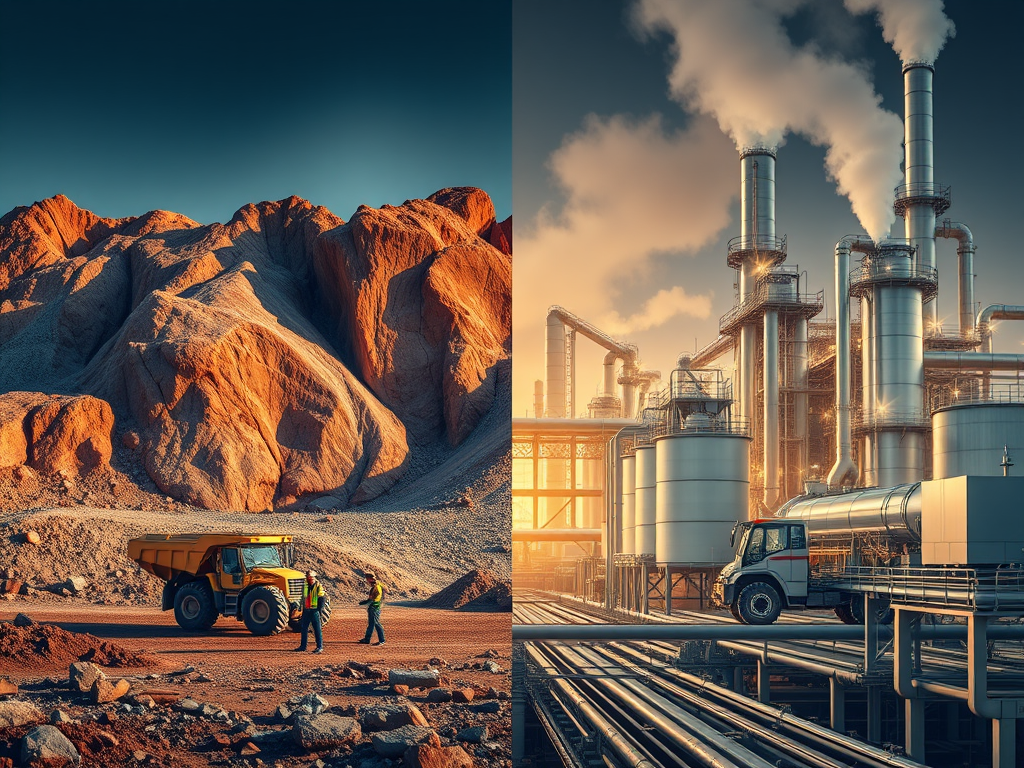
The global electric vehicle (EV) transition is often framed as a battle for lithium reserves. In reality, the more consequential chokepoint lies downstream: in lithium chemical processing.
While Australia, Chile and Argentina dominate raw lithium extraction, China controls an estimated 60-70% of global lithium chemical conversion capacity. This asymmetry creates pricing power, supply-chain leverage and margin volatility that ripple across battery manufacturers and automotive OEMs.
This article evaluates lithium processing as a geopolitical and financial choke point, analysing refining margins, pricing transmission, capacity concentration and strategic policy implications through a market-research lens.
From Ore to Battery: Where Value Accrues
Lithium is mined primarily in two forms:
- Hard rock (spodumene), dominant in Australia
- Brine extraction, concentrated in Chile, Argentina and Bolivia
However, raw lithium concentrate cannot be directly used in batteries. It must be chemically converted into:
- Lithium carbonate (Li₂CO₃)
- Lithium hydroxide (LiOH)
These refined chemicals are critical inputs for battery cathodes such as NMC (Nickel Manganese Cobalt) and LFP (Lithium Iron Phosphate).
The refining step is capital-intensive, energy-intensive, environmentally sensitive and technologically complex. It is here that China has built overwhelming dominance.
According to the International Energy Agency (IEA), China accounts for roughly two-thirds of global lithium chemical processing capacity. In contrast, Australia, the world’s largest lithium miner, processes only a fraction domestically.
This separation between mining and refining creates strategic asymmetry: control over chemical conversion equals control over battery-grade supply.
Capacity Concentration and Geographic Leverage
China’s lithium refining ecosystem is concentrated in provinces such as Jiangxi and Sichuan, supported by:
- Integrated supply chains
- Subsidized industrial power
- Established cathode and battery manufacturers
- State-backed financing
- Ganfeng Lithium
- Tianqi Lithium
- CATL
- BYD
This vertical integration compresses logistics costs and enhances pricing coordination.
By contrast, Western efforts under the US Inflation Reduction Act (IRA) and European Critical Raw Materials Act aim to expand refining capacity domestically. However, chemical plants require 2-4 years for permitting and construction, alongside high environmental compliance costs.
Thus, even if Western mining expands, processing remains a bottleneck, sustaining China’s leverage.
Lithium Price Volatility and Refining Margins
Lithium markets have experienced extreme volatility:
Lithium carbonate prices surged from under $10,000 per tonne in 2020 to over $70,000 per tonne in late 2022. By late 2023, prices had collapsed below $20,000 per tonne. This volatility had asymmetric impacts across the value chain.
Refiners operate on conversion spreads: the margin between spodumene input costs and lithium chemical output prices. During the 2022 price spike, refiners captured extraordinary margins as demand outpaced chemical supply capacity.
However, the 2023 price crash led to severe margin compression and inventory write-downs, particularly for companies holding high-cost feedstock contracts.
The ability to withstand such cycles depends on:
- Vertical integration
- Long-term supply agreements
- Access to subsidized financing
- Domestic demand support
Chinese refiners, integrated with battery giants like CATL and BYD, absorbed shocks more effectively than smaller Western entrants. Western chemical producers such as Albemarle Corporation and SQM have expanded lithium processing capacity, but remain smaller and less vertically integrated than Chinese competitors.
This demonstrates a critical insight: lithium processing is not just a physical bottleneck but a financial resilience advantage.
Pricing Transmission to Batteries and EV Margins
Lithium represents approximately 10-13% of total EV battery pack cost, depending on chemistry and pricing conditions.
In 2022, soaring lithium prices increased battery pack costs after a decade of decline. According to the Bloomberg NEF, average battery pack prices rose for the first time in years during the lithium spike.
OEMs such as Tesla, Volkswagen Group and Ford Motor Company faced margin pressure due to raw material inflation. Chinese OEMs, supported by integrated domestic refining and battery supply, experienced relatively lower exposure.
This pricing transmission reveals a second-order geopolitical effect:
Refining concentration affects global EV competitiveness.
Countries dependent on imported lithium chemicals face:
- Higher cost volatility
- FX exposure
- Trade risk
- Strategic vulnerability
Thus, lithium refining capacity influences not only supply security but industrial competitiveness.
Capital Intensity and Barriers to Entry
Lithium chemical plants require:
- Capex ranging from $500 million to $1 billion for large-scale facilities
- Significant water usage
- Environmental compliance infrastructure
- Skilled chemical engineering expertise
Additionally, refining requires stable feedstock supply agreements with miners, often denominated in long-term contracts.
China’s early investment wave (2015-2020) coincided with lower lithium prices, allowing capacity build-out at lower cost. Western projects now face:
- Higher construction costs
- Stricter ESG compliance
- Community opposition
- Energy price volatility
As a result, entry barriers are both financial and regulatory. This solidifies China’s position, even as geopolitical tensions intensify.
Policy Responses and Strategic Realignment
The United States has introduced incentives under the Inflation Reduction Act to localize battery supply chains. However, qualifying for tax credits requires materials sourced from “friendly” nations.
Australia is expanding domestic conversion capacity, seeking to capture more value locally rather than exporting spodumene to China.
India has announced critical mineral missions and refining ambitions, but capacity remains nascent compared to China’s established chemical clusters.
The strategic dilemma is clear:
Mining diversification without refining capacity does not break dependency. Unless chemical processing capacity is geographically diversified, geopolitical leverage remains concentrated.
What Breaks the Chokepoint?
Three possible developments could weaken China’s refining dominance:
- Technological substitution (e.g., sodium-ion batteries reducing lithium dependence)
- Large-scale Western refining subsidies sustained over a decade
- Coordinated supply-chain alliances between mining nations and refining hubs
However, each scenario faces structural constraints.
Sodium-ion remains commercially limited relative to lithium-ion density requirements.
Subsidies require long-term political continuity.
Alliances face coordination challenges and capital scarcity.
Therefore, in the medium term (2026-2030), refining dominance is likely to persist.
Investment and Market Implications
For investors, lithium processing concentration creates several themes:
- Margin volatility risk in battery manufacturers
- Refining spread opportunities in chemical producers
- Policy-driven capex cycles
- Sovereign strategic investment in processing assets
Valuations of vertically integrated Chinese players reflect not just production scale but systemic leverage within the EV ecosystem.
Meanwhile, Western entrants carry execution risk and prolonged payback periods.
Understanding lithium processing economics is therefore critical for:
- Equity analysts
- Sovereign investors
- Policy advisors
- Automotive strategists
Processing Power is Strategic Power
The geopolitics of lithium is often mischaracterized as a mining story. In reality, it is a chemical processing story.
China’s dominance in lithium conversion grants:
- Pricing influence
- Industrial resilience
- Downstream competitiveness
- Strategic leverage in trade negotiations
In the evolving geopolitical landscape of energy transition, lithium processing stands as a decisive chokepoint. Control of chemical transformation, not geological abundance, will shape the future of electric mobility.



Leave a Reply