
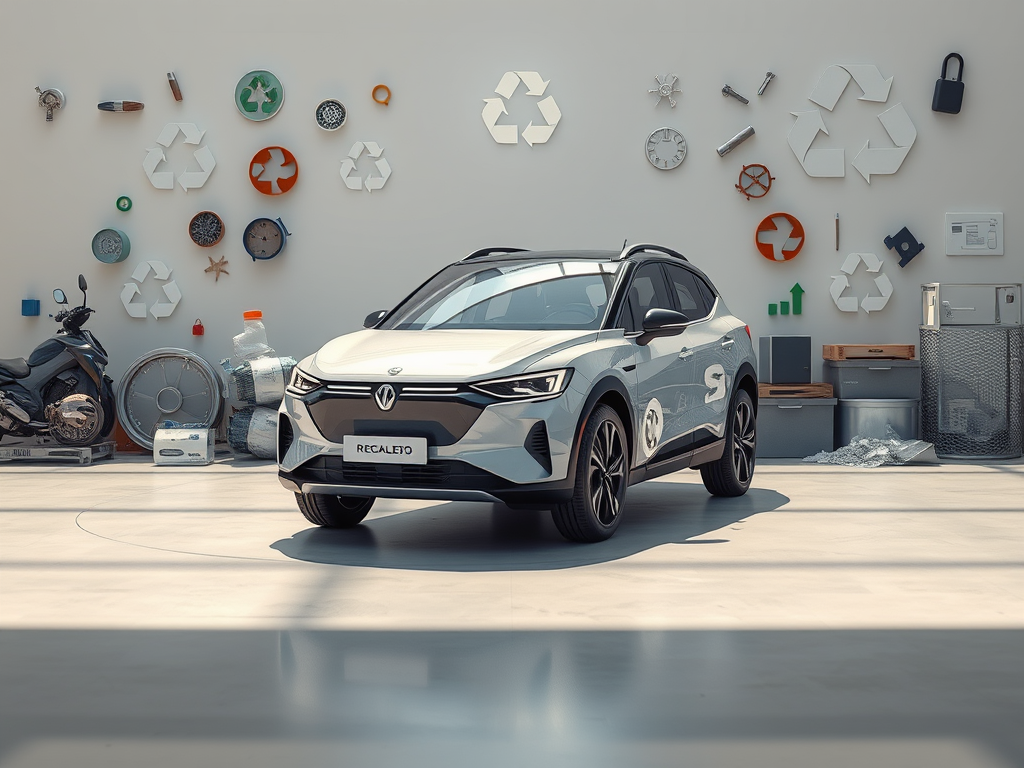
India’s automotive industry is entering its most capital-intensive decade. Electrification mandates, tightening emission norms, and rising localization targets are pushing manufacturers to invest billions in new platforms and supply chains. Yet beneath this transformation lies a structural vulnerability: modern vehicles, especially electric ones, are becoming more material-intensive at the very moment raw materials are becoming more volatile.
Steel, aluminium, copper, lithium, nickel, cobalt, and rare earth elements increasingly determine whether an Indian automaker ends the year with stable margins or unexpected losses. For an industry that operates on thin single-digit operating margins, this dependence on global commodity cycles is becoming a strategic risk.
Against this backdrop, a quiet shift is taking place. Circularity, once framed largely as an environmental initiative, is being reinterpreted as a financial strategy. Indian automotive firms are beginning to treat reuse, remanufacturing, and material recovery not as sustainability programs, but as tools for cost control, risk reduction, and capital efficiency.
The real promise of circularity in India is not greener cars. It is more predictable profits. This article explores different aspects of automotive manufacturing in terms of circularity.
The Financial Trap of Linear Manufacturing in India
India’s automotive economics have traditionally been built on a linear model: procure materials, manufacture vehicles, sell them, and let end-of-life units disappear into an informal scrap ecosystem. This model worked when material prices were stable and vehicles were mechanically simple. That world no longer exists.
Three forces are now colliding:
- Commodity Volatility: Prices of steel, aluminum, and copper, which are key inputs for Indian OEMs, have seen double-digit swings in recent years. Battery materials add an entirely new layer of uncertainty.
- Import Dependence: India remains heavily reliant on imported lithium, cobalt, and rare earth elements. Exchange-rate movements and geopolitical tensions translate directly into higher production costs.
- Electrification Pressure: Electric vehicles require far more critical minerals per unit than internal combustion vehicles, amplifying exposure to global supply shocks.
This results in a structural mismatch: Indian automakers must deliver affordable vehicles to price-sensitive consumers while operating cost structures increasingly tied to unpredictable global markets.
Circularity offers a way to break that dependence.
How Circularity Reshapes the Cost Structure
At its core, circularity changes the basic cost mechanics of automotive manufacturing.
The Linear Cost Logic
In the conventional model, variable costs are dominated by virgin raw materials. OEMs act as price-takers in global commodity markets, leaving margins to fluctuate with steel, aluminum, and battery material cycles. These locks working capital into large inventories and requires a fresh set of inputs for every unit sold, creating a permanently volatile earnings profile—a dangerous position in India’s price-sensitive market.
The Circular Cost Logic
Circularity introduces a different equation. Through component reuse, remanufacturing, parts harvesting, closed-loop material recovery manufacturers reduce the proportion of costs tied to new materials and increase the proportion tied to internal processes. Financially, this means lower bill of materials per vehicle, reduced exposure to spot commodity prices, more predictable input costs, less inventory risk, improved working capital cycles
For example, remanufacturing high-value components such as engines, transmissions, and electronic control units can cost 40-60% less than producing them from virgin materials. In the EV context, refurbishing battery modules rather than replacing entire packs can dramatically reduce lifecycle costs. Material circularity could increase companies’ top line by 10-20 per cent, reduce cost by 5-10 per cent, cut down virgin material use by 20-40 percent.
The critical insight is this: Circularity converts volatile variable costs (commodities) into more controllable operational costs (processes). For Indian OEMs operating in one of the world’s most price-competitive markets, that shift is transformative.
Capital Allocation: From Commodities to Process IP
The deeper impact of circularity is not only on operating costs but on how capital itself is deployed. Historically, capital has been allocated to expanding capacity, securing supply contracts, and hedging commodity exposure. Much of this spending creates little differentiation; every manufacturer buys steel at market prices, offering no structural advantage.
The Circular Investment Model
Circularity redirects capital toward assets that generate proprietary value, such as remanufacturing facilities, reverse logistics networks, battery refurbishment lines, vehicle dismantling and sorting centers, digital traceability systems and material recovery partnerships.
These investments create process intellectual property rather than mere procurement pipelines.
Consider the emerging Indian EV ecosystem. Firms investing early in battery take-back infrastructure, module refurbishment, and localized recycling are effectively building future material supply chains owned by them, not by global mining markets.
Over time, this produces three financial benefits:
- Higher Return on Invested Capital: Process capabilities generate recurring value; commodity purchases do not.
- Defensible Cost Advantages: OEMs with established circular systems can operate at structurally lower material intensity.
- Reduced Volume Sensitivity: Earnings depend less on new vehicle sales and more on lifecycle management.
Circularity, therefore, is not just an operational tweak; it is a different philosophy of capital deployment.
Risk Reduction as a Balance Sheet Strategy
Perhaps the most underappreciated benefit of circularity in India is its impact on risk. Indian automotive firms face a uniquely complex risk environment:
- currency fluctuations affecting imported materials
- geopolitical uncertainty around critical minerals
- regulatory changes such as Extended Producer Responsibility (EPR)
- sudden commodity price spikes
- supply chain disruptions
Circularity acts as a built-in hedge against each of these. By recovering materials domestically and reusing components internally, companies can:
- reduce exposure to global price cycles
- lower foreign exchange pass-through
- secure more predictable supply
- minimize the need for expensive hedging programs
- improve earnings stability
For businesses, this translates into tangible outcomes:
- smoother quarterly results
- better cost forecasting
- reduced working capital volatility
- stronger long-term planning
In a country where automotive demand is cyclical and competition intense, risk reduction is as valuable as revenue growth.
The EV Multiplier Effect in India
Electrification magnifies the financial logic of circularity.
An electric vehicle battery is essentially a concentrated bundle of expensive materials- lithium, nickel, cobalt, manganese, and graphite. Today, India imports the vast majority of these inputs. As EV adoption accelerates, material security will become one of the defining constraints of the industry.
Circular systems directly address this challenge:
- end-of-life batteries become domestic sources of critical minerals
- refurbished modules reduce replacement costs
- second-life applications in energy storage extract additional value
- localized recycling reduces import dependence
For Indian OEMs and two-wheeler EV manufacturers, this is not optional. Without robust circular strategies, they will remain permanently vulnerable to global supply shocks.
The firms that build early capabilities in battery recovery and remanufacturing will effectively control a strategic resource base inside India’s borders.
Implications for India’s Automotive Business Model
As circularity scales, the role of the Indian automaker itself begins to change.
The future OEM will not only be a vehicle manufacturer but also a remanufacturer, materials manager, lifecycle service provider and refurbisher. Profitability will depend less on selling the next car and more on managing the full life of the previous one.
This shift is particularly relevant for India, where:
- price sensitivity limits margin expansion on new vehicles
- regulatory pressure on recycling is rising
- the unorganized scrap sector is gradually formalizing
- EV penetration is accelerating faster than raw material security
Circularity aligns perfectly with these structural realities.
Circularity as India’s Automotive Financial Operating System
For years, circularity in India has been discussed primarily through the lens of sustainability targets and regulatory compliance. That framing misses the bigger point. In the Indian automotive context, circularity is fundamentally about financial resilience. It offers a pathway to:
- stabilize costs in a volatile material environment
- reduce import dependence
- improve capital efficiency
- protect margins in a hyper-competitive market
- build defensible long-term advantages
As India positions itself as a global automotive and EV manufacturing hub, the winners will not be those who merely produce more vehicles, but those who manage materials more intelligently. The industry is gradually recognizing a simple truth: In a resource-constrained world, profitability belongs to manufacturers who own processes, not just products.
Circularity is how India’s automotive sector will move from being a hostage to commodity cycles to becoming a master of its own economics.
And in that shift from metal to margins lies the next era of competitive advantage.
Author

Make Tatvita one of your preferred sources
See more insights from Tatvita Analysts in your Google Search results.



Leave a Reply