
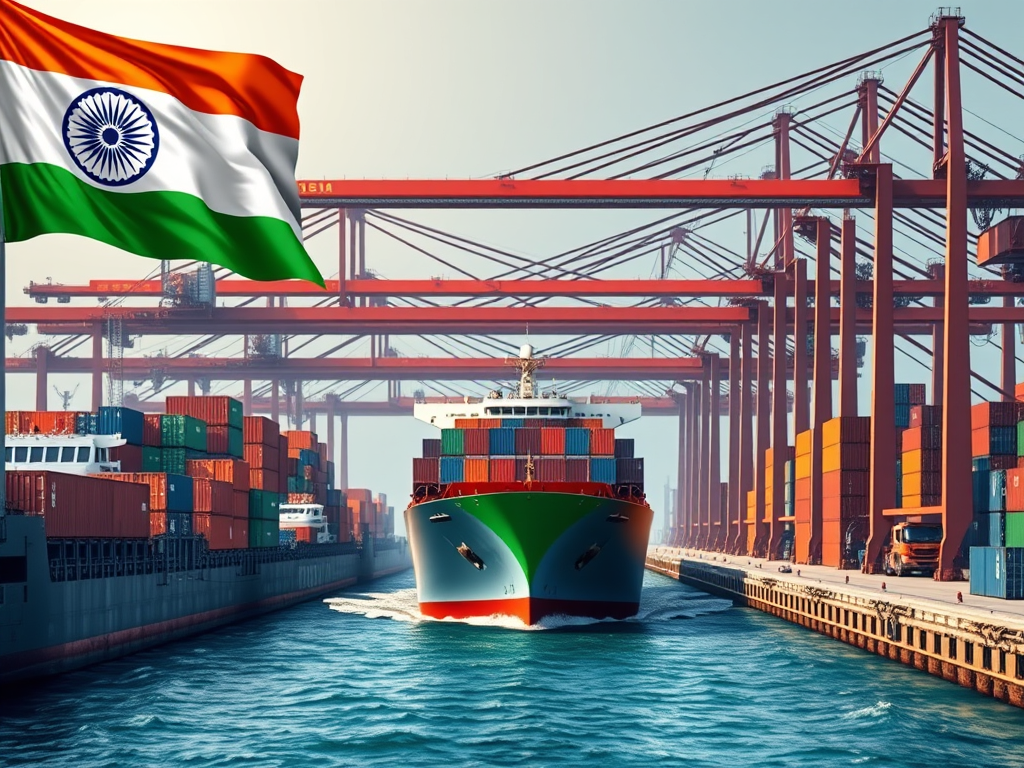
India’s export strategy is undergoing a discernible shift in Union Budget 2026–27. Instead of a headline-heavy approach anchored primarily in sectoral incentives, the Budget moves toward a systems-led export competitiveness model built on trade facilitation, trusted-trader architecture, customs digitisation, logistics corridors, and targeted input-cost rationalisation.
The message is clear: India wants to win export markets not only through price support, but through predictability, speed, compliance ease, and supply-chain credibility.
This pivot is particularly relevant for MSMEs and mid-sized firms, which often struggle more with compliance, logistics delays, and working-capital lock-ups than with production capability itself. The Budget’s trade-facing measures therefore appear to be designed to reduce “export friction”, the non-tariff costs embedded in delays, paperwork, uncertainty, and inspection risk. The net effect is a policy model where the state is attempting to become a facilitator of export execution, rather than merely a sponsor of export activity.
The Big Picture: Export strategy shifts from subsidies to ecosystem engineering
Two broad pillars reveal the Budget’s export strategy shift.
First, it attempts to make India’s trade regime more predictable and trust-based by recognising compliant importers, expanding advance ruling validity, moving toward operator-centric warehousing, and introducing automated notifications and digital windows for clearance.
Second, it strengthens the physical and procedural infrastructure of exports—freight corridors, waterways, coastal cargo promotion, and factory-to-ship facilitation through electronic sealing.
This is consistent with the document’s stated thrust on enhancing productivity and competitiveness and building resilience to volatile global dynamics.
Customs reforms: Building a “trusted trade” operating system
1) Trusted importers and risk-based recognition: The Budget introduces an explicit push toward risk-based facilitation by recognising regular importers with trusted longstanding supply chains in the Customs risk system, so repeated verification can be minimised. This is not a minor procedural tweak; it signals the emergence of a compliance-and-reputation based trade channel—where credibility becomes an asset.For exporters and importers, this creates a strong incentive to institutionalise compliance, documentation discipline, and supply-chain transparency. Over time, “trusted” status can materially reduce dwell times, inspection frequency, and shipment uncertainty—advantages that translate directly into delivery reliability and lower working capital blockage.
2) Advance rulings become longer-lived: Another critical move is extending the validity of advance rulings binding on Customs from 3 years to 5 years. For businesses planning medium-term sourcing strategies or long-cycle export contracts, this stability matters. It reduces classification and duty ambiguity—two key causes of disputes and cost unpredictability.
3) Warehousing reform: Operator-centric, self-declaration architecture: The transformation of the customs warehousing framework into a warehouse operator–centric system with self-declarations is another signal of trust-based governance. If implemented rigorously with audit trails, it can reduce procedural burden and accelerate intermediate storage and re-export operations—particularly relevant for firms using India as an assembly, finishing, or distribution hub.
4) Digital clearance: towards “single window + integrated system”: The Budget proposes a single interconnected digital window for cargo clearance approvals and plans to roll out a Customs Integrated System (CIS) within two years. Together, these measures point toward lowering transaction costs and improving time predictability—both central to export competitiveness in high-frequency sectors (electronics, garments, engineering goods) and in time-sensitive global value chains.
Export logistics: From “port efficiency” to corridor–waterway integration
Trade competitiveness is increasingly logistics-driven. Budget 2026–27 responds with a cluster of infrastructure initiatives that, while not labelled “export schemes,” are structurally export-enabling.
The document highlights: new dedicated freight corridors connecting Dankuni (East) to Surat (West); operationalising 20 new national waterways linking mineral-rich areas, industrial centres and ports; development of a ship repair ecosystem; and a Coastal Cargo Promotion Scheme to raise inland waterways and coastal shipping share from 6% to 12% by 2047.
This is an implicit export strategy: reducing logistics cost, improving cargo mode options, and decongesting road/rail choke points.
For exporters, especially bulk commodities, food processing, chemicals, engineering goods, and heavy manufacturing, such corridor-waterway integration can lower per-unit transport costs and reduce variability in transit times two determinants of export pricing and contract performance.
The export competitiveness play: Input cost rationalisation and time flexibility
A prominent feature of the Budget’s trade agenda is targeted customs relief for inputs and export processing especially in labour-intensive sectors and select manufacturing chains.
1) Seafood exports: duty-free input limit increased: The Budget increases the limit for duty-free imports of specified inputs used for processing seafood exports from 1% to 3% of the FOB value of the previous year’s export turnover. This is a clear competitiveness lever: it lowers effective input costs and supports processors operating in highly price-sensitive international markets.
2) Footwear value chain expansion: shoe uppers included: Duty-free imports of specified inputs are extended to exports of shoe uppers, in addition to leather or synthetic footwear. The policy significance here is that it explicitly supports intermediate export segments rather than only finished products—an approach aligned with global value chain integration.
3) Extended export timelines for garments and footwear: Exporters of leather or textile garments and leather/synthetic footwear receive an extended time window for export of final product from 6 months to 1 year. This is a working-capital and compliance reform disguised as a timeline change. It reduces execution stress and helps exporters manage production and shipment cycles, especially when demand is volatile.
4) Manufacturing-linked customs exemptions: electronics and aerospace: The Budget also includes basic customs duty exemptions on specified parts for microwave ovens, and on components and parts used in aircraft manufacturing, including raw materials for aircraft parts used in maintenance, repair, and overhaul requirements (including defence units). While these may appear sector-specific, their trade significance is broader: they strengthen India’s position in higher value manufacturing and potential export categories where reliability, certification, and supply-chain depth are critical.
MSMEs, export scale, and the shift to “liquidity + compliance + digital trade”
A major export bottleneck for MSMEs is not just market access—it is working capital, compliance capacity, and small-ticket export logistics. The Budget addresses this through an integrated set of measures.
1) Courier exports: removal of consignment value cap: One of the most MSME-relevant trade proposals is the removal of the current value cap of ₹10 lakh per consignment on courier exports. This is strategically important for e-commerce exporters, D2C brands, small manufacturers, and artisan-led enterprises that rely on courier channels rather than containerised freight.
2) Equity and growth capital for MSMEs: The Budget announces a ₹10,000 crore SME Growth Fund and a ₹2,000 crore top-up to the Self-Reliant India Fund (2021). For export-oriented MSMEs, growth capital determines the ability to scale capacity, invest in compliance, and fulfill larger orders.
3) Liquidity via TReDS, GeM linkages, and invoice discounting: The Budget mandates TReDS as the settlement platform for purchases from MSMEs by CPSEs, introduces credit guarantee support through CGTMSE for invoice discounting on TReDS, links GeM with TReDS, and proposes securitisation of TReDS receivables to develop a secondary market. While not export-specific, liquidity stability is export capability: it funds raw material procurement, production cycles, and shipping.
4) “Corporate Mitras”, compliance support at scale: The Budget proposes that government will facilitate professional institutions to develop “Corporate Mitras”, especially in Tier-II and Tier-III towns, to help MSMEs meet compliance requirements at affordable cost. This can become an enabling layer for export documentation, GST processes, reporting, and trade compliance—if implemented with clear standards and accountability.
Fisheries and “export recognition”: a policy signal with sectoral impact
A notable tax proposal treats fish catch by Indian vessels in the Exclusive Economic Zone (EEZ) or high seas as duty-free, and further states that landing such fish at a foreign port will be treated as export of goods.
This is both a fiscal incentive and a recognition mechanism potentially improving the formal export treatment for certain operations, affecting documentation, duty treatment, and market strategy for fisheries.
What exporters and importers should do now?
This Budget’s trade agenda is best understood as a competitive shift toward compliance-driven speed. To benefit materially, businesses must adopt operational readiness rather than only interpret announcements.
1) Rebuild your trade model around “trust-based facilitation”
If Customs is moving toward trusted importer recognition and reduced verification, exporters and importers should create internal systems that strengthen credibility: clean documentation, audit-ready processes, consistent vendor records, and traceability practices.
Over time, the firms that institutionalise compliance will gain a practical advantage through lower clearance friction.
2) Use advance rulings strategically as a stability instrument
With advance ruling validity extended to five years, businesses should treat advance rulings as a tool for medium-term sourcing and pricing certainty.
This reduces the risk of classification disputes that can otherwise derail margins.
3) MSME exporters should revisit courier export strategy
The removal of the ₹10 lakh cap on courier exports is an invitation to reconfigure export logistics for smaller shipments and new market testing.
For D2C exporters, this can enable faster market entry cycles, lower overhead, and better cash conversion.
4) Identify eligibility and compliance pathways for duty-free inputs
Seafood, footwear, garments, and select manufacturing segments should immediately map the duty-free input provisions and revised timelines into their production planning and export compliance calendars.
The benefit here is not automatic; it requires accurate documentation and timely procedural action.
5) Treat TReDS and receivable financing as export working-capital infrastructure
Export scaling fails when receivables choke liquidity. The Budget’s TReDS and CGTMSE-backed invoice discounting measures should be integrated into export financing strategy, especially for firms supplying large domestic buyers alongside export markets.
6) Plan for digitised clearance: invest in internal digital readiness
With a single digital window and the CIS rollout proposed, exporters/importers should upgrade internal systems to reduce errors, delays, and compliance mismatch.
Digital reform benefits firms that can respond quickly with clean data and documentation.
A pragmatic export strategy rooted in execution economics
Union Budget 2026–27 does not present a single “export mega-scheme.” Instead, it signals something more structural: India’s export strategy is shifting toward execution economics, the costs of time, uncertainty, compliance, and logistics. This is a mature direction. Global markets reward reliability as much as price, and supply chains are increasingly sensitive to lead times, documentation discipline, and regulatory predictability.
For businesses, the implication is equally clear. The Budget’s trade reforms will disproportionately benefit firms that are operationally ready—those who build compliance capacity, digitise processes, secure liquidity pipelines, and align logistics choices with emerging corridor and facilitation reforms. In short, Budget 2026–27 is an invitation for exporters and importers to treat competitiveness not as a slogan, but as a system.
Author

Make Tatvita one of your preferred sources
See more insights from Tatvita Analysts in your Google Search results.



Leave a Reply