
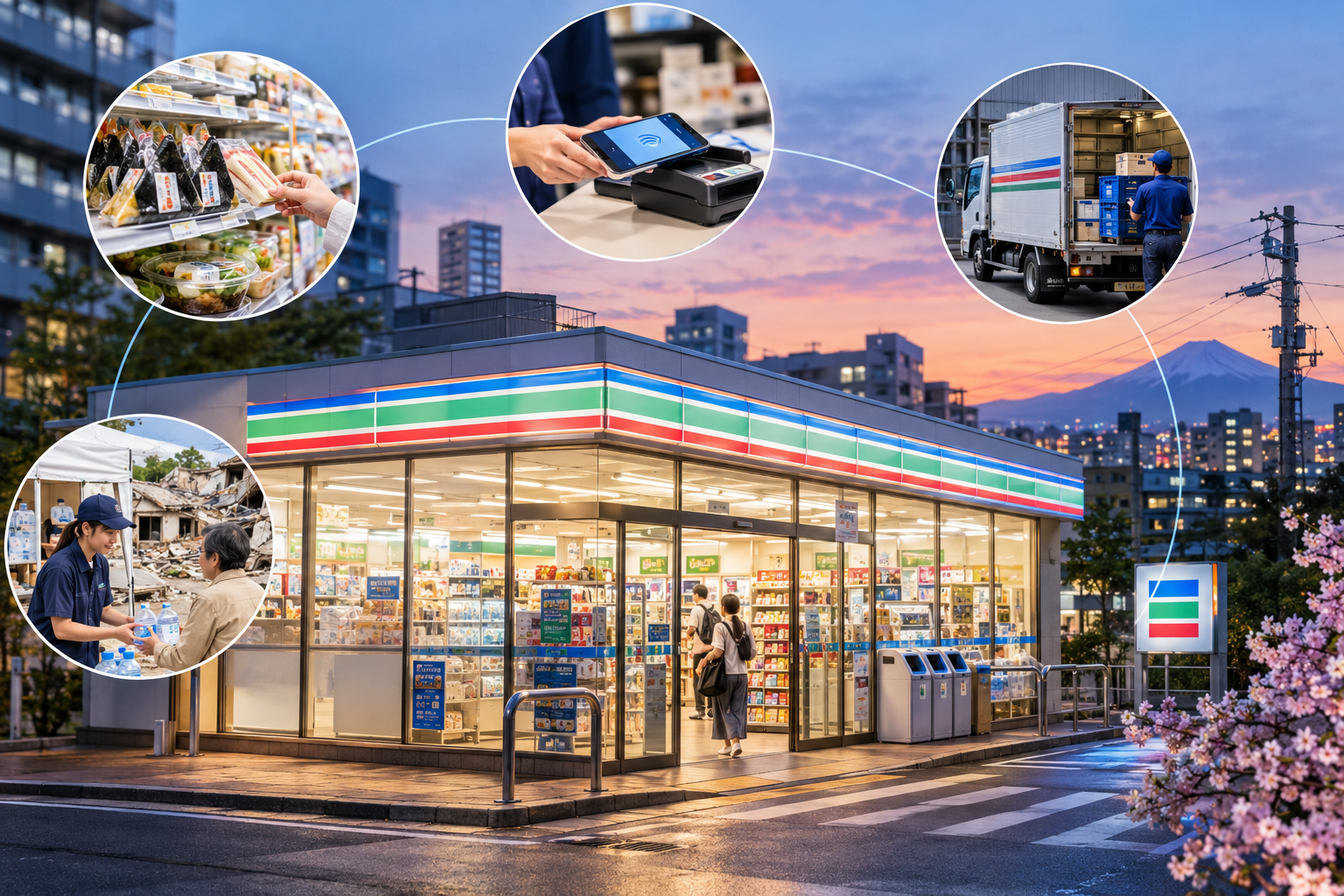
Japan turned convenience stores konbini into more than places to buy snacks. Through dense networks, reliable supply chains, standardised service, and public-private cooperation, they became a daily interface for food, payments, logistics, and disaster support.
Urban time scarcity
By the early 1970s, Japan was urbanising rapidly, households were becoming smaller, and more people especially women were entering formal employment. Traditional family-run shops often had limited hours and inconsistent product availability, while large supermarkets were less accessible for small, frequent purchases. Urban consumers needed nearby, predictable access to meals, daily essentials, cash, and services outside normal office hours.
The gap was therefore not simply “lack of shops.” It was the absence of a dependable neighbourhood institution that could combine retail with time-saving services. Japan’s solution was to make a small store perform the work of several institutions: grocer, restaurant, bank counter, courier point, and emergency supplier.
Reliability plus services
Japan’s konbini model succeeded because it standardised the customer experience. A customer can generally expect clean premises, fresh ready-to-eat food, clear pricing, rapid checkout, and a predictable range of services at almost any store. This consistency is central to why konbini feel like infrastructure rather than ordinary retail.
Three design choices were especially important:
- Small stores, high density: Stores are located close to homes, railway stations, offices, and hospitals, reducing travel time for routine purchases.
- Frequent replenishment: Sophisticated logistics deliver fresh food multiple times a day, allowing small stores to offer freshness without large storage space.
- Service integration: Customers can pay utility bills, withdraw cash from ATMs, send or collect parcels, print documents, buy tickets, and access other services at the same counter.
The result is a store that solves many small daily problems in one visit. This “one-stop neighbourhood utility” model is what made konbini socially valuable, not merely commercially successful.
Where and when it emerged
The modern Japanese convenience-store industry began in May 1974, when Ito-Yokado partnered with the United States’ Southland Corporation to open the first Japanese 7-Eleven in Toyosu, Koto Ward, Tokyo. The format was adapted from the American convenience-store idea, but Japan transformed it through dense urban planning, franchise discipline, and continuous product innovation.[web-japan][sej.co]
The model spread first through Tokyo and other major metropolitan areas, then into suburban and rural Japan. Over time, 7-Eleven, Lawson, and FamilyMart became the industry’s dominant chains. By fiscal 2023, 7-Eleven alone operated 21,533 stores in Japan and recorded ¥5.3 trillion in sales.[nippon]
A broad but unequal user base
Konbini primarily serves busy urban workers, students, elderly residents, single-person households, commuters, and tourists. Their long operating hours make them particularly useful for people whose schedules do not match bank, post-office, or government-office timings.
They are also important for rural communities. In areas where banks, clinics, and public offices may be distant, a convenience store can provide cash access, parcel services, and basic supplies. Reuters reported that rural Japanese rely on konbini for parcel and ATM services, and even as lifelines during disasters such as earthquakes.[jp.reuters]
However, the model has not benefited everyone equally. Franchise owners often bear long working hours, staffing difficulties, and financial risk. Workers, especially those covering night shifts, face demanding conditions. The convenience enjoyed by customers has partly depended on labour arrangements that have become harder to sustain.
Conditions that enabled the model
Japan’s konbini system did not emerge automatically. It depended on a specific set of economic and institutional conditions:
- High urban density and public-transport use, which made small, frequent purchases commercially viable.
- A strong franchise system, in which headquarters provided branding, supply chains, technology, training, and product development while local owners managed stores.
- Trust in food safety and quality, allowing ready-to-eat meals to become a core product rather than a side business.
- Cooperation among retailers, banks, utilities, courier firms, and local governments, which enabled bill payment, parcel pickup, and disaster-related roles.
- A culture of standardisation, where chains could test products regionally, remove weak sellers quickly, and scale successful items nationally.
Government recognition also mattered. In 2019, Japan’s industry minister described convenience stores as part of “Japan’s social infrastructure,” reflecting their role beyond private commerce.[convenience]
Scale and performance
The evidence for konbini’s importance is visible in their scale. Japan had 55,736 convenience stores at the end of 2024, while industry sales reached a record ¥11,795.3 billion, according to Japan Franchise Association data. The sector accounts for 28.4 percent of Japan’s total retail food and beverage sales, and the number of stores has remained broadly stable at roughly 55,500–55,900 since 2019.[convenience][apps.fas.usda]
These figures show that konbini are not a niche urban phenomenon. They are a mature, nationwide system embedded in daily consumption. Their stability is also significant: rather than expanding indefinitely, the industry has shifted toward improving services, efficiency, and product quality.
The public-service dimension is equally important. Convenience stores handle everyday payments, parcel collection, cash access, printing, and ticketing; during disasters, major chains coordinate with authorities and help maintain access to essential goods. This service integration explains why many Japanese treat the local konbini as a reliable part of daily life, not just a retail outlet.[revealjapan][japanmakessense]
Labour, waste, and saturation
The model’s biggest limitation is labour. The 24-hour format requires staff at all hours, but Japan’s ageing population and shrinking workforce have made recruitment difficult. A government survey cited in 2019 found that 61 percent of franchisees could not find enough staff, up from 22 percent in 2014. Many franchise owners worked long hours themselves to maintain round-the-clock operations.[jp.reuters][businesstimes.com]
The issue became publicly contentious when a 7-Eleven franchise owner reduced opening hours without approval and was fined, prompting a national debate over whether headquarters could impose 24-hour operations regardless of local labour conditions. Major chains subsequently began allowing some stores to apply for shorter hours, though most remained open overnight because night shifts also support cleaning, restocking, and deliveries.[convenience][japonity]
Food waste is another challenge. Fresh ready meals require frequent disposal of unsold items. Japan responded through the Act on Promotion of Food Loss and Waste Reduction, which came into force on October 1, 2019 and frames reducing food waste as a shared responsibility of government, businesses, and consumers. The law supports prevention, recycling, and reduction of edible food being discarded.[gov-online.go][caa.go]
These limitations remain relevant. Labour scarcity has become more structural rather than temporary, and the industry’s response reduced-hour trials, automation, and revised franchise arrangements addresses the problem only partially. Food-waste rules have created stronger incentives, but high freshness standards still generate waste. The newer solution is therefore not to abandon konbini, but to redesign their economics: fewer unnecessary overnight hours, better demand forecasting, automation of routine tasks, and more efficient inventory management.
Adapting
No country should not copy Japan’s konbini model directly. The goal should be to adapt the underlying principles proximity, reliability, service integration, and resilience to neighbourhood retail ecosystem.
The stores are already adapting through digital payments, mobile commerce, loyalty programmes, and digital inventory management. B2B platforms have also helped stores order stock digitally and receive faster replenishment. Rather than replacing stores with Japanese-style chains, take maesures that can strengthen them.[business.cornell]
A practical adaptation strategy would include:
- Create neighbourhood service hubs: Select stores in dense residential areas to offer bill payments, parcel pickup and drop-off, printing, mobile recharge, and government-service information.
- Upgrade supply chains gradually: Use shared warehousing, demand-based replenishment, and better cold-chain facilities for fresh and perishable goods.
- Standardise essential quality: Introduce basic certification for hygiene, pricing transparency, digital billing, and inventory practices without imposing a uniform store format.
- Use franchise-like support, not franchise-like control: Provide stores with technology, credit, branding, and logistics support while preserving their ownership and flexibility.
- Plan for disaster resilience: Identify stores that can remain operational during floods, heatwaves, or supply disruptions, and integrate them into local emergency planning.
- Protect workers and owners: Avoid importing Japan’s earlier problem of forcing 24-hour operations. Operating hours should reflect local demand, staffing availability, and safety.
- Reduce food waste from the start: Use demand forecasting, dynamic discounts near expiry, donation linkages, and composting or recycling systems.
Other countries’ opportunity lies in combining the konbini’s local trust and reach with Japan’s operational discipline. A modernised network could improve access to essentials, create employment, support digital commerce, and make neighbourhood retail more resilient.
The lesson from Japan is not that every country needs 55,000 convenience stores. It is that everyday retail becomes infrastructure when it is dependable, nearby, service-rich, and designed around people’s real time constraints.
Author

Make Tatvita one of your preferred sources
See more insights from Tatvita Analysts in your Google Search results.


Leave a Reply