
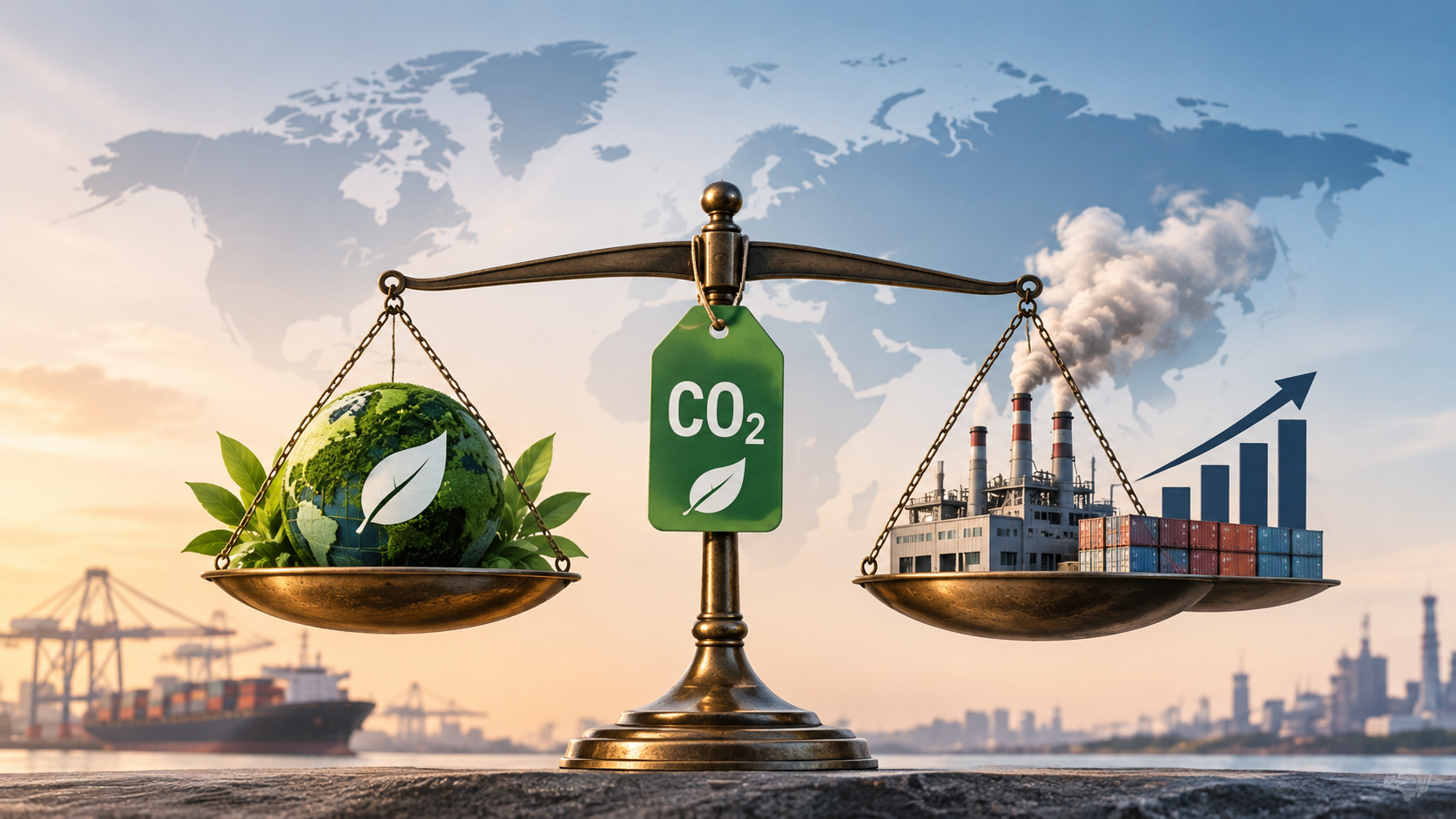
Carbon pricing is increasingly being adopted as a tool to address climate change. However, concerns remain about its impact on industrial costs, investment and international trade. Global evidence suggests that emissions can be reduced without significantly weakening industrial competitiveness, provided carbon pricing is introduced gradually and supported by appropriate safeguards.
Carbon Pricing: The Competitiveness Debate
Carbon pricing has emerged as an important instrument in global climate policy. By attaching an economic cost to greenhouse gas emissions, governments encourage businesses to adopt cleaner technologies, improve energy efficiency and reduce their carbon footprint. However, an important question remains: can countries impose a cost on carbon without making their domestic industries less competitive?
Industries such as steel, cement, aluminium, chemicals and refining are particularly exposed because their production processes are energy-intensive and generate substantial emissions. When governments introduce carbon prices, these industries may face higher production costs than competitors in countries with weaker environmental regulations. This creates two major concerns: domestic firms may lose market share and employment, while production may shift to countries with less stringent climate policies. The latter is known as carbon leakage.
This concern is particularly relevant for developing economies such as India, where manufacturing expansion, employment generation and export competitiveness remain important development priorities.
Despite these concerns, carbon pricing is becoming increasingly widespread. According to the World Bank’s 2025 assessment, 80 carbon-pricing instruments were operating globally in 2025, covering approximately 28% of global greenhouse gas emissions.
The central question, therefore, is not simply whether carbon should be priced, but how it can be done without undermining industrial development.
How Carbon Pricing Reduces Emissions
Carbon pricing works by making pollution economically costly. When firms must pay for every tonne of carbon dioxide they emit, they have an incentive to improve energy efficiency, switch to cleaner fuels, recycle materials and invest in low-carbon technologies.
Unlike direct production restrictions, carbon pricing allows individual firms to identify the least expensive ways of reducing emissions. This flexibility can make it an economically efficient instrument for achieving environmental objectives.
Empirical evidence indicates that carbon pricing can deliver meaningful emission reductions. A 2024 meta-analysis examining 21 carbon-pricing policies found that at least 17 policies reduced emissions by between 5% and 21%.
Country-level evidence also demonstrates its potential. In France, manufacturing firms covered by the European Union Emissions Trading System (EU ETS) reduced emissions by an average of 14% during 2005–07 and 16% during 2008–12. In Sweden, manufacturing emissions in 2015 would have been approximately 30% higher without carbon pricing.
These findings suggest that carbon pricing can influence industrial behaviour without necessarily requiring a reduction in overall production.
What Does Global Evidence Show About Industrial Competitiveness?
The European Union provides one of the most extensively studied examples of carbon pricing through its Emissions Trading System, introduced in 2005. The system covers power generation and energy-intensive industries, requiring regulated firms to account for their emissions through tradable allowances.
Evidence from the EU ETS suggests that its effects on industrial competitiveness have generally been limited. A study examining the cement and steel industries found limited evidence of carbon leakage. Similarly, research examining the relationship between the EU ETS and international trade found little evidence that the system significantly weakened export competitiveness.
A major review of the EU ETS also found no widespread negative effect on the competitiveness of regulated firms and no significant carbon leakage during its first two trading periods.
This conclusion is reinforced by the World Bank’s High-Level Commission on Carbon Pricing and Competitiveness, which found little evidence that carbon pricing had caused production or investment to shift to other countries.
Experiences outside Europe provide additional insights. British Columbia in Canada introduced a carbon tax and subsequently developed a clean-technology sector comprising more than 200 companies, generating approximately $1.7 billion annually. Sweden, despite having one of the world’s highest carbon prices, has also managed to reduce emissions while maintaining economic growth.
These examples demonstrate that carbon pricing does not automatically result in industrial decline. However, they must be interpreted within their institutional and economic contexts. These economies generally have stronger institutions, more reliable electricity systems, better access to finance and more developed low-carbon technology markets. Their experiences cannot be transferred directly to developing economies without considering these differences.
Who Bears the Cost of Carbon Pricing?
Although the overall competitiveness effects may be limited, the costs of carbon pricing are not distributed equally.
Large, energy-intensive firms are directly exposed because they consume substantial amounts of fuel and electricity and generate significant emissions. Export-oriented industries face an additional challenge when competing against producers in countries that do not impose comparable carbon costs.
Small and medium enterprises may experience indirect effects through higher electricity, transportation and raw-material prices. Workers in carbon-intensive regions may also face employment uncertainty if firms close facilities or shift towards cleaner production technologies.
Consequently, carbon pricing can influence employment, regional economic activity, household costs and the broader industrial structure. It should therefore be viewed as part of a wider economic transition rather than as a standalone environmental policy.
Policy Design: Protecting Competitiveness While Reducing Emissions
International experience suggests that the impact of carbon pricing depends considerably on how the policy is designed and implemented.
Several measures can help governments balance environmental objectives with industrial competitiveness:
- Gradual and predictable carbon prices: Firms need sufficient time to plan investments and adopt cleaner technologies. Sudden increases in carbon costs can create unnecessary financial pressure.
- Protection for trade-exposed industries: Energy-intensive industries facing strong international competition may require temporary free allowances, rebates or border adjustment measures to reduce carbon leakage.
- Revenue recycling: Governments can use carbon-pricing revenues to finance clean technologies, industrial modernisation, electricity infrastructure and worker training.
- Reliable emissions monitoring: Accurate measurement, reporting and verification systems are necessary to ensure transparency and maintain the credibility of carbon markets.
- Complementary industrial policies: Carbon pricing works more effectively alongside renewable energy investments, green finance and industrial decarbonisation programmes.
The Carbon Pricing Leadership Coalition highlights the importance of stable, well-designed policies in protecting vulnerable industries while encouraging lower-emission production.
Similarly, the World Bank’s analysis of carbon pricing and competitiveness emphasises that carbon pricing is more effective when combined with policies that address barriers to low-carbon investment.
Carbon Leakage: The Remaining Challenge
Despite the generally encouraging evidence, carbon leakage remains an important limitation, particularly when carbon prices increase and differences in climate regulations across countries become more significant.
The European Central Bank has identified evidence suggesting that some carbon-intensive production shifted from Europe to regions outside the European Union, particularly as emissions allowance prices increased. This creates a situation in which emissions may decline within Europe but increase elsewhere, weakening the overall environmental benefits.
Earlier research often found limited evidence of carbon leakage. However, much of this evidence came from the initial phases of the EU ETS, when carbon prices were relatively low and industries received generous free allowances. More recent research by the German Institute for Economic Research finds suggestive evidence of carbon leakage towards the end of the third phase of the EU ETS.
The European Union has responded through the Carbon Border Adjustment Mechanism (CBAM). Since 1 January 2026, its definitive phase has applied to imports of certain carbon-intensive goods, including cement, iron and steel, aluminium, fertilisers, electricity and hydrogen. Importers must purchase and surrender certificates corresponding to the embedded emissions of these products.
Under the European Commission’s CBAM framework, carbon prices already paid in the country of production can be deducted from the amount due, subject to applicable rules.
CBAM is not a complete solution. It can create additional compliance costs, particularly for smaller exporters, and its product coverage remains limited. Nevertheless, it reflects an important development in international climate policy: domestic carbon pricing becomes more economically sustainable when differences in carbon costs across trading partners are also addressed.
What Does This Mean for India?
India faces a distinct policy challenge. Its industrial structure, income levels, energy mix and development priorities differ considerably from those of developed European economies. A sudden introduction of high carbon prices could increase production costs for industries already dealing with financial constraints, infrastructure limitations and international competition.
Rather than directly replicating the European model, India needs an approach that combines emissions reduction with continued industrial expansion.
India has begun developing a domestic carbon market through the Carbon Credit Trading Scheme (CCTS). Under this framework, emissions are priced through tradable Carbon Credit Certificates, with greenhouse gas emission-intensity targets notified for seven energy-intensive sectors. The government has also expanded the compliance mechanism to cover 490 obligated entities, including petroleum refineries, petrochemicals, textiles and secondary aluminium.
An important feature of India’s approach is its reliance on emissions-intensity targets. Instead of imposing an absolute limit on total emissions, the system encourages firms to reduce emissions relative to their level of output. This can allow industrial production to expand while encouraging greater energy efficiency and cleaner technologies.
An assessment of India’s Carbon Credit Trading Scheme highlights its potential while drawing attention to the importance of credible implementation and market development.
For India, several priorities should guide the development of carbon pricing:
- Introduce a moderate and predictable carbon price, with gradual increases that allow firms to adjust.
- Direct revenues towards energy-efficiency improvements, clean electricity infrastructure, research and worker reskilling.
- Prioritise steel, cement, aluminium and chemicals, which are both emissions-intensive and exposed to international trade.
- Strengthen emissions measurement, reporting and verification systems before expanding market coverage.
- Prepare exporters for CBAM through improved product-level carbon accounting and independent emissions verification.
- Ensure that carbon-pricing revenues contribute to industrial modernisation and household protection rather than functioning simply as an additional tax.
Carbon pricing should also be viewed as an opportunity to strengthen India’s export competitiveness. As CBAM enters its definitive phase, Indian exporters that can accurately measure and reduce the embedded emissions of their products may be better positioned to access European markets. A credible domestic carbon market can help Indian industries prepare for changing international trade requirements rather than respond to them after they become binding.
Conclusion: Towards a Managed Industrial Transition
Global evidence suggests that carbon pricing can reduce emissions without broadly damaging industrial competitiveness. The experiences of the European Union, Sweden and British Columbia demonstrate that environmental regulation does not necessarily result in declining industrial performance or large-scale relocation of production.
However, competitiveness concerns cannot be dismissed. Carbon leakage, higher production costs and unequal effects across industries become more important when carbon prices increase and protective measures are reduced.
The outcome ultimately depends on policy design. A gradual and predictable carbon price, targeted protection for genuinely exposed sectors, effective revenue recycling, reliable emissions monitoring and investment in cleaner technologies can help reconcile environmental and economic objectives.
For India, the challenge is to develop a carbon-pricing framework that reflects its development priorities while preparing domestic industries for an increasingly carbon-conscious global economy. The objective should not simply be to make production more expensive, but to make cleaner production economically attractive.
Carbon pricing need not represent a trade-off between environmental sustainability and industrial competitiveness. With appropriate institutional support and a carefully managed transition, it can become an instrument for achieving both.
Author

Make Tatvita one of your preferred sources
See more insights from Tatvita Analysts in your Google Search results.


Leave a Reply