
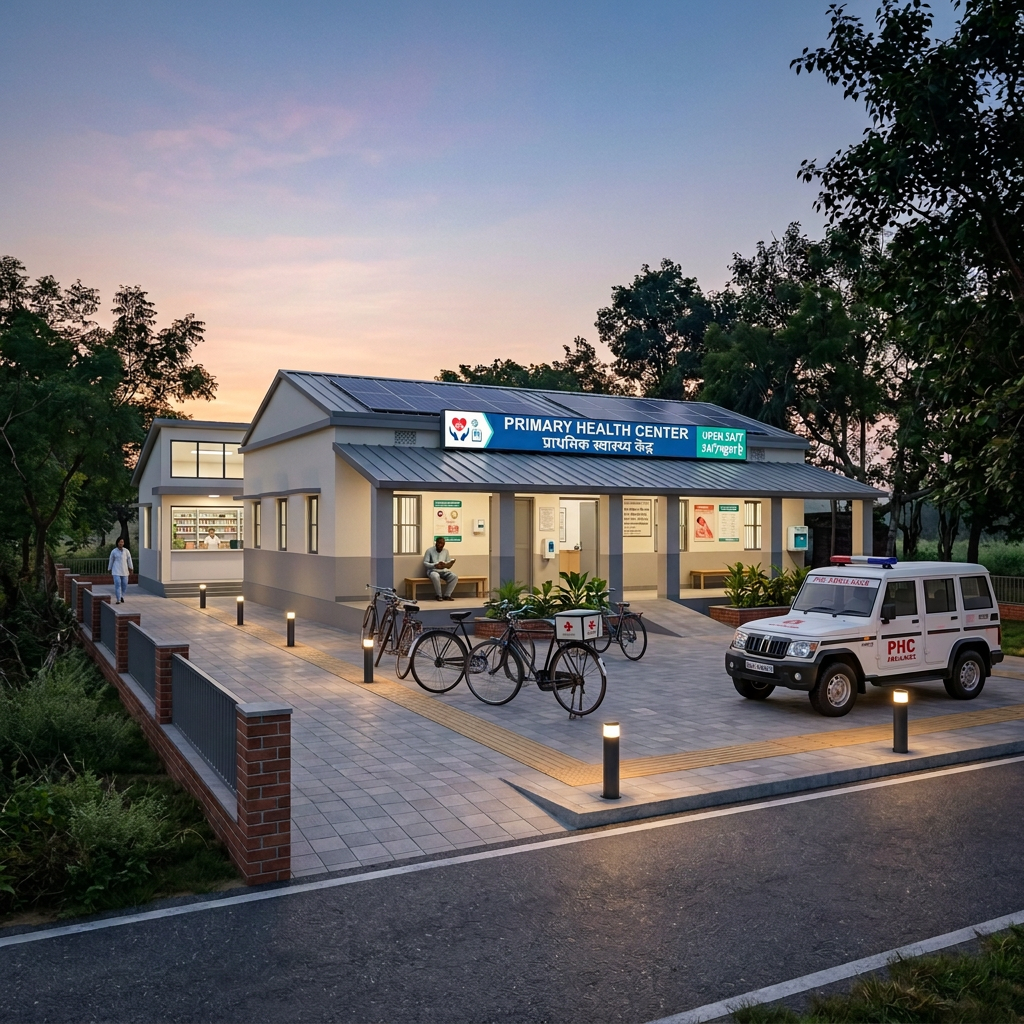
A government Primary Health Centre (PHC) may be only a few kilometres from a village, yet a patient may still travel farther to a private clinic. The reason may be simple: the doctor is unavailable, the required medicine is out of stock, or a diagnostic test cannot be performed. For the patient, the question is not whether a PHC exists on paper, but whether it works when care is actually needed.
India has built one of the world’s largest public primary-healthcare networks. The system has also changed significantly: the traditional PHC model has expanded towards comprehensive primary healthcare through Ayushman Arogya Mandirs, covering preventive care, maternal and child health, non-communicable diseases, mental health, elderly care, diagnostics and essential medicines. As of 14 September 2026, 1,87,108 Ayushman Arogya Mandirs were reported functional, including 24,511 PHCs.
Yet scale is not the same as access. Earlier research from rural Maharashtra found that communities often bypassed PHCs because of concerns about medicines, services and trust, while research from Rajasthan found that better-equipped PHCs were substantially more likely to be used.
As WHO Director-General Dr Tedros Adhanom Ghebreyesus has put it, investing in primary healthcare is the “most inclusive, equitable and cost-effective” path towards universal health coverage.
The real question, therefore, is simple: Has India’s primary healthcare policy successfully travelled from government policy documents to the everyday experience of patients?
India’s Primary Healthcare Network Has Expanded

Why Was the PHC Created in the First Place?
After Independence, India’s healthcare challenge was not only a shortage of hospitals. Distance, affordability and unequal access, especially in rural areas, were major barriers. The Bhore Committee (1946) proposed bringing healthcare closer to communities and combining preventive and curative care. It recommended the Primary Health Centre (PHC) as the basic unit of rural healthcare, with one PHC for about 40,000 people under its short-term plan.
The First Five-Year Plan adopted this approach, and the first PHC was established in October 1952 under the Community Development Programme. PHCs were expected to provide medical care, disease control, maternal and child healthcare, vital statistics, water supply and sanitation.
However, the Mudaliar Committee (1962) found many PHCs unsatisfactory and stressed strengthening existing centres before simply creating more.
This problem remains relevant. The National Health Mission (2005) again focused on infrastructure, human resources and decentralised healthcare. Later reforms expanded PHCs into comprehensive primary healthcare and Ayushman Arogya Mandirs.

What Does India’s PHC Policy Actually Promise?
India’s primary healthcare policy has gradually moved from a “treat illness” approach to a “keep people healthy” approach. The National Health Policy (NHP) 2017 focused on universal health coverage, preventive and promotive care, affordability, quality and financial protection. It aimed to provide free, comprehensive primary healthcare covering maternal, child and adolescent health, communicable and non-communicable diseases.

Who Actually Implements the Policy?
A health policy may be designed in Delhi, but its success is decided closer to the patient. “Public Health and Hospitals” are State subjects, so State and UT governments have the primary responsibility for healthcare delivery. The Union government, through the Ministry of Health and Family Welfare and NHM, provides policy guidance, technical support and funding. States submit Programme Implementation Plans (PIPs), which are approved through Records of Proceedings (RoPs).

The 17th Common Review Mission also highlighted the need for stronger public-health management. Ultimately, the challenge is not only making policy, but ensuring every level can implement it effectively.
How Much Does Primary Healthcare Receive?
A PHC cannot function on policy promises alone. It needs paid staff, medicines, working laboratories, maintained buildings and timely funds. Therefore, health financing is a key part of primary healthcare policy.

India’s primary healthcare system is mainly financed through the broader National Health Mission (NHM) rather than a separate PHC budget. In Union Budget 2026–27, NHM received ₹39,390 crore, up from ₹37,100.07 crore in 2025–26 (RE), an increase of 6.17%. The Ministry of Health and Family Welfare received ₹1,06,530.42 crore, while PM-ABHIM received ₹4,770 crore for health-system infrastructure.
Under NHM, most States follow a 60:40 Centre-State funding pattern, while Northeastern and certain hilly States generally follow 90:10. Union Territories without legislatures receive 100% Central funding. States submit Programme Implementation Plans (PIPs) based on local needs, which are then considered and approved by the Union government.
There is evidence of growing expenditure, but also a warning about how effectively that money is converted into services. The 17th Common Review Mission reported that the Centre had released ₹3.92 lakh crore under NHM up to FY 2024–25, including ₹32,997 crore in 2023–24 and ₹36,120 crore in 2024–25. It also stressed that timely and efficient utilisation remains essential for improving services and health outcomes.
A crore spent on a building does not automatically produce a functioning PHC. Similarly, a sanctioned post does not guarantee a doctor at the facility, and a budget for medicines does not guarantee that the required medicine will be available when a patient arrives.
There is also considerable variation between States. The 17th Common Review Mission, using National Health Accounts 2021–22 data for the States it reviewed, found government health expenditure ranging from 6.6% to 14.1% of total general government expenditure. This indicates that the fiscal priority given to health differs substantially across States.

Inside the PHC: Policy Meets the Frontline Worker
A health policy becomes real when a patient meets a health worker. Primary healthcare therefore depends on workforce, not infrastructure alone. PHC teams include Medical Officers, nurses, pharmacists and laboratory technicians, supported by ANMs, multipurpose workers, ASHAs and Community Health Officers. Yet the gap between required and available staff remains. Health Dynamics of India 2022–23 reported that rural PHCs required 25,354 doctors/medical officers against 41,931 sanctioned posts; 32,901 were in position, leaving 9,354 vacancies and a shortfall of 976 against the requirement.
The 17th Common Review Mission (2025) found uneven staffing, vacancies in remote and tribal areas and NCD screening gaps. Meanwhile, 5.23 lakh additional healthcare workers were engaged in FY 2023–24, including 1.38 lakh CHOs.
IPHS, revised in 2007, 2012 and 2022, sets standards for staff, infrastructure, equipment and services. The key question is not simply recruitment, but whether the right people with the right skills are available where patients need them.
How Does the Government Know Whether a PHC Is Working?
A government cannot improve what it cannot see. For primary healthcare, monitoring is therefore as important as funding and staffing. The government must know whether PHCs have the required staff, medicines, diagnostics, equipment and services—and whether patients receive quality care.
The Indian Public Health Standards (IPHS) provide the main benchmark. Introduced in 2007 and revised in 2012 and 2022, IPHS sets standards for infrastructure, equipment, human resources and essential services. A digital IPHS assessment tool and dashboard now help facilities identify and track gaps.
The latest data show both progress and concern. As of 6 March 2026, all healthcare facilities had undergone IPHS assessment, but only 63% scored above 50%. A facility is considered IPHS-compliant only at 80% or above.
The 17th Common Review Mission (2025) reviewed 17 States, examining services, HR, medicines, diagnostics, governance and digital health. It highlighted the need for better staffing, medicines, diagnostics, referrals, data quality, supervision and community participation.
Can the Patient’s Voice Travel Back Up the System?
India’s primary healthcare framework recognises community participation and patient feedback. The Rogi Kalyan Samiti (RKS) works at PHCs, CHCs and higher facilities to improve accountability, patient experience and community oversight. IPHS assigns it roles in patient feedback, grievance redressal, essential drugs and diagnostics, cleanliness and service quality.
IPHS also recommends patient-satisfaction surveys, social audits through RKS or Panchayati Raj Institutions, community surveys, Jan Sunwais and Jan Samvads, along with citizens’ charters and grievance mechanisms.
But recording a complaint is not enough. A medicine shortage, staff vacancy or equipment failure matters only when it leads to corrective action and later verification. The 17th Common Review Mission also stressed community participation, supportive supervision, better data quality and evidence-based decisions.
The goal is a continuous loop: The real challenge is ensuring that data travel upward and solutions travel downward.
The Implementation Gap
The first gap is between staffing norms and actual workforce. A PHC may have a doctor but lack nurses, pharmacists, laboratory technicians or trained staff for newer services. The 17th Common Review Mission found uneven staffing, especially in remote areas.
The second gap is between services promised and delivered. The AAM model includes NCD screening, mental health, elderly and palliative care, but implementation remains uneven, including gaps in elderly care and mental-health manpower.
The third is between infrastructure and functionality. By March 2026, all facilities had been assessed, but only 63% scored above 50%; IPHS compliance requires 80% or above.
Finally, there is an accountability gap: monitoring can identify problems, but timely corrective action is not always assured.
Has the PHC Policy Actually Worked?
The answer depends on what we mean by “worked.” India has made substantial progress in expanding primary healthcare, but implementation remains uneven.
As of 14 September 2026, 1,87,108 Ayushman Arogya Mandirs were functional, including 24,511 PHCs. Primary care now covers NCDs, mental health, elderly and palliative care, diagnostics and preventive services.
Health indicators have also improved. MMR fell from 130 per lakh live births in 2014–16 to 88 in 2021–23, while IMR declined from 39 per 1,000 in 2014 to 25 in 2023. Institutional deliveries increased from 78.9% in NFHS-4 (2015–16) to 90.6% in NFHS-6 (2023–24), while four or more ANC visits rose from 51.2% to 65.2%.
Financial protection improved too: government health expenditure rose from 29% to 48% of total health expenditure (2014–15 to 2021–22), while OOPE fell from 62.6% to 39.4%.
However, these improvements cannot be attributed to PHCs alone. Staffing gaps, uneven facility readiness, medicine and diagnostic shortages, referral problems and State-level variation remain.
Conclusion
India’s primary healthcare story is neither a failure nor a finished success. It is a story of institutional expansion followed by an increasingly difficult implementation challenge.
The country has moved from the original PHC model towards comprehensive primary care. More than 1.87 lakh Ayushman Arogya Mandirs are reported functional, with a much wider range of services than earlier PHCs.
Health outcomes have also improved. MMR fell from 130 to 88 per lakh live births, while IMR declined from 39 to 25 per 1,000 live births over the periods reported by the government. However, these gains cannot be attributed to PHCs alone; they reflect the combined impact of several programmes and wider social changes.
The next challenge is not simply building more facilities, but ensuring they are staffed, supplied, monitored and connected to higher levels of care while listening to citizens.
Ultimately, a PHC succeeds not when its building is open, but when patients can trust that the right care will be available when they need it.
Author

Make Tatvita one of your preferred sources
See more insights from Tatvita Analysts in your Google Search results.


Leave a Reply