
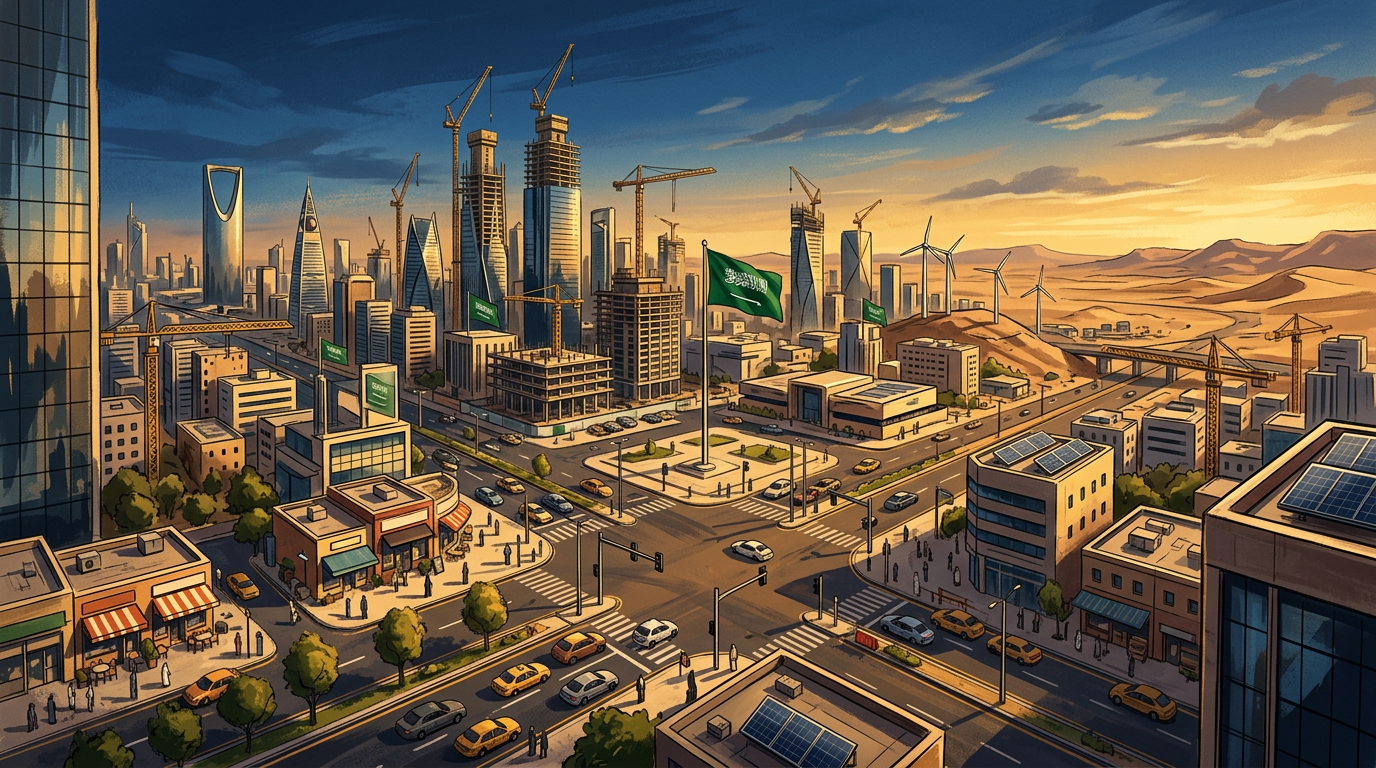
Economists rarely get a clean experiment. In 2026, Saudi Arabia got one. After the US and Israeli strikes on Iran on 28 February disrupted shipping through the Strait of Hormuz, the Kingdom’s crude exports were squeezed through a bottleneck that normally carries around a fifth of the world’s oil and gas.
The result was the sharpest contraction in the Saudi economy since the pandemic: real GDP fell 4.8% year on year in the second quarter, and oil activity alone dropped 24.7%, subtracting 5.4 percentage points from headline growth, more than the entire contraction. Strip oil out and the economy still grew. A decade into Vision 2030, that is the question worth asking: not whether Saudi Arabia has diversified its output, but whether it has diversified the thing that actually pays the bills.
The case for transformation is real, and it is not trivial. When Vision 2030 launched, non-oil activity made up roughly 45.4% of real GDP; by the first half of 2025 it had reached 55.6%, and the Finance Ministry now puts it at a record 57.3% for the first half of 2026. The fiscal side moved too. Non-oil government revenue rose from SR166 billion in 2015 to SR505 billion in 2025, roughly a threefold increase, which means the state is no longer funding itself purely from the wellhead.
Small and medium enterprises now contribute almost 23% of the economy, above the Vision 2030 target, with 935 of 1,290 activated initiatives completed, and unemployment among Saudi nationals fell to 6.5% in the second quarter.
Foreign capital has taken notice as well: Gulf News reports FDI inflows of $35.5 billion and more than 700 firms establishing regional headquarters in the Kingdom. Even in the worst quarter of the war, the IMF credited the economy with agility, and the third quarter showed non-oil activity accelerating to 1.9% year on year, with the non-oil purchasing managers’ index at 55.3 in September.
But the headline numbers deserve a second reading, because part of the improvement is arithmetic rather than achievement. The “record” non-oil share of 57.3% was set in a half-year when oil output was collapsing; when the denominator shrinks, the other slice grows as a proportion even if it does not grow much in absolute terms. And in absolute terms, the non-oil economy was not roaring. Non-oil activity grew 0.6% in the second quarter on the flash estimate, and one analysis of the full release argued that this growth was narrow and leaned heavily on the state. The third quarter interestingly complicates that story: government activity contracted 2.7% while non-oil activity still expanded, which is at least suggestive of private-sector momentum. The honest reading is that the evidence is mixed, and one or two quarters under wartime conditions cannot settle it.
What can be said with more confidence is that the non-oil economy remains tethered to oil by money, if not by molecules. PwC’s modelling finds that a 10% change in oil prices is associated with roughly a 0.5% change in non-oil GDP, and that a sustained 10% price decline could cost around SR430 billion in cumulative non-oil output over three years. The transmission channel is the government: when hydrocarbon revenue weakens, public spending, contracts and wages are what adjust, and these are the demand that much of the private sector sells into.
The 2027 pre-budget statement shows the same dependence from the other side, with expenditure of SR1.39 trillion against revenue of SR1.20 trillion, a deficit of 3.6% of GDP, and continued borrowing through bonds, sukuk and loans. Non-oil revenue has tripled, yet the state still spends well beyond what it collects. Nor is the export base yet a second engine: non-oil exports were just over 22% of non-oil output in 2025, and PwC itself argues that export competitiveness will define the next phase of growth.
An economy that produces more things but sells most of them to itself, with the government as its anchor customer, has diversified its activity without yet diversifying its income.
The most telling evidence about sustainability, though, may be what Riyadh has chosen to stop doing. The giga-projects that defined the Vision 2030 imagination are being cut back. NEOM’s The Line, originally billed as a 170-kilometre linear city, has been scaled back to a 2.4-kilometre stretch that includes a World Cup stadium, and giga-project contract awards have fallen to $10.6 billion so far this year, extending a decline that began in 2024. The Public Investment Fund’s new 2026–2030 strategy will direct about 80% of its $925 billion portfolio into domestic investment, reorganised around six sectoral ecosystems, with delayed NEOM components described as off the “critical path” that now belongs to Expo 2030 and the 2034 World Cup. The fund is pivoting toward AI infrastructure, and the pressure to show returns is real: PIF’s average annual return between 2017 and 2024 was 7.2%, down from 8.7% at the end of 2023 after impairments.
The tourism ambition has been caught in the same recalibration; the incoming tourism chief inherits a target of 150 million visitors just as the projects meant to draw them are pared back.
There are two ways to read this retreat, and both are partly right. The optimistic reading is that this is what maturity looks like: a state that once spent to create demand is now allocating capital by return, which is precisely what a post-oil economy must learn to do. The sceptical reading is that the first phase of Vision 2030 was, in effect, a bet that oil-funded spending could seed industries that would soon stand on their own, and that the bet has proved more expensive and slower than planned. The IMF’s earlier guidance, as summarised by one Gulf analysis, was that PIF interventions should stay targeted and temporary to avoid crowding out private investment, and that advice makes sense only if the private sector is ready to take over. That is the unresolved part.
Saudi Arabia also looks better placed than its neighbours to ride out the shock. The IMF projects the Kingdom to be less affected than several Gulf producers because of its more diversified export routes, forecasting a 3.3% contraction in 2026 and a rebound of 7.9% in 2027, though even the pipeline route to the Red Sea has not restored exports to pre-war levels. The coming rebound will be flattering, because oil volumes returning will lift headline growth mechanically. That is exactly why the rebound will be a poor test. The better test is what happens to the non-oil economy once oil recovers and the fiscal pressure eases: does the private sector keep growing without a spending impulse, or does it, as the PwC coupling suggests, ride up and down with the oil price?
So is the Kingdom building a sustainable economy beyond oil?
The fairest answer is that it has built an economy beyond oil output but not yet beyond oil revenue. The composition of GDP has changed in ways that are measurable and probably durable: a larger non-oil base, more non-oil taxes, more Saudis in work, and more firms with a regional headquarters in Riyadh. What has not changed is the source of the surplus that funds the system.
Three indicators will tell us when it does: whether non-oil revenue closes the gap with spending without further borrowing, whether non-oil exports climb meaningfully above their current share of non-oil output, and whether private-sector growth holds up in a year when government spending is flat.
Until those move, Vision 2030 is best described not as a finished transformation but as a transition that has survived its first real stress test, bruised, and with the harder half of the exam still ahead.
Author

Make Tatvita one of your preferred sources
See more insights from Tatvita Analysts in your Google Search results.

Leave a Reply