
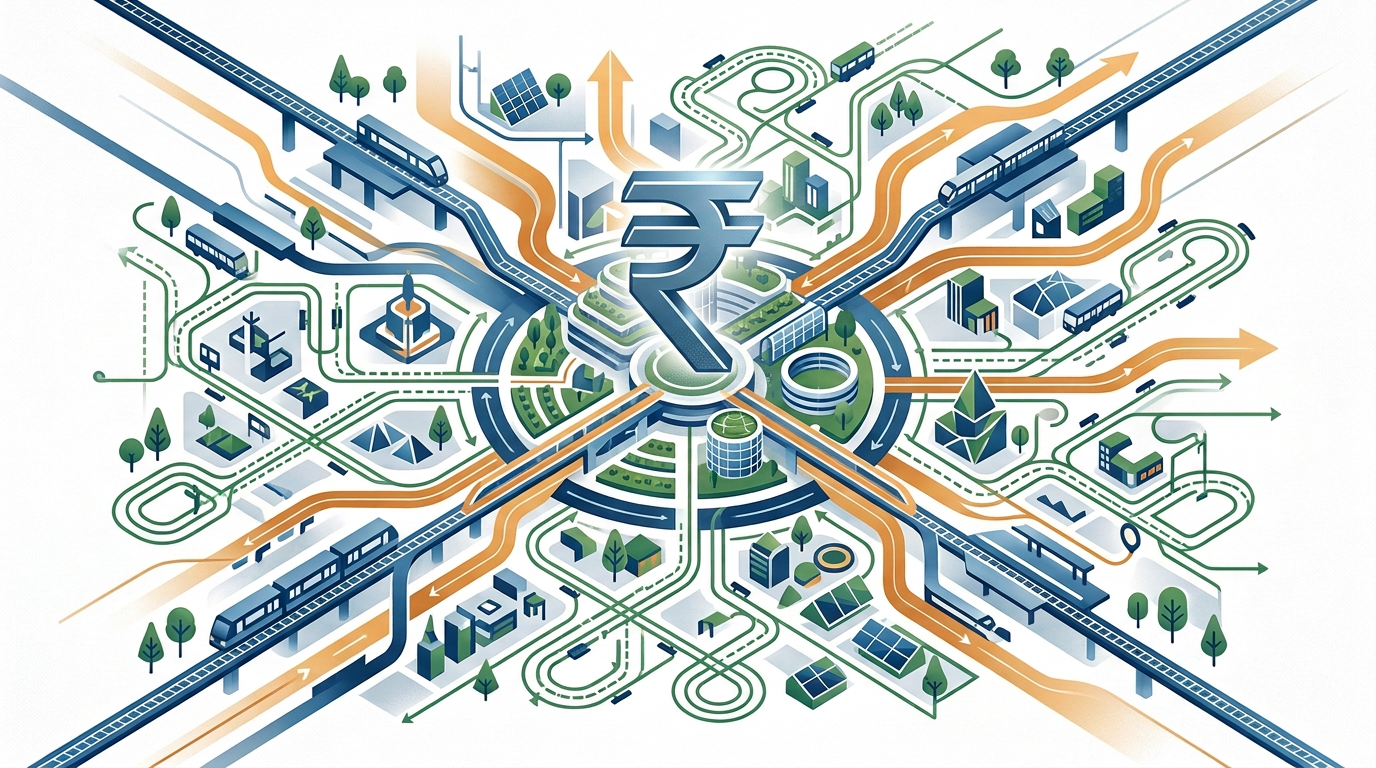
Every day, millions of Indians depend on buses, metros and autorickshaws to reach their workplaces, educational institutions and essential services. Yet behind every affordable ticket lies a difficult economic question: who pays the actual cost of keeping a city moving?
As India’s urban population expands, public transport systems face growing pressure to accommodate rising passenger demand while maintaining affordable fares, reliable services and financial stability.
Cost of Urban Mobility
India’s investment in urban mobility has increased substantially. According to the Ministry of Housing and Urban Affairs (2026), the country’s operational metro and Regional Rapid Transit System (RRTS) network expanded from 248 kilometres in 2014 to approximately 1,096 kilometres by early 2026. Average daily ridership also increased from 28 lakh in 2013–14 to 1.15 crore in 2025–26.
However, expanding infrastructure does not automatically guarantee financial sustainability. Rising operational expenditure, infrastructure maintenance, labour costs and regulated fares continue to complicate transport financing. In states such as Maharashtra, labour relations and fare-setting mechanisms introduce additional challenges in balancing transport workers’ livelihoods with passenger affordability.
This raises a fundamental question: should public transport be expected to generate profits, or should its success be measured by the economic and social value it creates? This article examines the financial challenges confronting India’s urban transport systems, the role of labour and regulatory frameworks, and lessons from international financing models to explore how cities can fund reliable mobility without making it unaffordable.
Why Public Transport Struggles Financially
Public transport systems face a fundamental economic challenge: balancing affordable fares with the high costs of providing reliable services. Unlike private businesses, public transport operators must consider social accessibility alongside financial performance. Their expenditure includes infrastructure maintenance, energy, employee salaries, fleet replacement and service operations. Many of these costs remain substantial even when passenger demand fluctuates.
A key indicator of financial performance is the farebox recovery ratio, which measures the proportion of operating expenditure covered by passenger fares. A ratio below 100% indicates that fare revenue alone is insufficient to finance operations. However, this does not necessarily imply economic inefficiency, since public transport generates benefits beyond direct ticket revenue, including reduced congestion, lower emissions and improved access to employment.
Raising fares may increase revenue per passenger but can also discourage ridership, particularly among price-sensitive commuters. Conversely, maintaining affordable fares can require government subsidies or alternative revenue sources. Financial sustainability therefore depends not only on recovering costs but also on securing predictable funding without compromising service quality.
India’s Public Transport Financing Challenge
India’s urban transport systems demonstrate how financial performance differs across transport modes.
The Delhi Metro Rail Corporation (DMRC) reported revenue of ₹4,600.62 crore from traffic operations and other operating activities in FY 2024–25, against corresponding expenditure of ₹4,187.83 crore, generating an operating surplus of ₹412.79 crore. However, after accounting for depreciation, financing costs and other activities, the corporation recorded a net loss of ₹1,597.81 crore (Delhi Metro Rail Corporation, 2025). This distinction illustrates how operational viability does not necessarily translate into overall accounting profitability.
Bengaluru’s bus system faces different challenges. The Comptroller and Auditor General of India (CAG, 2024) identified personnel and fuel costs as major components of BMTC’s operating expenditure, accounting for approximately 60% and 27%, respectively, during the audit period. The audit also highlighted inadequate reimbursement for concessional travel schemes and underutilised commercial assets. Approximately 62% of BMTC’s land remained vacant for over 15 years, suggesting missed opportunities for generating non-fare revenue.
These cases demonstrate that financial sustainability requires different strategies for rail and bus systems. While metro operators must manage substantial infrastructure-related financial obligations, bus operators face recurring expenditure pressures, fleet requirements, and service-coverage responsibilities. Both require reliable funding arrangements alongside improvements in operational efficiency.
Labour Relations and Regulatory Challenges: Evidence from Maharashtra
Labour regulation and fare-setting mechanisms are important institutional factors affecting transport financing in Maharashtra. The Motor Transport Workers Act, 1961, regulates working hours, rest intervals, weekly rest, overtime compensation, and welfare facilities for workers employed in covered transport undertakings (Government of India, 1961). These provisions establish employment standards that transport operators must incorporate into workforce planning and operating expenditure.
Autorickshaw operators face a different regulatory framework. Maharashtra’s Khatua Committee Report (2017) identifies fuel expenditure, vehicle maintenance, insurance, depreciation and drivers’ living costs as components of fare determination. The report also documents disagreements among stakeholders over earlier fare calculations, demonstrating the difficulty of balancing operator earnings with passenger affordability (Government of Maharashtra, 2017).
The state’s published autorickshaw tariff schedules further illustrate the role of regulated fares in determining operators’ earning opportunities (Motor Vehicles Department, Maharashtra, 2026). Consequently, transport financial sustainability requires more than controlling labour expenditure or increasing fares. It depends on transparent fare-setting mechanisms, adequate provision for employment costs and coordination between transport authorities, operators and workers.
How Other Cities Finance Public Transport
International experiences demonstrate that public transport financing can extend beyond passenger fares. Hong Kong’s MTR Corporation follows a Rail plus Property model, integrating railway development with commercial and residential property projects. Revenue generated through property development helps bridge infrastructure financing gaps and supports railway operations. This approach captures part of the economic value created by improved accessibility and increased development around transit stations (MTR Corporation, n.d.).
London follows a diversified financing approach. According to Transport for London (TfL), passenger fares generate approximately 60% of its operating income. Additional resources come from road-user charges, commercial activities, property-related income and public grants. TfL also receives government support for capital investment, including a £2.2 billion funding agreement covering 2026–27 to 2029–30.
These models offer two important lessons for Indian cities.
First, transport infrastructure can generate economic value beyond ticket sales, creating opportunities for commercial revenue and land value capture.
Second, predictable public financing can support long-term investment and infrastructure renewal. However, replicating these models requires effective urban planning, institutional coordination and transparent financial management.
Making Indian Public Transport Financially Sustainable
Achieving financial sustainability requires a combination of diversified revenue, predictable public support and improved operational efficiency.
Non-fare revenue generation offers one potential solution. Advertising, commercial leasing, station retail and transit-oriented development can supplement passenger fares. Land value capture mechanisms can also recover part of the increase in property values associated with improved connectivity. India’s Metro Rail Policy recognises land value capture and transit-oriented development as mechanisms for improving project financial viability (Ministry of Housing and Urban Affairs [MoHUA], 2017). However, their effectiveness depends on land availability, market demand and institutional capacity.
Predictable government funding is equally important. Public transport provides social and economic benefits that are not fully reflected in fare revenue. Therefore, targeted subsidies and transparent reimbursement arrangements can help maintain affordable services without undermining operators’ financial stability. The CAG (2024) specifically recommended adequate budgetary support and reimbursement for concessionary travel schemes operated by BMTC.
Operational efficiency represents the third component. Better route planning, improved bus utilisation, coordinated feeder services and integrated ticketing can strengthen ridership and resource allocation. However, cost reductions should not compromise service frequency, accessibility or safety. Financial performance must therefore be evaluated alongside reliability and passenger accessibility.
Ultimately, a sustainable financing framework should combine commercial income, accountable public expenditure and service improvements rather than depend exclusively on fare increases.
Conclusion
The financial evidence suggests that profitability alone cannot determine the sustainability of public transport. In FY 2024–25, Delhi Metro recorded an operating surplus of ₹412.79 crore from traffic operations and related activities, yet incurred an overall net loss of ₹1,597.81 crore (DMRC, 2025). Similarly, the CAG (2024) identified high operating costs, inadequate reimbursements and underutilised commercial assets as financial challenges for BMTC.
These findings highlight the need for policies that prioritise diversified non-fare revenue, timely subsidy reimbursements and efficient asset utilisation. State governments should also strengthen financial transparency and establish predictable funding mechanisms linked to service performance.
Ultimately, sustainable urban mobility requires a policy framework that balances fiscal responsibility with affordable, accessible and reliable public transport.
Author

Make Tatvita one of your preferred sources
See more insights from Tatvita Analysts in your Google Search results.

Leave a Reply