
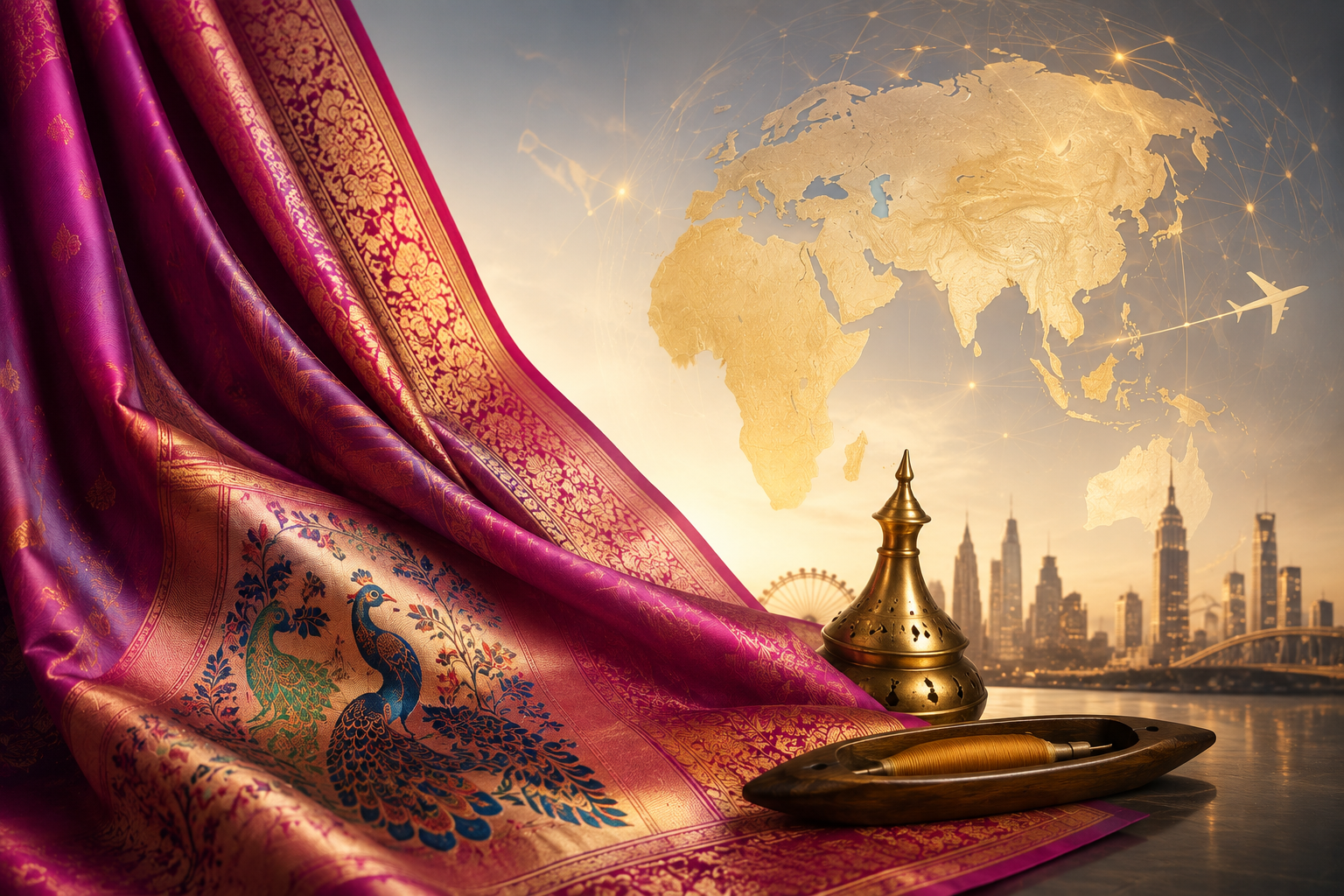
A Paithani saree is more than a piece of clothing. It is a story woven into silk and zari.
Known for its vibrant colours, intricate borders and traditional motifs such as peacocks, parrots, lotuses and flowers, Paithani is one of Maharashtra’s most distinctive handwoven traditions. The craft is closely associated with Paithan, while Yeola has developed into one of its most important production and trading centres. For thousands of weaver families, Paithani is not simply a luxury product it is a livelihood passed down through generations. Press Information Bureau – Paithani factsheet
Yet there is a striking gap between Paithani’s cultural importance and its international presence.
A saree can be admired as heritage, but becoming a successful export requires much more. Consumers need to recognise the product, trust its authenticity and understand why it deserves a premium price.
This raises an important question: Can Paithani move beyond its regional reputation and become a globally recognised luxury textile?
Heritage Is Paithani’s Biggest Advantage
Paithani’s greatest strength is its craftsmanship.
Unlike mass-produced textiles, an authentic Paithani represents skilled manual work, traditional techniques and knowledge passed from one generation to another. Its value comes not only from the silk and zari but also from the time, skill and cultural meaning behind every piece.
This gives Paithani an advantage in the luxury market. Luxury consumers often look for uniqueness, craftsmanship and a story. Paithani can offer all three.
Imagine an international customer buying a saree and being able to see where it was woven, how long it took to make, what its motifs represent and how the purchase supports artisans. The saree becomes more than clothing it becomes a piece of Maharashtra.
But heritage needs to be explained. Outside India and the Indian diaspora, many consumers may not know how Paithani differs from Banarasi, Kanchipuram or other Indian silk traditions. Without effective storytelling, Paithani could remain a regional treasure instead of becoming a global brand.
A GI Tag Helps, But It Cannot Build the Brand Alone
Geographical Indication (GI) protection can strengthen Paithani’s identity by connecting the product with its geographical origin and reputation. The official Intellectual Property India – Geographical Indications Register provides information on registered GIs and authorised users.
For Paithani, this can help distinguish genuine products from imitations and strengthen its connection with Maharashtra.
However, a GI tag alone will not create international demand. Many overseas consumers may not understand what a GI means, and it does not automatically ensure that artisans receive a larger share of the final selling price.
The Handloom Mark and India Handloom Brand can add another layer of credibility by communicating the handwoven nature and quality standards of products. Information on handloom initiatives and certification is available through the Development Commissioner for Handlooms.
Technology could make these certifications more meaningful. A QR code on a saree could show its place of production, materials, certification, artisan or producer details and care instructions. For a luxury product, transparency can itself become part of the brand.
Where Could Paithani Find Global Customers?
India already has a strong textile export base. According to the Ministry of Textiles’ 2025 review, India’s textile and apparel exports, including handicrafts, reached US$37.8 billion in 2024–25, with the United States, European Union and United Kingdom together accounting for 55% of exports. Ministry of Textiles – 2025 Review
These figures are not specific to Paithani, but they indicate where demand for Indian textiles already exists.
The United States and United Kingdom could be important markets because of their large Indian-origin populations and established demand for Indian clothing. Weddings, festivals, cultural events and luxury gifting provide natural opportunities.
The Gulf, particularly the UAE, offers another promising market. Dubai’s luxury retail environment, large Indian diaspora and strong wedding and occasion-wear segments could suit premium Paithani collections.
Europe presents a different opportunity. Consumers in countries such as Germany, France and Italy have strong interest in fashion, design and craftsmanship. Paithani’s handmade production and cultural story could appeal to this segment, although exporters would need to meet international requirements relating to product information, packaging, traceability and sustainability.
Broader trade trends can be explored through TradeStat – India’s Export Database and UN Comtrade. However, these databases generally classify products under wider textile and silk categories, so they cannot be treated as direct Paithani export figures.
Yeola: Where the Global Story Begins
If Paithani is to become a global luxury product, its story should begin in Yeola.
The journey from raw material to international customer involves several stages:
Silk and zari sourcing → Weaving → Finishing → Retailing → Exporting
Every stage affects the final price and the income received by the weaver.
The cost of silk and zari, the time required to weave a saree, availability of skilled labour and the role of intermediaries all matter. At the other end, branding, retailing, logistics and international marketing can significantly increase the final price.
Paithani sarees can range from approximately ₹15,000 to more than ₹5 lakh, depending on materials, design, craftsmanship and quality. Press Information Bureau – Paithani factsheet
This raises a crucial question: When a Paithani sells for a premium price in London or Dubai, how much of that value reaches the person who actually wove it?
For globalisation to benefit the craft, export growth must also improve the position of the artisans behind it.
Tradition and Modernity Can Coexist
Paithani does not have to choose between tradition and innovation.
The traditional saree should remain at the heart of the brand, but new products could introduce Paithani craftsmanship to consumers who do not regularly wear sarees. Scarves, jackets, stoles, bags, dresses and home décor using Paithani-inspired motifs could create additional markets.
The distinction should remain clear: an authentic traditional Paithani should be identified as such, while contemporary products should be presented honestly as Paithani-inspired.
Digital marketing can strengthen this approach. A good international website can combine detailed product information with photographs and short videos showing the weaving process. For Paithani, showcasing the craft is part of selling it.
The Road Ahead
Paithani faces genuine challenges. Its slow production process makes large orders difficult. High-quality materials increase costs. Small producers may struggle with working capital, export documentation, shipping and international returns. Machine-made imitations can also confuse consumers and weaken the position of genuine handloom products.
Most importantly, Paithani still lacks the international brand recognition enjoyed by several established luxury textile traditions.
The answer is not mass production. Paithani’s strength lies in being distinctive.
A better strategy would be to build a premium niche around weddings, cultural celebrations, luxury gifting, ethical fashion and heritage textiles. The United States, United Kingdom, Gulf markets and selected European countries could provide starting points.
Yeola could also be promoted as both a production centre and a cultural destination, allowing visitors to experience the weaving process and buy directly from artisans.
From Local Heritage to Global Luxury
Paithani already has what many new brands spend years trying to create: a story, a place, a distinctive identity and generations of craftsmanship.
What it needs is a stronger bridge between that heritage and the global consumer.
Better branding, transparent certification, digital storytelling, contemporary product development and improved market access can help build that bridge.
But there is one condition that should remain central: global success must create value for the people who preserve the tradition.
A Paithani should not become valuable only after it leaves Yeola.
If its heritage can be made visible, its authenticity verifiable and its artisans fairly rewarded, Paithani has the potential to travel far beyond Maharashtra not as a mass-produced fashion product, but as a distinctive Indian luxury textile with a story worth wearing.
Author

Make Tatvita one of your preferred sources
See more insights from Tatvita Analysts in your Google Search results.



Leave a Reply