
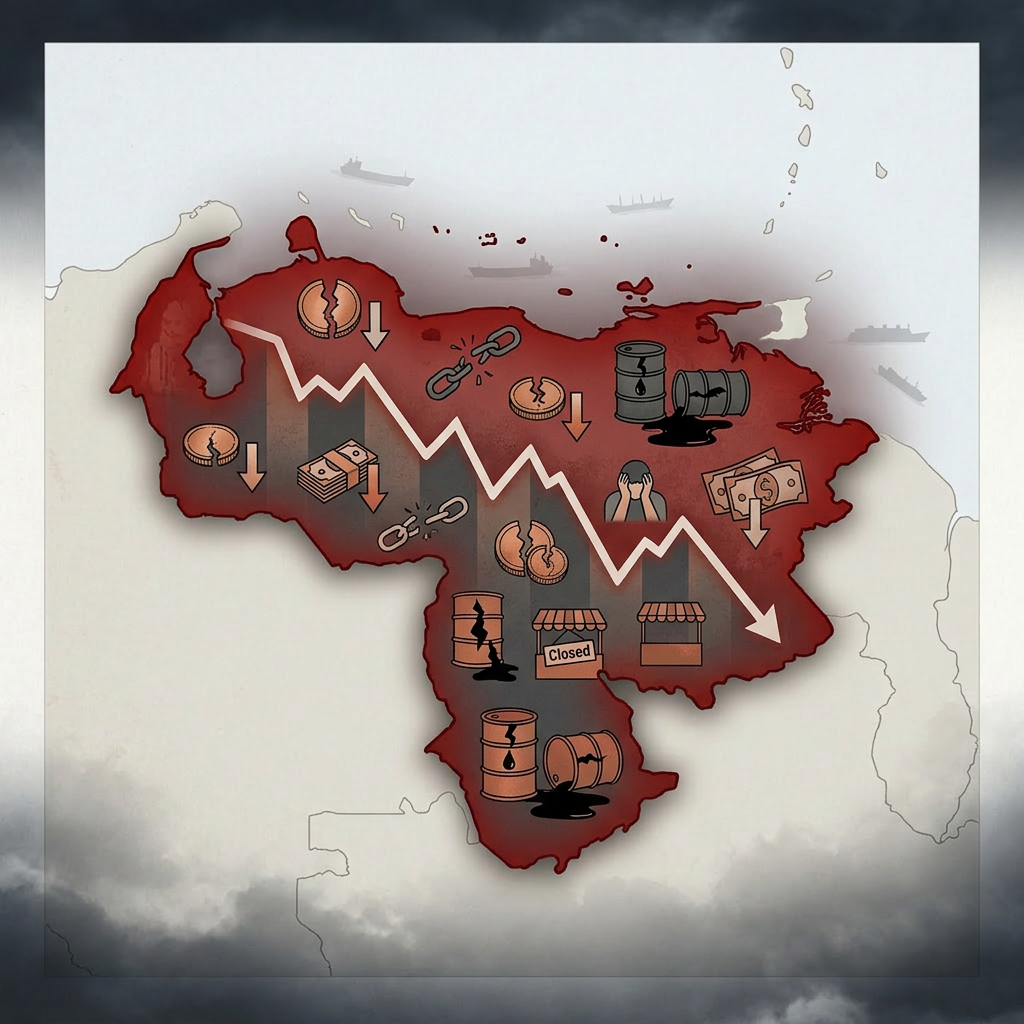
A Global Financial Crisis (GFC) is a severe disruption of financial markets characterized by collapsing asset prices, banking failures, liquidity shortages, and economic slowdown across countries. The 2008 crisis, triggered by the U.S. subprime mortgage collapse, remains the most notable example. In recent years, global instability has evolved into a broader “polycrisis” marked by post-pandemic inflation, supply-chain disruptions, geopolitical conflicts, and increasing economic fragmentation, creating significant challenges for developing economies.
Within this context, Venezuela represents one of the clearest examples of how global shocks can amplify domestic vulnerabilities. Once among Latin America’s wealthiest nations due to its vast oil reserves, Venezuela became heavily dependent on oil, which accounted for nearly 95% of export earnings.
The collapse of global oil prices after 2014 exposed this structural weakness, triggering a prolonged economic crisis marked by GDP contraction, hyperinflation, debt distress, and international financial isolation. As a result, Venezuela’s decline from an oil-rich economy to one facing severe economic hardship and mass migration serves as a cautionary example of the interaction between global financial instability and domestic policy failures.
This article examines how these factors combined to shape Venezuela’s economic trajectory.
CURRENT GLOBAL FINANCIAL CRISIS DYNAMICS
Current global financial dynamics are defined by a shift from the “easy money” era to high-interest rate environments. It is characterized by multiple overlapping crises rather than a singular shock.Global inflation surged post-pandemic due to supply disruptions and energy shocks. As the U.S. Federal Reserve and the European Central Bank hiked rates to combat post-pandemic inflation, capital fled emerging markets. Although it is expected to moderate to around 3–4%by 2026, monetary tightening has reduced global liquidity (IMF, 2025).
Simultaneously, capital flow volatility has intensified, with emerging economies experiencing currency depreciation and financial stress. The IMF’s 2024-2025 outlooks consistently warn of “fragmentation,” where trade blocks split along geopolitical lines. Venezuela, under heavy U.S. sanctions (specifically the 2017 and 2019 rounds), finds itself on the wrong side of this divide, forced to sell its “Merey” crude at steep discounts to “shadow markets” to maintain any semblance of cash flow.
VENEZUELA’S CONTEMPORARY ECONOMIC CONDITIONS
Internal Mismanagement: The “Original Sin” (Pre-2017)
Most economists argue that Venezuela’s collapse began well before the first broad US sanctions in 2017. The roots lie in the Chavista economic model.
- Nationalization of Industries: Over 1,000 firms were expropriated (2007–2015), causing capital flight and reduced private investment.
- Excessive Public Spending: Despite high oil revenues during 2004–2013, large fiscal deficits persisted.
- Money Printing & Hyperinflation: Financing deficits through monetary expansion led to hyperinflation, peaking above 1 million percent in 2018.
- Decline of PDVSA: The dismissal of thousands of skilled oil workers weakened the state oil company, causing falling production even before sanctions.
US Sanctions: The “Maximum Pressure” Era (2017–2026)
While mismanagement broke the engine, sanctions cut the fuel lines and removed the spare parts.
- Financial Sanctions (2017): Blocked Venezuela from restructuring its debt. This made it impossible for the country to find a legal way out of its $150 billion default.
- Oil Embargo (2019): This was the “nuclear option.” It cut off Venezuela from its primary cash customer (the USA) and prohibited the import of diluents (needed to process Venezuela’s heavy crude).
- Recent Escalation (2025-2026): Following the disputed 2024 elections and subsequent geopolitical friction, the US “Maximum Pressure 2.0” strategy has further targeted the “dark fleet” tankers, making it even harder for Venezuela to sell oil to its remaining allies (China/Iran).
Venezuela’s current economic condition
It reflects partial stabilization amid deep structural fragility.
- GDP: Around $82–85 billion (2025) with modest recovery (SECO, 2025)
- Inflation: Over 600% projected in 2026, after peaking above 300,000% in 2019 (Trading Economics, 2026)
- Debt: Approximately $150–170 billion, with ~180% debt-to-GDP ratio (IMF; Reuters, 2026)
IMPACT OF GLOBAL FINANCIAL CRISIS ON VENEZUELA
The impact of global financial crises on Venezuela is multi-dimensional, affecting not only the economy but also political stability, society, institutions, and sustainability.
Oil Price Volatility: The Single-Point Failure
Despite possessing the world’s largest proven oil reserves (over 300 billion barrels), Venezuela remains highly vulnerable to global oil price fluctuations. Economic slowdowns and energy transition trends reduced demand, causing oil production to fall from about 3 million barrels per day (1998) to around 800,000–900,000 bpd by 2024–26. Declining prices and underinvestment pushed the state oil company, PDVSA, into a prolonged crisis.
Currency Collapse and the Hyperinflationary Vortex
Falling oil revenues reduced foreign exchange earnings and widened fiscal deficits. To finance spending, the government relied heavily on money creation, resulting in one of the worst hyperinflation episodes in modern history and a sharp decline in the value of the national currency.
External Debt and Financial Isolation
Venezuela’s external debt exceeds $150 billion, and the country has remained in default since 2017. Political isolation has limited access to international financial institutions and debt restructuring mechanisms, deepening financial exclusion.
To cope with isolation, Venezuela adopted alternative mechanisms:
- Debt-for-Oil Deals: Oil exports are used to repay loans, particularly to China.
- Cryptocurrency Experiments: While the state-backed Petro failed, cryptocurrencies such as USDT have become increasingly important for international transactions and business activities.

THE ‘PESTEL’ IMPACT FRAMEWORK
1. Political Impact
Declining oil revenues weakened state capacity and political legitimacy, while U.S. sanctions increased financial isolation. In 2026, a shift towards conditional U.S. engagement and renewed diplomatic ties signaled a possible political reset. The use of “ghost tankers” and “dark fleets” to export oil also imposed a significant sanctions-related cost on Venezuela’s revenues.
2. Economic Impact
Overdependence on oil created a classic case of Dutch Disease, leaving the economy vulnerable when the oil sector collapsed. Key outcomes included:
- GDP contraction of 70–80% (2013–2020)
- Hyperinflation above 300,000% (2019)
- Public debt around 180% of GDP
Global oil price volatility severely undermined fiscal stability and contributed to one of the deepest peacetime economic crises in modern history.
3. Social Impact
Economic collapse triggered a humanitarian crisis:
- Over 8 million migrants since 2014
- Poverty exceeding 80%
- Widespread food insecurity and healthcare breakdown
Remittances now contribute 5–8% of GDP, making migration a key survival mechanism for many households.
4. Technological Impact
Financial isolation reduced access to foreign technology and investment, leading to declining oil-sector efficiency and infrastructure deterioration. At the same time, digital transactions and dollarization expanded as coping mechanisms. Lack of advanced oil technology has contributed to chronic fuel shortages.
5. Environmental Impact
The crisis weakened environmental governance, resulting in:
- Oil spills from deteriorating infrastructure
- Expansion of illegal mining
- Reduced regulatory oversight
Economic decline has therefore increased environmental risks and resource degradation.
6. Legal Impact
Institutional deterioration weakened the rule of law, contract enforcement, and judicial independence. Expropriation policies and political interference discouraged investment and further eroded economic confidence.
Overall, global financial shocks amplified Venezuela’s oil dependence, deepened economic and social crises, encouraged survival-based technological adaptation, increased environmental degradation, and reinforced legal and institutional fragility.
VENEZUELA’S POLICY RESPONSE
After years of rigid socialism, the government shifted to a form of “crony capitalism” or “authoritarian pragmatism.”
Initially, the response to the post-GFC decline was increased price and currency controls. This created a massive black market and incentivized corruption. However, by 2019, the Maduro administration performed a pragmatic “U-turn.”
- Informal Dollarization: The government stopped enforcing the ban on the U.S. dollar, allowing it to become the primary medium of exchange.
- Reduction of Subsidies: Long-standing fuel subsidies were slashed, bringing domestic prices closer to international rates.
- Monetary Discipline (Tentative): The Central Bank of Venezuela (BCV) attempted to stabilize the exchange rate by injecting dollars into the banking system, a move highly dependent on erratic oil revenues.
“Venezuela is not healing; it is merely being sedated by an informal dollar economy that leaves the bottom 80% of the population behind.” — Ricardo Hausmann, Harvard Center for International Development (Paraphrased).
LESSONS LEARNT
- The Resource Curse is Real: Overdependence on a single commodity (oil) without a stabilizing fund (like Norway’s) is economic suicide in a volatile global market.
- Populism vs Sustainability Trade-off: Short-term welfare policies (subsidies, free services) created Fiscal burden, Dependency culture, Political legitimacy without economic foundation.
- Economic Mismanagement Can Trigger Humanitarian Crisis: Economic policy failures can escalate into human security crises
- Institutions Matter More than Assets: Gold and oil are useless if the Central Bank lacks independence and the judiciary cannot enforce contracts. Monetary policy must remain independent and rule-based, not politically controlled
- Monetary Expansion has Limits: Using the printing press to solve fiscal deficits in an environment of low productivity inevitably leads to hyperinflation.
- Global Integration is Double-Edged: Integration exposes countries to shocks. But isolation worsens crisis recovery. Countries need managed integration with safeguards
“The Venezuelan crisis demonstrates that economic collapse is rarely the result of a single shock; rather, it is the cumulative outcome of structural weaknesses, policy misjudgements, and institutional failures interacting with global financial volatility.”
Conclusion
Venezuela’s experience illustrates how global financial crises can magnify domestic weaknesses, turning external shocks into prolonged economic collapse. While oil price volatility and financial tightening triggered the crisis, overdependence on oil, weak institutions, and policy failures deepened its impact. The consequences are hyperinflation, debt distress, economic contraction, and mass migration, highlight the costs of structural mismanagement.
Recent diplomatic engagement and partial sanctions relief offer opportunities for recovery, but progress remains fragile. Sustainable stability will require institutional reforms, economic diversification, and stronger integration with the global economy.
Ultimately, Venezuela serves as a cautionary tale that resource wealth alone cannot ensure prosperity; long-term resilience depends on sound governance, prudent economic policies, and effective global engagement.
Author

Make Tatvita one of your preferred sources
See more insights from Tatvita Analysts in your Google Search results.



Leave a Reply