
Every time you buy a phone recharge, eat at a restaurant, or pick up a bottle of shampoo, a part of that price goes into a system not many people think about. In India, that part is GST. In Singapore, it is also called GST. In Germany, it is VAT. In the United States, it might not exist at all, or it might change depending on which side of a city street you are. The receipt in your hand looks almost identical everywhere, but the philosophy behind how much is taken, from whom, and what it buys back tells you more about a country’s economic character than almost any other single number.
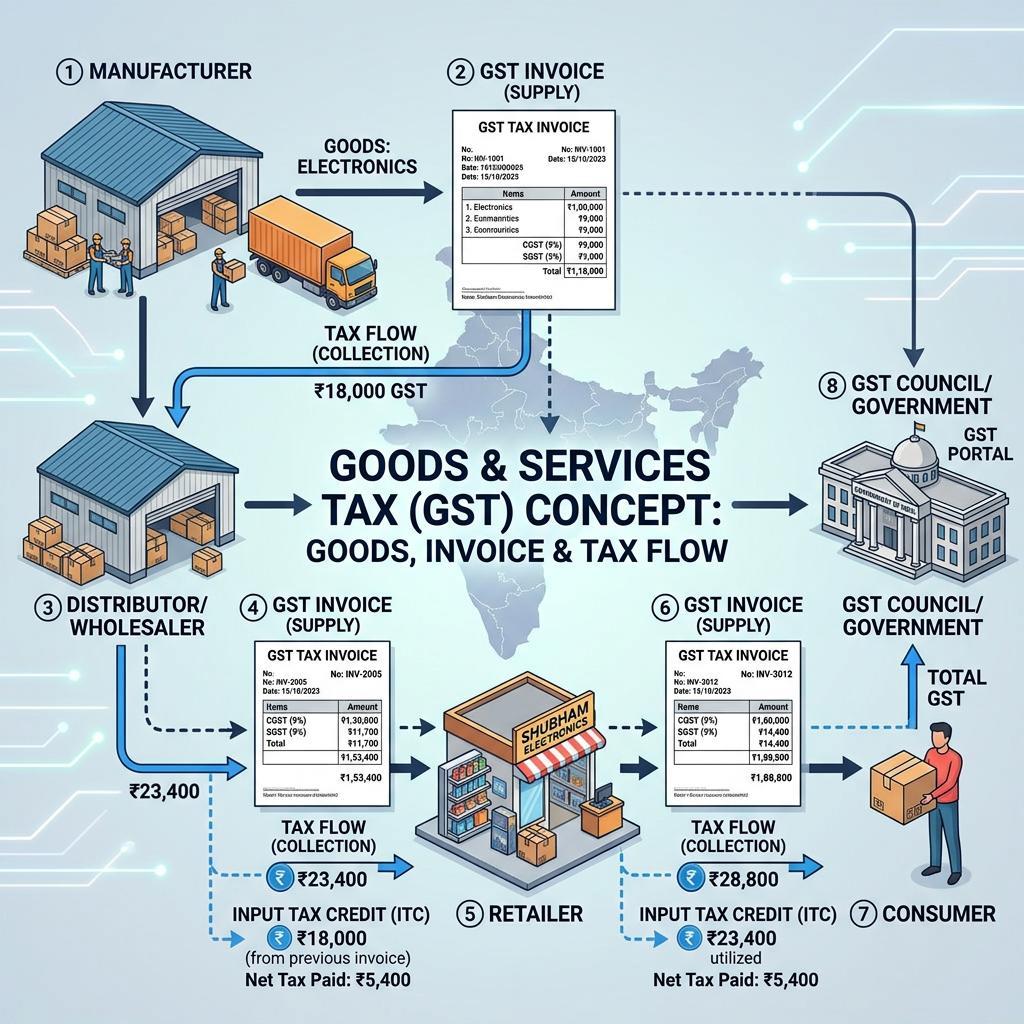
GST, or Goods and Services Tax, is a consumption tax charged at each stage of the supply chain, but designed so that only the “value added” at each stage is taxed, with businesses able to claim credit for the tax they already paid on their inputs. Before India adopted this model on July 1, 2017, the country ran on a separate central and state levies excise duty, service tax, VAT, octroi, entry tax each state effectively behaving like its own economic territory. The pre-GST system subsumed 17 different taxes and 13 cesses into one unified levy, which is the kind of number that sounds abstract until you remember that every one of those 17 taxes meant a separate filing, a separate rate, and a separate opportunity for a truck full of goods to get taxed twice on its way from Maharashtra to Gujarat. GST’s founding promise was “one nation, one tax,” collected through a dual structure of Central GST and State GST on transactions within a state, and Integrated GST on transactions that cross state lines.
Eight years in, the numbers suggest the promise has partly been delivered. The taxpayer base has grown from 66.5 lakh registered businesses in 2017 to 1.51 crore in 2025, and annual gross collections crossed ₹22.08 lakh crore in FY 2024-25, doubling in just four years at a compound growth rate of 18%. The monthly run rate has been holding remarkably firm through 2026 June 2026 collections came in at ₹1,94,812 crore, up 13.9% year-on-year, with April 2026 setting an all-time monthly high of ₹2,42,434 crore. But the structure carrying that revenue has always been more complicated than “one tax” implies. For years, India ran four major slabs 5%, 12%, 18%, and 28% plus a compensation cess on top of the highest bracket for so-called sin and luxury goods. The complexity produced genuinely absurd disputes, the most famous being whether popcorn should be taxed at 5%, 12%, or 18% depending on how it was packaged and flavoured.
That changed in September 2025, when the GST Council approved what is now being called GST 2.0. The Council collapsed the four-slab structure down to two primary rates 5% and 18% while introducing a new 40% rate reserved for luxury and sin goods such as pan masala, tobacco, aerated drinks, premium cars, and private aircraft. The reform took effect on September 22, 2025, and its stated logic was straightforward: reduce classification disputes, lower the effective tax burden on everyday goods, and hand consumers what the government explicitly called a “Diwali gift.” In practice, this meant items like soap, toothpaste, packaged food, life and health insurance premiums, and Indian breads either dropped to 5% or were exempted entirely, while consumer durables like televisions, refrigerators, air conditioners, and small cars moved down from 28% to 18%. Economists at the time projected the reform could lower headline retail inflation by up to 1.1 percentage points, while also warning of a possible short-term revenue gap estimated at around ₹48,000 crore, a bet that higher consumption and better compliance would eventually close.
This is the part of the story that a comparative lens makes genuinely interesting, because India’s two-and-a-half slab structure sits between two very different philosophies practiced elsewhere.
Take Singapore, often cited as the tidiest consumption tax model in the world. Its GST is a single flat rate applied almost universally 9% as of 2026, up from 3% when it was introduced in 1994, with no maze of slabs to classify goods into. The revenue this single rate generates is substantial relative to the country’s size: in FY2024, GST brought in S$20 billion, making it the second-largest source of tax revenue after corporate income tax, at 22.6% of the S$88.9 billion IRAS collected that year, up from S$16.6 billion the year before. That total tax haul itself works out to roughly 77% of the government’s entire operating revenue, which tells you how central taxation is to how the city-state funds itself, given it has no natural resource wealth to fall back on. What makes Singapore’s model instructive isn’t just the simplicity or the scale, though it’s the explicit, almost transparent link between the tax rate and what it funds. When the government raised GST from 7% to 9% over 2023 and 2024, it stated plainly that the additional revenue would go toward healthcare spending and support for its ageing population, noting that by 2030 roughly one in four Singaporeans will be 65 or older, up from one in six in 2024. Singapore also runs permanent offsets for the tax’s regressive nature: the government absorbs GST on publicly subsidised healthcare and education and layers on cash transfers, MediSave top-ups, and utility rebates targeted at lower- and middle-income households. In other words, Singapore doesn’t pretend GST is painless for poorer citizens; it taxes broadly, collects efficiently, and then compensates narrowly.
Germany offers a contrasting middle path, common across the European Union. Its VAT runs on a standard rate of 19%, alongside a reduced 7% rate for categories the state has decided deserve protection basic groceries, books and newspapers, cultural and sporting events, and (from January 2026) restaurant and catering food services, a change explicitly designed to keep German restaurants competitive with neighbouring countries that already tax hospitality more lightly. The scale of what this single tax generates is enormous: turnover tax (Germany’s VAT, including import VAT) brought in €310.2 billion in 2025 out of total nationwide tax revenue of
€989.8 billion, making it, on its own, the single highest-yielding tax category in the entire German system, ahead of even wage tax. Framed as a share of the total, VAT typically accounts for close to a fifth of Germany’s tax revenue, behind only social contributions and personal income tax. Germany’s 19% standard rate sits roughly in the middle of the EU pack, where rates range from 17% in Luxembourg to 27% in Hungary. The German model reflects the EU’s broader instinct: a high headline rate that funds an extensive welfare state, softened by a permanent reduced-rate carve-out for necessities, rather than the periodic, politically negotiated rate cuts India has just gone through. Notably, German policymakers are now debating the reverse of India’s recent move. Reports have floated raising the standard rate from 19% to 21% specifically to fund cuts in labour taxes, a reminder that shifting the tax burden between consumption and income is a live policy lever everywhere, not just in India.
Laid side by side, the four systems reveal genuinely different tradeoffs rather than a simple hierarchy of “better” and “worse.” On revenue efficiency, Singapore’s single-rate model minimises the classification disputes that plagued India for years; nobody in Singapore needs to argue about whether a snack counts as “packaged” or “fresh.” India’s own popcorn dispute has now effectively been legislated away by GST 2.0’s slab collapse, but the country still carries more structural complexity than Singapore by design, partly because a federal system with 28 states negotiating revenue shares cannot easily converge on Singapore’s centralised simplicity. On compliance cost, the US arguably imposes the heaviest burden of all four systems on businesses that operate across state lines, precisely because there is no unifying national framework. A business selling nationally must track thousands of jurisdiction-specific rates and exemptions, something no VAT or GST country asks of its firms. On the question of regressiveness the well-documented problem is that consumption taxes take a larger share of income from poorer households, since everyone pays the same rate on a loaf of bread regardless of income every system studied here builds in some offset. India exempts and zero-rates a wide basket of essentials, Singapore pairs its GST directly with targeted rebates,
Germany maintains a permanent reduced rate for necessities, and several individual US states simply exempt groceries and medicine outright.
What ties all of this back to the reader is the same question in every country: what do you get for what’s taken? Singapore’s answer is explicit and almost contractual a higher GST rate, openly justified as the price of an ageing population’s healthcare needs. Germany’s answer is embedded in a wider European social contract, where a relatively high VAT rate coexists with universal healthcare, subsidised education, and generous unemployment protections.
India’s answer is still being written; GST revenue funds everything from infrastructure to welfare schemes to defence, but unlike Singapore, India has not tied a specific rate change to a specific promise in the same transparent way. The nearest thing to that promise is GST 2.0 itself, a bet that lower rates on daily essentials would loosen household budgets enough to lift consumption, formalise more of the economy, and eventually recover the short-term revenue gap through volume rather than rate. Whether that bet pays off will show up first in the same monthly collection data that has, so far through 2026, kept surprising economists on the upside.
For a country that spent seventeen years debating how to build a single tax before finally launching it in 2017, and then spent eight more years discovering that “single” and “simple” are not the same thing, GST 2.0 is less a finish line than an admission that tax design is never really finished. Singapore has revised its rate five times since 1994. Germany’s finance ministry is already floating a possible 2027 VAT reform that would raise rates while zero-rating basic food. The US, true to form, will likely keep doing nothing at the federal level and leave the patchwork to the states. India’s own next move whether petrol, diesel, and electricity ever enter the GST net, a debate that has been deferred since 2017 will decide whether “one nation, one tax” becomes something closer to reality, or remains the aspiration it was always destined to be an ongoing negotiation toward.
Author

Make Tatvita one of your preferred sources
See more insights from Tatvita Analysts in your Google Search results.



Leave a Reply