
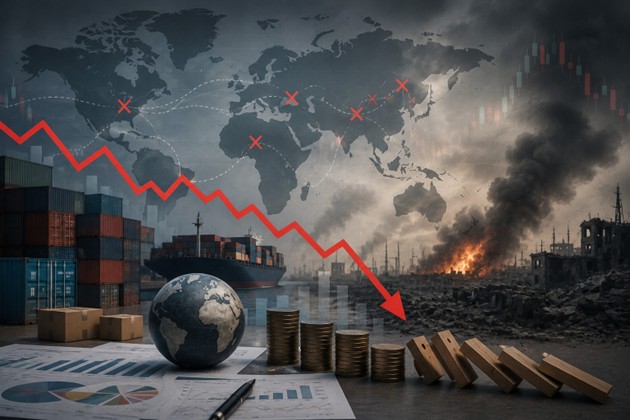
War has always been more than just a military event; it is also a trade shock. During World War I, global trade is estimated to have fallen by about 25%. At the same time, World War II drove a far deeper collapse as many economies shifted towards war production and international commerce was severely fragmented.
In today’s economy, trade is not just the exchange of finished goods but a dense web of supply chains, just-in-time manufacturing, commodity flows, and shipping networks that connect firms and consumers across borders.
When conflict breaks out, it can disrupt ports, routes, finance and supplier relationships at once, creating effects that go far beyond the battlefield. This article argues that armed conflict does not merely destroy infrastructure and lives; it reshapes the architecture of global commerce, sometimes permanently.
It examines seven linked themes: supply chain disruption, commodity price spikes, sanctions, trade realignment, the human cost, and the long road to recovery
Disruption of Supply Chains & Shipping Routes
Wars can disrupt trade by blocking important routes such as straits, ports, railways, air corridors, and land routes. Even the closure of one major chokepoint can create ripple effects across the global economy because so many countries depend on these pathways for essential goods. During conflict, war-risk insurance also becomes much more expensive, which raises shipping costs and can make trade unprofitable even when routes remain technically open.
These disruptions break supply chains at multiple levels. Factories may lose access to raw materials, components, and semi-finished goods that are needed for production. When one link in the chain is damaged, the effects spread quickly to other businesses and countries. This is known as the bullwhip effect where a small disruption at the start of the chain turns into a much larger shortage later because firms begin over-ordering to protect themselves. As a result, prices rise, deliveries slow down and uncertainty increases.
Even countries far from the conflict can be hit hard if they depend on imports or foreign transport networks. Landlocked and import-dependent nations are especially vulnerable. In the long run, wartime disruptions often push countries and firms to adopt alternative routes, suppliers, logistic systems and some of these changes remain even after the war ends. Historical examples such as the Suez crisis, the gulf war and the Ukraine war show how quickly global trade can be redirected or interrupted.

Commodity and energy prices shocks
Commodity and energy markets are often among the first places where war is felt. Prices rise quickly because of three forces happening together: fear that supply will be cut off, speculative trading by market participants and the real physical disruption of production and transport. When a conflict takes place in a resource-rich or strategically import region, the price effect can be much larger than the conflict itself because global markets react to the risk of future shortages, not just current losses.
High energy prices spread through the whole economy. Manufacturing becomes more expensive because factories need fuel and electricity. Freight costs also rise because shipping, trucking and air transport all depend on energy.
In agriculture, the impact is even broader, since fertilizers, pesticides, irrigation and machinery all become costlier. These shocks often encourage speculations and prices can rise beyond what the actual shortage justifies, creating artificial scarcity and increasing profits for traders while hurting consumers.

The burden is not shared equally. Developing countries and import-dependent economies are usually hit hardest because they have less protection against price jumps and fewer policy tools to absorb them. Even after the war stops, prices may stay high for some time because markets need time to adjust and rebuild confidence. Historical examples such as the 1973 oil crisis, the 1990 Gulf war and the 20222 Ukraine war show how wartime shocks can push commodity prices sharply higher and keep them unstable for months or even longer.
Sanctions, Embargoes & Trade Policy Shifts
Sanctions and embargoes are often used as a form of economic warfare. Instead of relying on direct military force, states use trade and financial pressure to weaken or influence another government. These measures can include freezing assets, banning exports, restricting imports, excluding banks from international payment systems and imposing secondary sanctions on third countries that continue trading with the target state. In many cases, sanctions are introduced before, during or after armed conflict as part of a wider strategy to isolate the opponent.
The impact is often severe for ordinary people. Even when humanitarian exemptions exist on paper, shortages of food, medicine, fuel and other essential goods can still emerge because trade and payment channels become difficult to use. Third party countries are also affected when their firms lose markets, supply chains must be reorganized or diplomatic relations become strained. Sanctions can also trigger wider trade policy shifts as allied states raise tariffs or add new trade barriers against the adversary forcing a rapid realignment of trade relationships.
A useful distinction is between targeted sanctions and broad sanctions. Targeted sanctions focus on specific individuals, firms or sectors while broad sanctions affect the wider economy. Broad sanctions usually cause far greater trade disruption because they interfere with ordinary commercial activity, financial flows and access to imported goods.
Long-term Trade Realignment & Emergence of New Alliances
Wars often do more than interrupt trade for a short time but they can permanently redraw the map of global commerce. Trade relationships formed under pressure tend to last long after the war ends because governments and firms usually keep the safer routes, suppliers and partners they discovered during the conflict. In this way war becomes a powerful force for trade realignment and the creation of new alliances.
Two important strategies in this shift are friend-shoring and near-shoring. Friend-shoring means moving supply chains towards politically trusted countries while near-shoring means shifting production closer to home or to nearby regions. Both strategies reduce dependence on adversaries and lower the risk of future disruptions. They also encourage countries to rethink reserve currencies, payment systems and financial links which can slowly challenge the existing global economic order.
Neutral countries often benefit from this process. They may become new trade corridors, alternative suppliers or diplomatic middlemen when major powers stop trading directly with each other. At the same time war pushes many states to invest in import substitution meaning they begin producing at home, goods that were earlier imported from abroad. Over time, this can change the structure of industry and employment inside the country.
The long-term result is often a more fragmented global economy. Instead of one highly integrated market, trade may split into competing blocs. This can reduce the efficiency because countries lose the gains from cheapest global sourcing but it can also increase resilience against future geopolitical shocks. After World War II, the Bretton Woods system, the Marshall Plan and GATT built a new Western trade order. During the Cold War, global trade split into US-led and Soviet-led blocs. More recently the Ukraine war has accelerated Europe’s push for energy independence while India and China have increased imports of Russian oil showing how conflict can reshape trade ties for years to come.
The Human Cost – Food Security, Inflation & Economic Displacement
Trade disruption always has a human cost. When wars break supply chains, the effects quickly reach ordinary people through food shortages, medicine shortages, unemployment and rising poverty. Prices of basic goods often rise faster than wages so inflation works like a hidden tax on families especially those with low incomes. In import-dependent developing countries even a conflict far away can make food and fuel unaffordable once shipping routes, ports or payment systems are disrupted
The labour market also suffers. Export industries, logistics, tourism and manufacturing can lose demand or access to inputs which destroys jobs not only in war zones but also in countries connected through trade. The burden is rarely shared equally. Women, children, refugees and informal workers are often hit hardest because they usually have less savings, weaker job security and fewer safety nets. Recent global conflicts have shown that food insecurity rises sharply when trade is interrupted; in the 2022 Ukraine war, international agencies reported a major worsening of hunger across dozens of countries.
Historical examples show the same pattern. During World War I, the British blockade contributed to severe starvation in Germany. In the 1990s, sanctions on Iraq were linked to large
child mortality and shortages of essentials. These cases show that when trade collapses, the damage extends far beyond economics and becomes a direct threat to human survival.
War leaves behind more than destruction on the battlefield. It can break supply chains, push up commodity prices, trigger sanctions, redirect trade routes and create deep human suffering through hunger, unemployment and poverty. These effects do not stay separate; they reinforce one another. A blocked shipping lane can raise fuel costs, higher fuel costs can worsen inflation and inflation can then deepen poverty and food insecurity. In that sense the economic damage of war is usually wider and long-lasting than the fighting itself.
Real trade recovery depends on more than the end of shooting. A ceasefire is only the first step. For trade to normalize, sanctions often need to be lifted or eased, damaged infrastructure must be rebuilt, diplomatic channels must reopen and investors must regain confidence that commerce can happen safely.

History shows that this process is slow. After major conflicts, trade often takes 5 to 10 years to recover and in many cases it never fully returns to its old pattern. Some economies such as postwar Europe recovered faster with strong external support while others such as Bosnia, Iraq and Libya still show incomplete recovery many years later.
The main lesson is clear: the world needs stronger ways to measure and reduce the trade cost of war before conflict begins. Governments and international institutions should assess trade disruptions before military actions, improve humanitarian exemptions in sanction regimes and
invest more seriously in conflict prevention and diplomacy. In today’s hyper-globalized economy no war is truly local. Every conflict sends economic shockwaves across borders affecting markets, households and industries far from the battlefield. Policymakers, institutions and businesses must treat trade disruption as part of the true cost of war and not an afterthought.
Author

Make Tatvita one of your preferred sources
See more insights from Tatvita Analysts in your Google Search results.



Leave a Reply