
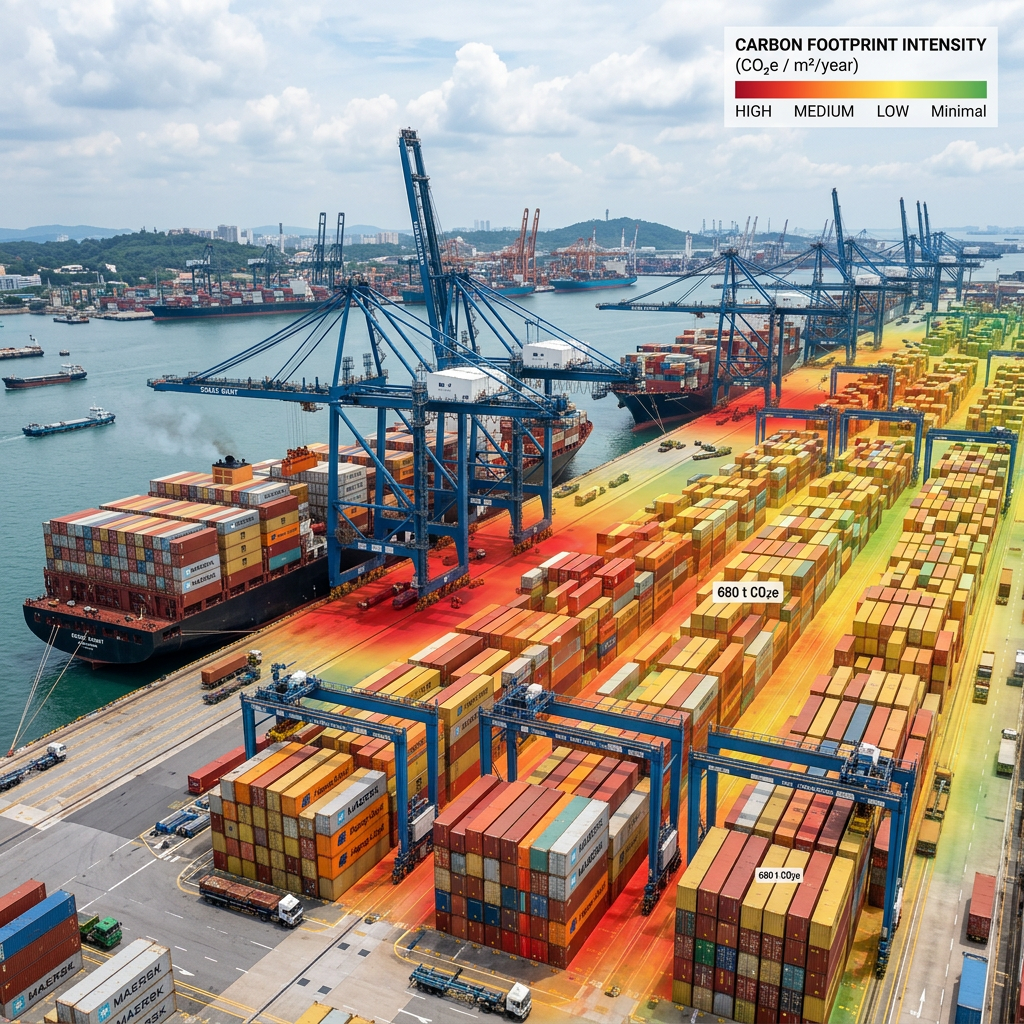
World trade is no longer restructuring itself just in terms of cost effectiveness or supply chains but is becoming conditioned by what was until recently a highly domestic constraint: carbon.
What is changing is not simply the price of goods, but the criteria by which goods are allowed to compete.
In this emerging system, production is evaluated not just by how cheaply it is done, but by how carbon-intensive it is and whether that intensity can be measured, verified, and priced.
The European Union’s Carbon Border Adjustment Mechanism (CBAM), operational in its compliance phase from 2026 is a rare financial phenomenon that embodies this change. It does not function like a traditional tariff. Rather, it incorporates carbon directly into the price system of trade, and competitiveness is re-defined in terms of emissions.
The EU’s Carbon Border Adjustment Mechanism (CBAM) is a climate policy tool designed to prevent “carbon leakage” by applying a carbon price to high-emission goods imported into the EU. Starting in 2026, importers must buy certificates to cover embedded emissions, aligning imported costs with the EU Emissions Trading System (ETS).
CBAM is part of the “Fit for 55 in 2030 package”, which is the EU’s plan to reduce greenhouse gas emissions by at least 55% by 2030 compared to 1990 levels in line with the European Climate Law.
Under the EU Emissions Trading System, companies have to buy allowances to emit each tonne of CO 2. The price of this carbon has been stable over the last few years, ranging between approximately €70-100 per tonne of carbon, with the certificate prices linked to CBAM being approximately €75 per tonne at the beginning of 2026. For carbon-intensive sectors, this is not marginal.
Carbon pricing would increase the cost of steel production by between €80 to 120 per tonne, and the production cost of cement and aluminium by €5-20 overall. The issue was that this expense was only special to local manufacturers. There was no corresponding pricing of imports entering the EU market which are usually produced with more emissions. This formed two distortions:
- EU companies were fined due to decarbonisation
- Emissions risked relocating rather than declining globally
The EU first responded to this by free allowances, which undermined climate incentives. CBAM substitutes this with a more stringent method: rather than subsidizing EU companies, it imposes the same carbon price on imports.
Measurement to pricing:
CBAM is implemented by a closely interconnected measurement, reporting, and pricing system, which is applied to industries including steel, aluminium, cement, fertilisers, electricity, and hydrogen, which collectively contribute to a significant portion of industrial emissions and trade exposure. The transition period between 2023 and 2025 was not just a formal one. Companies that sold their goods to the EU had to declare embedded emissions every three months, although no fines were levied.
By 2025, more than 4,000 importers had already submitted CBAM reports, which means that carbon accounting had already started to enter supply chains around the world. This step addressed a significant technical issue: emissions data comparability. CBAM relies solely on quantifiable and verifiable emissions. Any border pricing would be arbitrary and disputed without standardisation. The transitional period essentially transformed global production networks into measurable carbon systems, which formed the basis of enforcement. Since 2026, this informational layer becomes a financial requirement.
The importers are now required to buy CBAM certificates, which are one tonne of embedded CO 2. These certificates are directly related to the price of the EU carbon market. When a price on carbon has been paid in the country of origin, it can be offset, however, in most instances, the adjustment is still significant.
The implication is straightforward: higher emissions translate into higher costs at the border, compressing the advantage previously derived from weaker environmental regulation.
System obligations and incentives:
CBAM works due to the structured obligations that it places on the trade chain. To exporters, the EU market is now accessible based on three capabilities:
- The capability to quantify emissions at a product level, in a granular manner
- The capacity to certify and report such emissions according to EU standards
- The capacity to adapt production processes or absorb increased costs
This is not a trivial. According to industry estimates, a significant proportion of companies in developing economies continue to have no credible Scope 1 and Scope 2 emissions data, and even less of them are able to satisfy EU verification standards. This, in practice, implies that data capability itself is a determinant of competitiveness.
CBAM is also challenging to the EU. It should have a plausible price on carbon, have a central registry, eliminate free allowances to prevent double protection, and protect the mechanism under international trade law. CBAM is not, then, merely a tax, but a regulatory framework that is integrated into trade flows.
Theoretically, CBAM helps to overcome a fundamental weakness of global climate policy: by pricing carbon in only a few countries, the emissions will be redirected instead of reduced. The EU has put a price on imports to make sure that carbon has a price irrespective of the source. Empirical modelling indicates that CBAM has the potential to cut emissions embodied in EU imports by approximately 3-5 percent, and to shift production to cleaner or domestic sources. Nevertheless, it is still limited.
Studies have shown that existing coverage only covers 50-60 percent of lifecycle emissions in certain sectors, excluding upstream emissions to its pricing system. This shows the two-sided nature: it is a climate correction mechanism. but also, an instrument of reorganizing production and trade flows.
The Iran factor and energy instability: The enforcement of CBAM is timely in relation to the increasing instability in the global energy markets associated with the tensions with Iran. The Strait of Hormuz, through which about 20 percent of the world oil supply flows, has been disrupted, leading to oil prices rising to over $100-120 per barrel in 2026, as well as LNG flows and fertiliser supply chains.
These shocks have increased the cost of inputs around the world and have revealed a greater weakness: the current production systems are still highly reliant on carbon-intensive energy that is channelled through geopolitically weak areas. CBAM is a response to this weakness, albeit indirectly. By putting a price on emissions, it:
- discourages the use of heavy production based on fossil fuels
- promotes cleaner energy inputs
- minimizes vulnerability to unstable external supply chains
In this regard, carbon pricing is not only a climate instrument, but a kind of economic risk management.
Lack of even adjustment and the constraint of the developing economy:
Although CBAM uses a standardized rule, which is the pricing of carbon at the border, the capacity to adhere to the rule is very unequal. Global trade model evidence indicates that CBAM results in a reduction in the exports of non-OECD economies in covered sectors, and EU production increases. The same applies to welfare effects, where marginal gains are experienced by high-income regions and losses by a number of developing economies. It is not only the emissions that are limited, but capability.
Most developing economies do not have systems of plant-level emissions monitoring and verification infrastructure availability of low-carbon production technologies. This puts a scenario where companies can be fined not only due to excessive emissions, but also due to failure to measure and certify them. The sectoral impact amplifies this asymmetry.
CBAM focuses on industries that are highly emission-intensive and at the heart of industrialisation in the developing economies. Let us take steel as an example. The energy systems in many developing countries are 1.5-2 times more carbon-intensive than EU standards because of coal-based production. This may be translated into an extra cost of between €100 and 150 per tonne of steel at a carbon price of €75 per tonne which will seriously undermine the competitiveness of exports. This dynamic is aggravated by the present energy environment.
Iran-related disruptions have raised the world fuel prices, which have increased the cost of production at a time when companies are being forced to decarbonise. This puts a two-sided strain:
- increased energy market input costs
- additional regulatory costs of CBAM
Adjustment is structurally uneven without similar access to finance, technology, or policy support. CBAM is thus not merely a price on carbon but it distinguishes between countries according to their ability to abide by carbon regulation.
What CBAM eventually transforms:
It is a change in the organisation of trade. Previously, comparative advantage, in terms of labour, capital and resource endowments, was used to define competitiveness. It is now more influenced by carbon-adjusted cost structures and regulatory alignment. To the EU, the mechanism provides three results at the same time:
- it maintains the plausibility of its climate policy
- it cushions domestic industry against regulatory disadvantage
- it spreads its norms across its boundaries
By so doing, the EU ceases to be a player in the global trade to a rule-setter of its terms. Cost is no longer the defining factor of trade. Emissions are now directly influencing competitiveness with carbon prices of approximately €70-100 per tonne equating to a difference of 100+ in the cost of major industries. The fact that 3-5 percent of carbon-intensive imports are being cut and production patterns are being changed is evidence that this is already restructuring trade flows. Meanwhile, the energy insecurity associated with the tensions with Iran, especially in the oil supply channels that process almost 20 percent of the world flows, has strengthened the economic argument of abandoning carbon-intensive systems.
The outcome is a more conditional trade order, in which success is not only based on efficiency, but also on the capacity to price, measure, and cut emissions in an ever-shifting energy environment.
Author

Make Tatvita one of your preferred sources
See more insights from Tatvita Analysts in your Google Search results.


Leave a Reply