
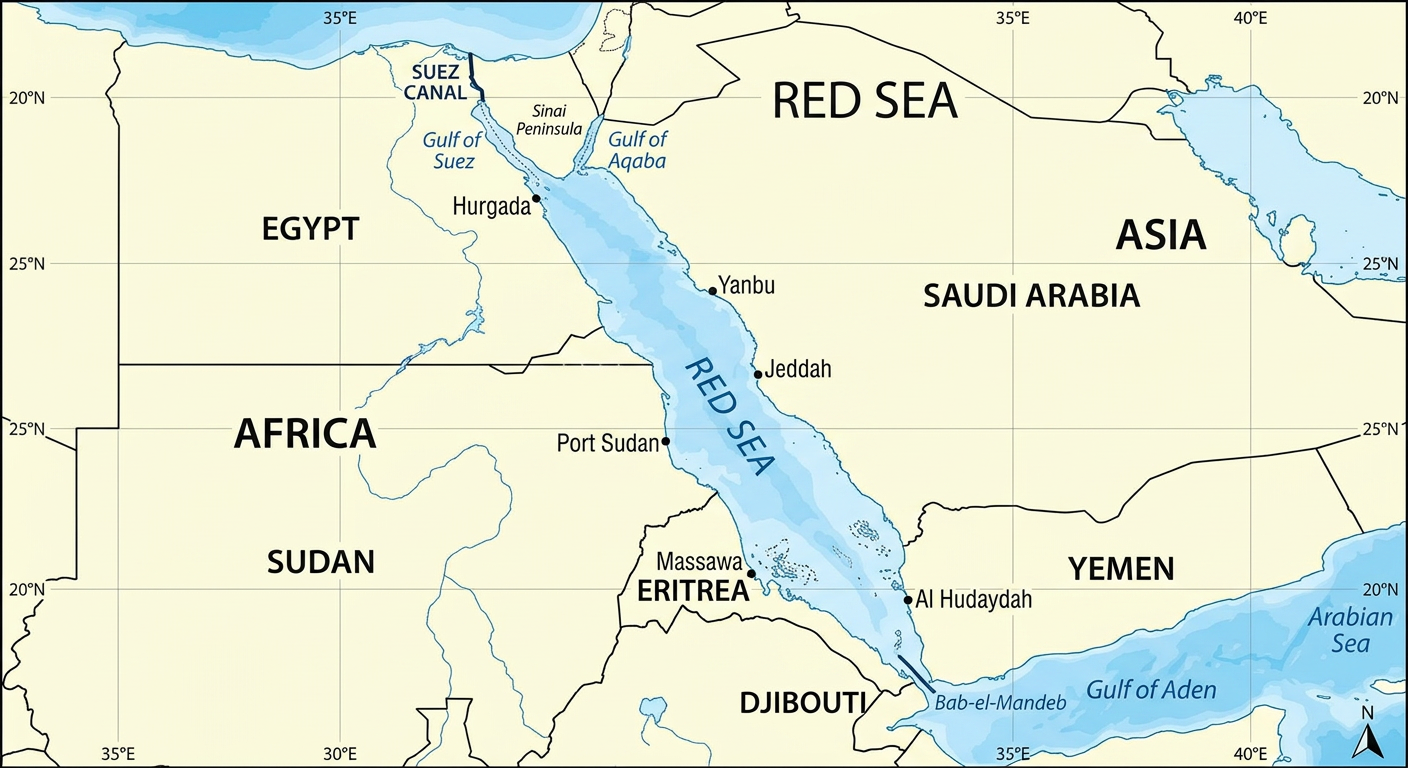
The ongoing disruptions in the Red Sea, triggered by geopolitical tensions and attacks on commercial shipping, have reintroduced systemic fragility into global supply chains. What initially appeared as a regional security issue has evolved into a structural cost shock for global trade. Freight rates have surged, transit times have lengthened, and supply chain predictability has deteriorated. The implications are particularly acute for fast-moving consumer goods (FMCG), where thin margins, high inventory turnover, and global sourcing amplify exposure to logistics volatility.
The Red Sea: A Critical Artery Under Stress
The Red Sea corridor, connecting Asia to Europe via the Suez Canal, accounts for approximately 12-15% of global trade flows. This includes containerized goods, crude oil, LNG, and bulk commodities. Any disruption here cascades across continents.
Since late 2023, attacks on commercial vessels have forced major shipping lines to reroute around the Cape of Good Hope. The consequences are immediate and quantifiable:
- Transit times increased by 10-14 days per shipment
- Voyage distances extended by 50-60%, producing roughly 40 percent more carbon dioxide emissions per voyage
- Fuel consumption increased by ~40% per voyage
Freight Inflation: From Cost Shock to Margin Compression
Freight markets have reacted sharply. According to UNCTAD and industry estimates:
- Container rates on Asia-Europe routes increased by 300-350%
- Global container rates rose ~61% in early 2024
- Some routes witnessed rate tripling within weeks
Shipping companies have capitalized on this disruption. For instance, A.P. Moller-Maersk reported a 49% increase in freight revenue in its ocean segment
However, for shippers, especially FMCG companies, this translates into margin erosion. Logistics costs, which typically account for 5-10% of product cost, have in some cases doubled, compressing already thin EBITDA margins.
A critical insight from McKinsey & Company is that supply chains are not designed for sustained volatility. Even short-term disruptions create ripple effects due to container imbalances, port congestion, and capacity constraints.
Transit Delays and Supply Chain Disequilibrium
While rising costs are visible, delays introduce more complex operational challenges.
- Global shipping delays have extended by up to 20 days in certain corridors
- Suez Canal container throughput declined by ~50% in early 2024
These disruptions create second-order effects:
- Inventory Mismatches: Longer lead times require higher safety stock, increasing working capital requirements.
- Production Disruptions: Delays in intermediate goods impact manufacturing schedules.
- Port Congestion: Rerouted vessels create bottlenecks in alternative hubs like Singapore and Shanghai.
Inflationary Pressures: A Slow-Burning Risk
The inflationary impact of Red Sea disruptions is measurable but uneven.
- Analysts estimate up to 0.7 percentage points addition to global inflation if disruptions persist
- Fuel consumption increases of ~23% per voyage amplify logistics costs
- Insurance premiums for high-risk zones have surged significantly
However, inflation transmission depends on sector dynamics. Unlike energy shocks, logistics-driven inflation is:
- Lagged (appears with inventory turnover cycles)
- Selective (impacts globally integrated sectors more)
This explains why some retailers have temporarily absorbed costs, while others, particularly in Europe, are beginning to pass them on.
Disproportionate Impact on FMCG and Consumer Goods
FMCG companies are uniquely exposed due to:
- High reliance on global sourcing (raw materials, packaging)
- Low margin structures (EBIT margins often 8-15%)
- High inventory turnover requirements
A 10-15% increase in logistics cost can materially impact profitability.
2.Margin Compression in Practice
Case evidence illustrates the strain. Retailers have reported fuel cost increases of ~40%due to rerouting. Profit forecasts in some sectors have been revised downward by 50% or more due to logistics disruptions.
For FMCG firms, the implications include:
- Reduced promotional spending
- Price increases (selective, not universal)
- SKU rationalization to manage logistics complexity
Longer shipping cycles increase cash conversion cycles:
- Inventory holding periods extend
- Cash tied up in transit rises
- Financing costs increase
This is particularly problematic in emerging markets where access to low-cost capital is limited.
Strategic Responses
Supply chains are evolving from efficiency-driven systems to resilience-oriented networks, where higher operating costs are increasingly accepted as a trade-off for continuity and risk mitigation.
1. Supply Base Diversification: Companies are actively reducing dependence on single-region sourcing by adopting multi-supplier and multi-geography procurement models. This includes nearshoring and “friendshoring” to improve supply continuity. While these strategies enhance resilience, they introduce higher input costs and reduce economies of scale, requiring a shift toward risk-adjusted sourcing decisions.
2. Logistics Network Flexibility: The disruption of key trade routes such as the Suez Canal has accelerated the adoption of multi-route logistics strategies. Companies are diversifying across ocean routes, rail corridors, and selective air freight to maintain service levels. This transition increases logistics costs but reduces exposure to single-route failures and transit uncertainty
3. Inventory Strategy Rebalancing: The traditional just-in-time model is being supplemented with higher safety stock and regional inventory hubs. This approach mitigates the impact of extended transit times and supply variability but increases working capital requirements and warehousing costs. As a result, firms are reassessing inventory as a strategic buffer rather than a cost inefficiency.
4. Pricing and Cost Management: To address rising freight and fuel costs, companies are adopting selective pricing strategies, including targeted price increases, product resizing, and portfolio rationalization. The ability to pass on costs remains uneven across categories, with premium segments demonstrating greater pricing flexibility than value segments.
5. Digital Supply Chain Capabilities: Investment in end-to-end visibility and predictive analytics is increasing. Companies are deploying real-time tracking, scenario modeling, and supplier risk assessment tools to improve responsiveness. Frameworks from McKinsey & Company and Deloitte highlight the role of digital control towers in enabling dynamic decision-making under volatile conditions.
Outlook: Temporary Shock or Structural Shift?
The key question for businesses is whether Red Sea disruptions are transient or indicative of a new normal.
Short-Term Outlook: If geopolitical tensions ease, shipping routes should stabilize, and historical data suggests freight rates typically normalize within two to six months after a resolution.
Medium-Term Reality: Several factors keep the risk high: growing political divides, vulnerable shipping bottlenecks, and climate-driven delays (like Panama Canal droughts). Together, these create a “multi-shock” environment where disruptions are a recurring reality rather than rare exceptions.
End of Single-Route Optimization: The disruption highlights the fragility of supply chains optimized around a single dominant corridor such as the Suez Canal, accelerating a shift toward inherently redundant, multi-route network design.
Implications for Business Strategy
For decision-makers, the Red Sea crisis offers three key lessons:
- Cost Overload: Low-cost supply chain models are increasingly exposed to volatility-driven disruptions.
- Calculated Resilience: Diversification and inventory buffers are now essential investments with a clear ROI, not optional overhead.
- Risk-Adjusted Strategy: Geopolitical volatility must be baked directly into pricing, supplier choice, and capital spending.
The Red Sea disruptions are reshaping cost structures and reliability expectations in global trade. This is being driven by rising freight costs, extended transit times, and increasing uncertainty.
For FMCG companies and other globally integrated sectors, the challenge is clear: adapt to a world where volatility is embedded in the system. Firms that proactively redesign their supply chains for resilience, rather than efficiency alone, will be better positioned to protect margins and sustain growth.
In other words, the real disruption is not in the Red Sea. It is in the outdated assumption that global trade will remain predictable.
Author

Make Tatvita one of your preferred sources
See more insights from Tatvita Analysts in your Google Search results.



Leave a Reply