
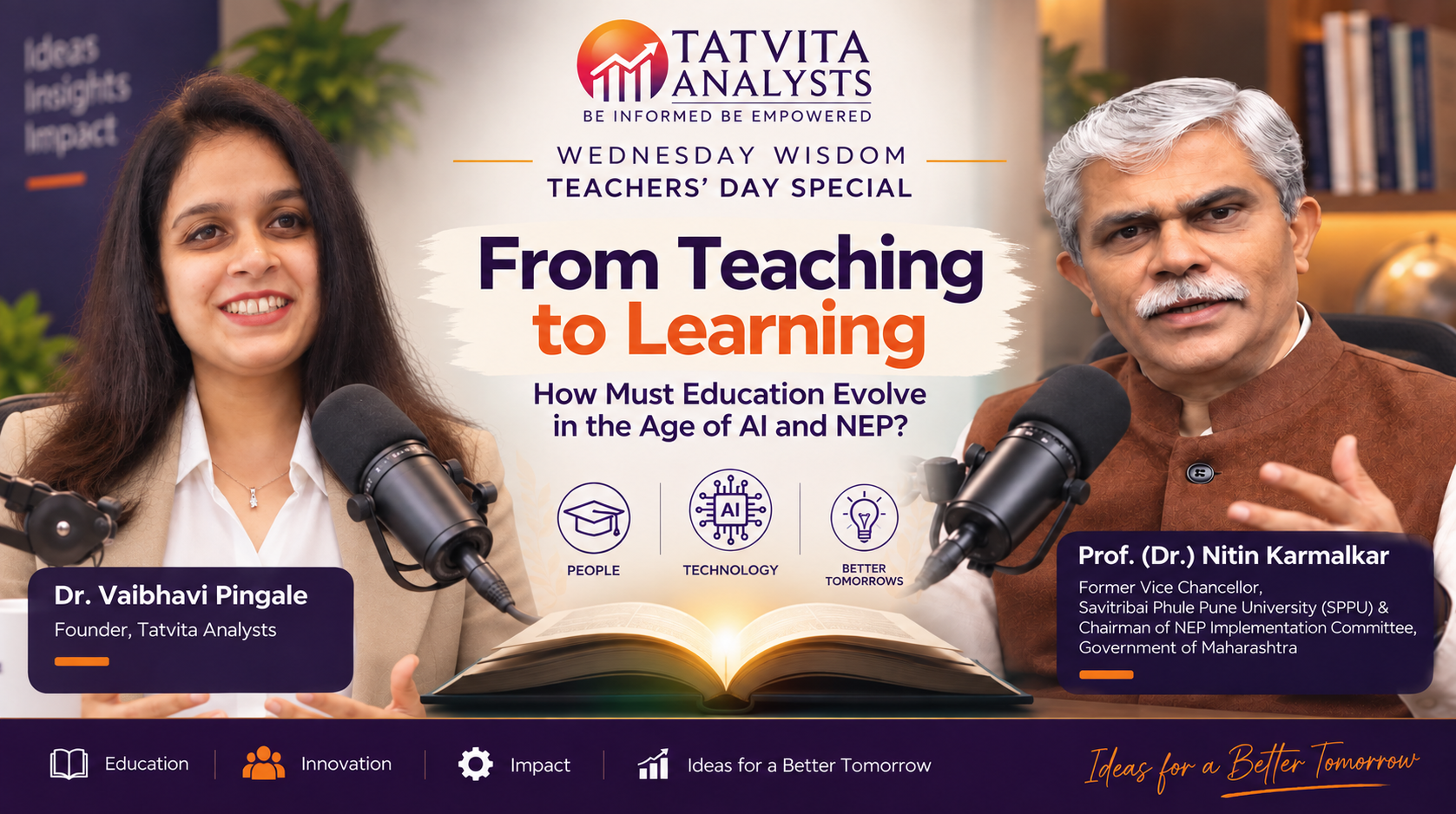
From Teaching to Learning: How Must Education Evolve in the Age of AI and NEP?
1. Indian education has evolved through several distinct phases. How do you see this evolution, and what have been the most significant changes in the purpose and structure of education?
Indian education has undergone a significant transformation over the centuries, and to understand where we need to go today, it is important to understand where we came from.
In the ancient Indian system, education was not confined to the acquisition of information or preparation for employment. The Guru-Shishya Parampara and Gurukul system looked at the overall development of the individual. Education incorporated knowledge, Samskar, social responsibility and the relationship of an individual with the larger world.
This philosophy can be understood through four dimensions—Vyashti, the individual; Samashti, society; Srishti, nature; and Parameshti, the higher or spiritual dimension. Education was therefore connected with life itself. Subjects were also not compartmentalised in the way they are today. Agriculture, astronomy, history, social engagement, literature and several other areas of knowledge could form part of the learner’s development.
Over different historical periods, this structure changed. During the medieval period, different systems and languages of education developed, including Pathshalas, Madrasahs and Maktabs. Colonial rule subsequently brought a much more formal institutional structure. The establishment of colleges and universities and the introduction of English education fundamentally altered the organisation and objectives of education. Macaulay’s educational approach, in particular, was oriented towards producing a workforce suited to the requirements of colonial administration.
At the same time, Indian social reformers recognised education as an instrument of social and national transformation. Leaders and reformers such as Lokmanya Tilak, Gopal Ganesh Agarkar, Mahatma Phule, Maharshi Karve, Rabindranath Tagore and Annie Besant established and supported institutions because they understood that education had a much larger role in shaping society.
After Independence, various commissions and national education policies attempted to develop an education system suited to an independent India. Yet, over time, education also became increasingly specialised. We started going deeper and deeper into individual disciplines, sometimes at the cost of understanding their relationship with other disciplines and with society.
This is one of the important issues NEP 2020 is attempting to address through multidisciplinary and holistic education.
From an implementation perspective, the lesson is important: multidisciplinary education should not simply mean allowing a student to select one additional subject. Institutions need to reconnect knowledge across disciplines. An engineering student should understand society and sustainability; a management student should be exposed to technology and data; a science student should understand communication and the social implications of scientific development.
The future of education may therefore require us to combine the strengths of both systems—the breadth and human orientation of earlier education with the scientific knowledge, technology, research capabilities and global exposure available today.
2. Alongside the education system, the learner has also changed significantly. What changes are you observing among today’s students, particularly with the influence of technology and social media?
The learner sitting in the classroom today is very different from the learner of even a decade or two ago.
Students today have extraordinary access to information. A teacher is no longer necessarily the first source from which a student learns about a concept. Students have search engines, social media, digital platforms and now artificial intelligence tools available to them continuously.
But access to information should not be confused with access to knowledge.
One of the challenges we increasingly observe is that students are surrounded by a very large volume of information without necessarily having the ability to judge its reliability. They may find multiple explanations, opinions, videos or AI-generated responses, but they must be able to distinguish between authentic and false information.
Social media has created another challenge. We are also seeing absenteeism and reduced engagement with conventional classroom processes. If students believe that everything is available online, they may ask why they need to attend a classroom at all.
That is a serious question for educators. The answer cannot simply be to insist on attendance. We have to make the classroom valuable enough that students understand what they gain by being there.
This means developing critical media literacy. Students should be trained to ask: Who produced this information? What is the evidence? Is the source credible? Can it be verified? Is another interpretation possible?
For teachers, there is a very practical implication. Instead of competing with the internet or AI on the availability of information, the classroom should become a place where information is questioned, interpreted, discussed and applied.
A teacher could, for example, give students two conflicting explanations of the same issue and ask them to determine which is better supported. Students could critique an AI-generated response, identify assumptions in it and verify its sources. That transforms digital exposure from a distraction into a learning resource.
The challenge today is therefore not information scarcity. It is developing the judgement required to use abundant information intelligently.
3. Has the way we teach evolved sufficiently to respond to these changes in students, technology and the world of work? Where do you see the biggest gaps?
I do not think the education system has changed at the same pace as technology, students and the workplace.
There are several gaps. Technology has entered almost every profession, but its integration into classrooms remains uneven. Infrastructure differs substantially across institutions. There are shortages of teachers in parts of the system, and there is also a considerable difference between the resources available to different categories of institutions.
This creates what may be described as an imbalance between education for the classes and education for the masses. If high-quality technology, teaching, infrastructure and exposure are available only to students who can afford particular institutions, educational inequality will widen.
There is also a pedagogical problem. We have developed a system in which students often go very deep into one discipline but receive limited exposure outside it. However, real-world problems do not arrive neatly divided into academic departments.
Climate change is not only an environmental-science problem. Public health is not only a medical problem. Artificial intelligence is not only a computer-science problem. Each has economic, technological, ethical, legal, behavioural and social dimensions.
The workplace is moving in precisely this direction. Employers increasingly need people who can work across functions, communicate with different specialists, learn new technologies and solve unfamiliar problems.
Therefore, curriculum reform alone will not be sufficient. Pedagogy has to change.
A practical classroom should increasingly combine conceptual learning with cases, problems, discussions, projects, field exposure, research and interaction with practitioners. Students should have opportunities to use what they learn rather than merely demonstrate that they remember it.
For institutions, the practical question should be: What can our students do at the end of this course that they could not do at the beginning?
That moves the focus from syllabus completion to learning outcomes.
4. With AI, machine learning, IoT, robotics and other emerging technologies becoming part of everyday life, how prepared are our teachers to integrate these technologies meaningfully into education?
This is one of the major challenges before the education system.
We often discuss whether students are prepared for artificial intelligence, but the first question should be whether our teachers are prepared.
A large number of teachers have been educated and trained in an environment that existed before AI, machine learning, IoT, robotics and many of today’s emerging technologies became mainstream. We cannot simply expect them to integrate technologies they have never systematically been trained to understand.
Therefore, faculty development has to take place on a very large scale.
And faculty development should not be reduced to one workshop or one orientation programme. Technology changes continuously. Teacher development must therefore become continuous as well.
Universities do not necessarily have to build all this capacity internally. External experts, industry professionals and practitioners can contribute significantly. This is also where mechanisms such as industry–academia partnerships and Professors of Practice become important.
From a practitioner’s perspective, institutions could begin with a simple three-level approach.
First, every teacher should develop basic technological literacy—what these technologies are, what they can and cannot do, and what ethical concerns accompany them.
Second, teachers should understand discipline-specific applications. An economics professor, a chemistry professor and a literature professor need not use AI in exactly the same way.
Third, teachers should learn how technology can improve pedagogy itself—preparing learning material, generating different examples, supporting differentiated learning, designing classroom activities and providing faster formative feedback.
The objective is not to turn every teacher into a technologist. It is to ensure that every teacher understands enough technology to remain an effective educator in a technology-rich society.
5. As technology makes information increasingly accessible, how can education ensure that students continue to develop critical thinking, independent thinking and problem-solving abilities rather than merely consuming or reproducing information?
This is perhaps the central educational challenge created by AI.
If a student can ask a machine to summarise a chapter, write an essay, explain a theory or solve a standard problem, then asking students only to reproduce information becomes increasingly meaningless.
The danger is not AI itself. The danger arises when technology replaces the intellectual process through which a student learns to think.
Our education and examination systems have already placed too much emphasis on memorisation and reproduction. If we continue with the same pedagogy in the age of AI, independent thinking and problem-solving may weaken further.
The solution is not simply to prohibit AI. Students will encounter these technologies outside the classroom and later in their professions. Education should instead teach them how to use technology intelligently and ethically.
For example, rather than asking a student merely to “write an essay”, the teacher could ask the student to compare an AI-generated argument with evidence from original sources, identify weaknesses in the argument and develop a better conclusion.
Instead of asking only for the answer to a problem, ask students to explain why they selected a particular method, what assumptions they made and how the result would change if those assumptions changed.
Instead of assessing only the final project, assess the student’s reasoning, sources, revisions and ability to defend the work.
This changes AI from an answer-producing mechanism into an object of inquiry and a tool for learning.
The principle should be simple: technology may assist the learner, but it should not replace the learner’s responsibility to think.
6. NEP 2020 places considerable emphasis on multidisciplinary education, skills, flexibility and experiential learning. What needs to change at the classroom and institutional levels for these ideas to be implemented effectively?
NEP 2020 has created an important opportunity because it recognises several limitations of the conventional education system. It emphasises multidisciplinary learning, skills, flexibility, experiential education, research and greater connection between education and the world outside the institution.
But a policy becomes meaningful only through implementation.
The first requirement is teacher capacity building. A multidisciplinary curriculum cannot succeed if teachers continue to operate entirely within traditional disciplinary boundaries.
Second, curricula need to be connected with contemporary national and global developments. Students should understand how what they study relates to technological change, industry, society and emerging challenges.
Third, experiential learning must become a genuine part of education. Students need hands-on experience, industrial exposure, research opportunities, projects and opportunities to solve actual problems.
Industry–academia partnerships are particularly important here. Universities cannot reproduce every development taking place in industry inside their campuses. Bringing practitioners into education and taking students into professional environments can bridge this gap.
The Professor of Practice framework is one mechanism that can support this interaction.
At the institutional level, however, implementation should go beyond creating new course structures. Departments must collaborate. Credit systems must permit genuine flexibility. Timetables should allow students to learn across disciplines. Faculty evaluation should recognise innovative teaching and mentoring, not merely conventional classroom hours.
A useful test for every institution implementing NEP would be:
What has actually changed in the student’s weekly learning experience?
If the programme has been redesigned on paper but the student still attends the same lecture-based classes, memorises the same type of material and writes essentially the same examination, the reform has not yet reached the learner.
7. Do our current examination and assessment systems adequately evaluate a student’s understanding, critical thinking and ability to apply knowledge? What changes would you recommend?
Our present assessment system continues to place excessive emphasis on reproduction.
A student may perform well because they are able to remember and reproduce information during a particular examination. But that does not necessarily tell us whether the student can analyse a situation, solve an unfamiliar problem, work collaboratively, communicate an argument or apply knowledge.
High-stakes examinations create another problem when a student’s future is determined disproportionately by performance in a single test. Entrance examinations such as CET and NEET illustrate how enormous pressure can become concentrated around one examination.
We need to move towards continuous and diversified assessment.
Assessment can include discussions, colloquia, projects, presentations, assignments, practical work and other forms through which students demonstrate understanding over time. Academic performance across earlier years can also be considered alongside entrance-test performance rather than allowing one examination to become the sole determinant.
The larger principle is that if we want different learning, we must assess differently.
If an examination rewards memorisation, students will memorise. If it rewards reasoning, students will practise reasoning. If it evaluates application, students will learn to apply knowledge.
Assessment should also recognise ethical conduct. Education is not merely about producing technically capable individuals; it should develop responsible individuals as well.
For practitioners designing assessment, every question can be subjected to a simple test: Could a student answer this successfully through memorisation alone?
If the answer is yes for most of an examination, the assessment is probably not measuring the capabilities we claim to value.
8. From your experience as Vice Chancellor, what enables institutions to translate multidisciplinary and experiential learning from policy into actual practice?
The most important factor is whether the institution is willing to break existing compartments.
Universities traditionally organise knowledge through departments, and departments are necessary for disciplinary depth. But students should not become prisoners of those boundaries.
Meaningful multidisciplinary education requires institutional mechanisms that allow students to experience other domains. A student from one discipline should be able to engage with performing arts, social sciences, technology or other relevant areas.
The same principle applies to experiential learning. Institutions need partnerships outside the university with industry, other universities, research organisations and practitioners.
Leadership therefore matters because someone has to create the structures that allow these interactions to happen.
The difference between reform on paper and reform in practice is often operational: Who will teach the interdisciplinary course? How will credits be recognised? How will departments coordinate? How will external practitioners participate? How will students obtain field or industrial exposure?
These may appear to be administrative questions, but they determine educational outcomes.
Institutions that innovate successfully tend to create space for experimentation, encourage faculty collaboration, expose students to different disciplines and cultures, and build external partnerships.
Educational innovation therefore cannot remain the responsibility of an individual enthusiastic teacher. It must eventually become part of institutional design.
9. Could you share some reforms or initiatives from your own academic leadership experience that demonstrated how multidisciplinary or collaborative education can improve student learning?
One approach that has produced encouraging outcomes is deliberately breaking disciplinary compartmentalisation and giving students exposure to areas beyond their principal subject.
This can include performing arts, social sciences and other disciplines that students may not ordinarily encounter within a conventional specialised programme. Such exposure broadens their thinking and allows them to approach their own discipline differently.
International collaboration provides another valuable form of learning.
One example was a blended BSc programme developed through collaboration involving the University of Melbourne and IISER Pune. Such collaborations allow institutions to work jointly on curriculum and teaching rather than treating internationalisation merely as student travel.
Short exposure programmes such as students spending around 15 days at partner institutions can also be extremely valuable. Students experience different academic environments, interact with people from different backgrounds and understand that knowledge can be approached differently across institutions and cultures.
Diversity itself is educational.
That diversity can be disciplinary students encountering different subjects. It can also be social and geographical students studying alongside people from different states, communities and backgrounds.
A liberal and multidisciplinary environment gives students the opportunity to encounter perspectives different from their own.
The practitioner lesson is that exposure should be designed into the curriculum rather than treated as an extracurricular benefit. Institutions can create cross-disciplinary electives, short immersion programmes, joint projects, practitioner-led modules and collaborations with other universities.
Not every intervention needs to be a new degree programme. Even relatively short, carefully designed exposure can alter how a student understands a subject and the world around it.
10. Finally, as today’s graduates enter a VUCA world and an increasingly dynamic gig economy, how should higher education prepare them for careers where continuous learning, upskilling and reskilling will become essential?
We are educating students for a world that is volatile, uncertain, complex and ambiguous, a VUCA world.
The traditional expectation that a person acquires a qualification, enters one occupation and continues doing essentially the same work throughout their career is becoming increasingly difficult to sustain.
Technology will change jobs. New occupations will emerge, existing roles will change and individuals may move repeatedly between organisations, projects and different forms of work. The gig economy is also changing the nature and duration of professional engagements.
Under these circumstances, the most important capability education can provide is the ability to continue learning.
Students need resilience. They need the ability to upskill and reskill. They should be comfortable entering an unfamiliar environment, identifying what they do not know and acquiring the knowledge necessary to move forward.
This has a major implication for universities. We should stop thinking of education as something that ends when a degree is awarded.
Higher education institutions will increasingly have a role in lifelong learning. Alumni may return to universities repeatedly for short courses, certifications, new technological capabilities or interdisciplinary learning as their careers evolve.
For students, therefore, employability should not mean preparation for the first job alone. Education should prepare them for the first job, the fifth job and perhaps careers that do not yet exist.
That requires a combination of disciplinary foundations, multidisciplinary exposure, technological literacy, critical thinking, ethical judgement, adaptability and the habit of continuous learning.
Ultimately, the future of education is not about choosing between teachers and technology, tradition and modernity, or knowledge and skills. It is about integrating them.
The teacher’s role will remain central, but it will evolve—from primarily transmitting information to developing judgement, curiosity, capability and the confidence to keep learning.
And that may ultimately be the most important purpose of education in the age of AI.
Author

Make Tatvita one of your preferred sources
See more insights from Tatvita Analysts in your Google Search results.



Leave a Reply