
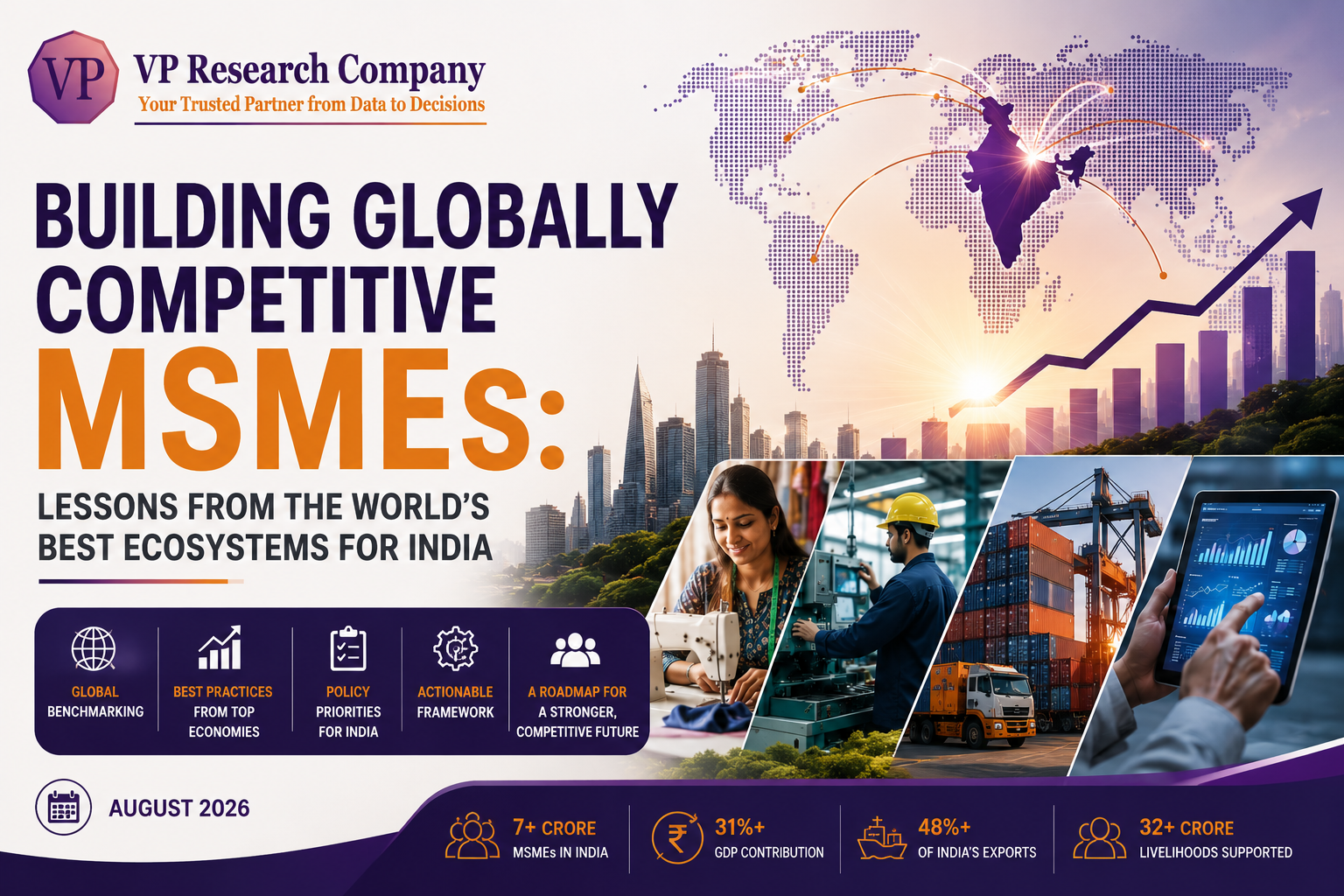
India has more than 7 crore MSMEs. But how many are actually able to grow from micro to small, from small to medium and eventually compete globally?
India’s MSMEs contribute around 31.1% of GDP, more than 48.5% of exports and approximately 35% of manufacturing output. The ecosystem supports an estimated 32.8 crore livelihoods. Yet nearly 97.7% of registered MSMEs are micro enterprises.
So perhaps the next MSME question for India is no longer:
How do we create more MSMEs?
It is:
How do we help existing MSMEs survive, scale, innovate and compete globally?
That question led VP Research Company to study some of the world’s strongest MSME ecosystems and the findings suggest that different countries have solved very different pieces of the MSME puzzle.
The numbers raise some uncomfortable questions.
97.7% of India’s registered MSMEs are micro enterprises.
Why does the enterprise pyramid remain so heavily concentrated at the bottom?
What prevents more micro enterprises from becoming small and more small enterprises from becoming medium-sized businesses?
MSMEs contribute more than 48% of India’s exports.
That sounds impressive.
But does a rising share of exports necessarily mean Indian MSMEs are becoming more globally competitive?
The answer changes when export performance is examined alongside the sophistication of what an economy produces and sells.
India already has an extensive MSME policy ecosystem.
Credit guarantees, cluster programmes, digital registration, procurement support, technology centres, export assistance and delayed-payment mechanisms already exist.
So why do financing, productivity, technology, payments and scaling continue to appear as major constraints?
Perhaps the issue is not simply:
“What new scheme does India need?”
but:
“What are the world’s best MSME ecosystems doing differently?”
We studied that question.
The report benchmarks India’s MSME ecosystem across six dimensions of competitiveness and investigates international models relevant to the challenges identified for India.
But benchmarking alone is not enough.
A programme that succeeds in a small, highly digitised economy may not work in India.
A manufacturing model developed over decades cannot necessarily be recreated through one government scheme.
And an attractive international policy may become impractical when its cost, administrative complexity and institutional requirements are considered.
So the research goes one step further.
Which global practices can India actually replicate?
That is where the report becomes particularly interesting.
Inside the Report
The full study answers questions including:
- Where does India’s MSME ecosystem actually stand against leading global ecosystems?
- What separates countries that successfully produce competitive small and medium enterprises from those that simply produce large numbers of small businesses?
- Which Indian MSME constraints should receive priority and which are symptoms of deeper structural problems?
- Which international policies produced measurable results?
- Which global best practices are realistically transferable to India?
- Which apparently attractive practices would be difficult to replicate in India’s institutional environment?
- Should India prioritise finance, productivity, innovation, exports, digitalisation or enterprise scaling first?
- What should government, financial institutions, industry associations, universities and MSMEs themselves do differently?
The answers are not the same for every problem.
From Global Best Practices to an India Roadmap
The final sections of the report do something deliberately different from a conventional benchmarking study.
International practices are subjected to an India Replicability Assessment, considering their potential impact as well as the practical conditions required to implement them.
The study then develops a Policy Priority Matrix and an Action Framework to distinguish:
what India should address first,
what can realistically be implemented,
and
what requires longer-term structural transformation.
Those findings and the resulting recommendations are reserved for the full report.
Who Should Read It?
- Policymakers and government institutions designing MSME and industrial policy.
- Banks, NBFCs and financial institutions working with MSME credit.
- Industry associations and chambers supporting member enterprises.
- MSME founders and business leaders trying to understand what enables firms to scale.
- Consultants, researchers and academics studying entrepreneurship, industrial development and competitiveness.
- Universities and incubation ecosystems seeking a stronger role in enterprise development.
One Question to Leave With
India has demonstrated that it can create entrepreneurship at extraordinary scale.
The next test is harder:
Can India turn millions of small enterprises into a pipeline of productive, innovative and globally competitive businesses?
Some countries have already solved parts of that challenge.
This report investigates what they did and which lessons India should actually act upon.
Download the full research report to see the Global Benchmarking, Best-Practice Cases, India Replicability Assessment, Policy Priority Matrix and Action Framework.
Author

Make Tatvita one of your preferred sources
See more insights from Tatvita Analysts in your Google Search results.

Leave a Reply