
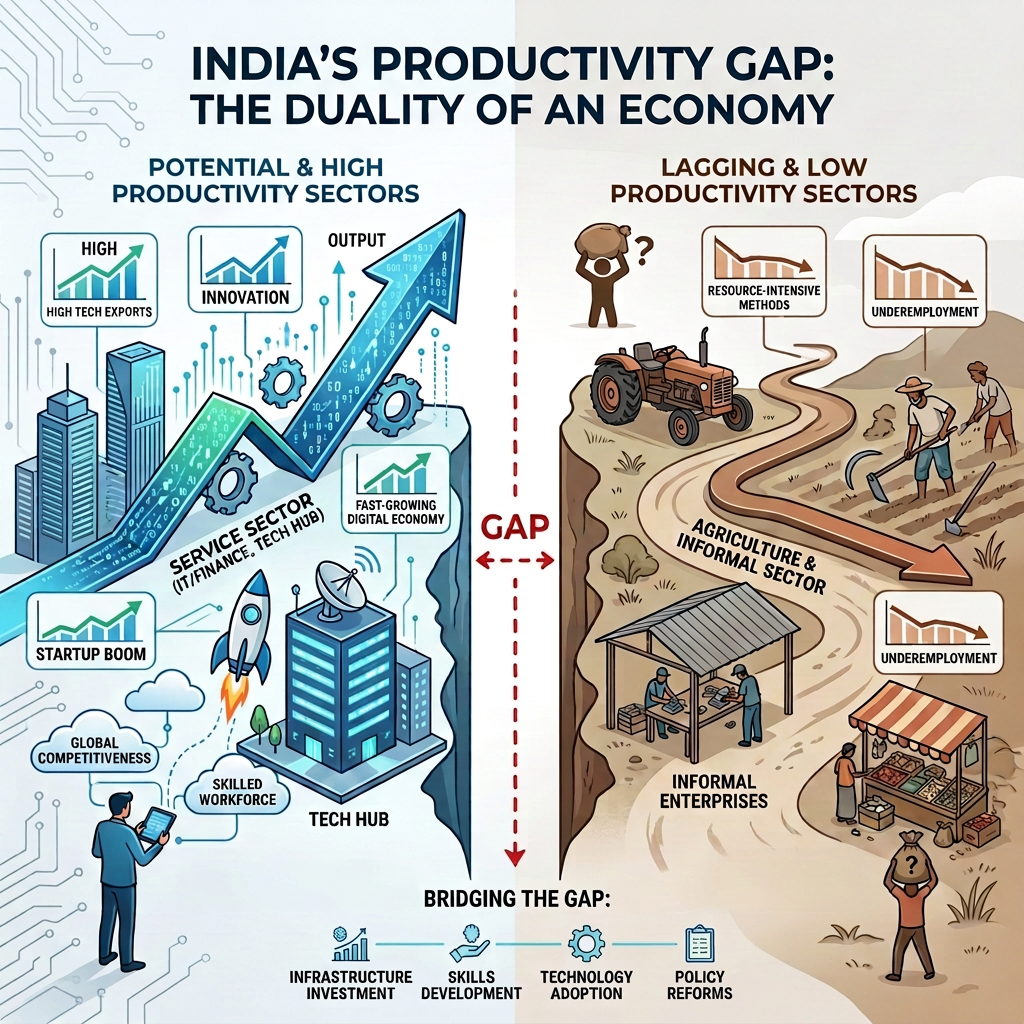
India’s economy is booming, yet a farmer in Iowa outproduces an Indian farmer by ten times, and a German factory worker generates in one hour what an Indian worker takes a full day to make. Why does rapid growth keep failing to close this gap and what can leaders actually do about it? Here’s what the data says. India’s economy grew 7.6% in 2025 and is projected to grow 6.5% in 2026, and it now ranks as the third-largest economy in the world by purchasing power parity. On paper, this looks like an unstoppable growth story. Yet beneath the headline number lies a persistent, structural weakness: India produces far less per worker than its economic rivals, and the gap is not closing fast enough. India’s labour productivity, measured as GDP per worker at constant 2021 purchasing power parity, rose from about $3,500 in 1970 to $24,900 in 2023. That sounds like progress until you compare it globally. India’s productivity was roughly 8.2% of the top-performing Asian economy in 1970, and even after decades of reform, it stood at just 11.9% of the top Asian performer (Singapore) in 2023. China’s labour productivity was more than twice India’s, and the United States’ was over six times higher. This is not a story of India failing to grow it is a story of India growing without converting that growth into output per worker. Job creation in India between 2013 and 2018 was strong, with productivity increasing 1.3 times, comparable to Vietnam and just […]
Unlock Full Access
Join thousands of Professionals
Who Rely on Tatvita for
research-backed intelligence
What You Get As A Member
Weekly Exclusive Articles
In Depth Analysis of critical issues
Monthly Research Reports
Data-rich reports across sectors and themes
Global Best practices platform
Lessons from leading countries and institutions
Business Intelligence
Industry insights and market research
Public Policy Insights
Evidence-based policy analysis and implications
Academic References
Citations, data sources and methodology
Latest Stories



How professionals see tatvita
“Our innovation team regularly reviews global practices before launching pilot projects. tatvita brings together examples that would otherwise require extensive searching”
“Useful whenever i need international examples for client presentations”
“the global case studies save me hours of searching before preparing lectures”
“A practical starting point for understanding how other countries have addressed similar challenges”
“One article often points me towards business ideas and strategies for exploring further”
“The reports provide context that is often missing from day-to-day business news”
“Helpful for exploring international approaches before beginning detailed research”
“The reports help connect global developments with India’s business environment”
“the articles helped me connect current affairs with economics and public policy in a way that standard textbooks rarely do”
“Tatvita gives me a good starting point while preparing assignments”