
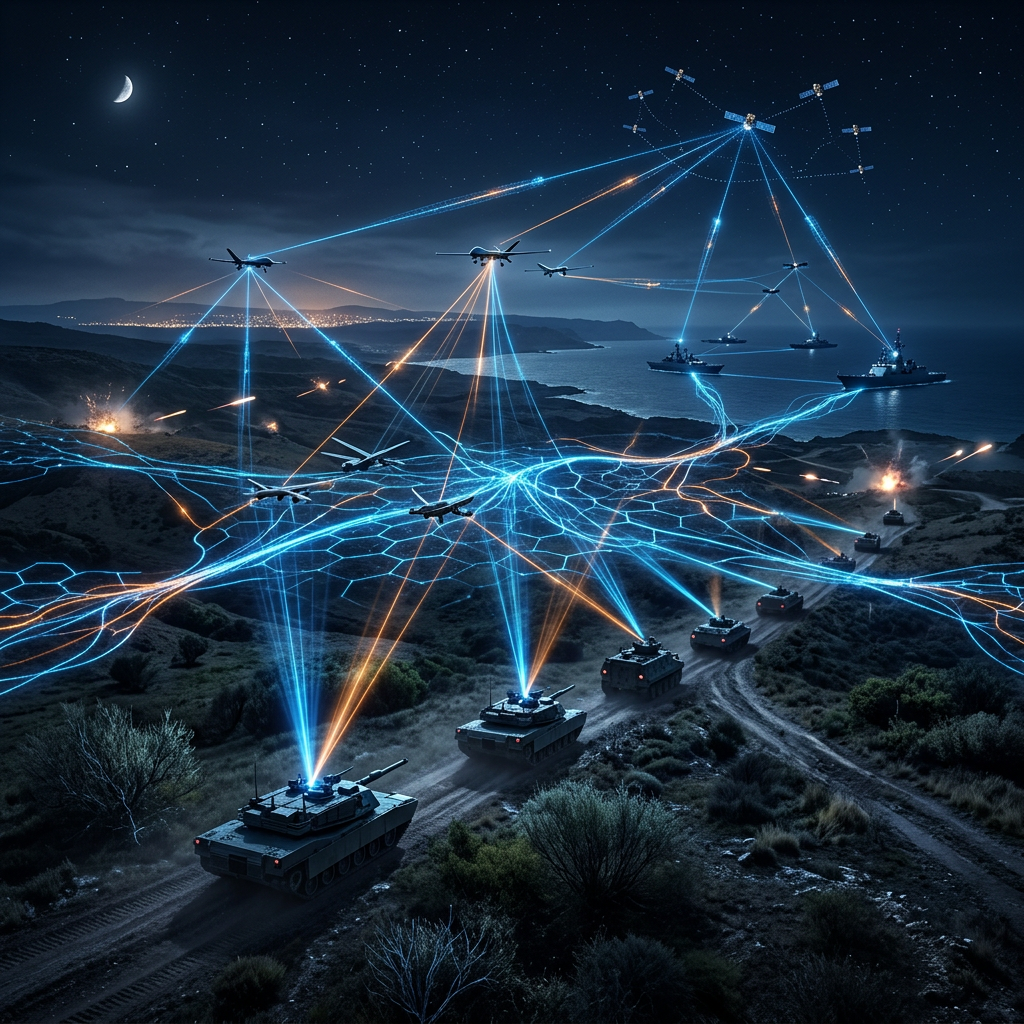
The first phase of the global quantum threat revolves around adversaries passively hoarding our digital secrets in dark archives. But the quantum arms race has a much darker, far more aggressive side. If stealing encrypted data today to read it tomorrow is an intelligence crisis, the weaponisation of quantum computers represents an active, kinetic military threat.
The race to build a Cryptographically Relevant Quantum Computer (CRQC)—a machine capable of breaking modern encryption—is the 21st-century equivalent of the Manhattan Project. The nation that crosses this technological finish line first will not simply gain the ability to read stolen emails; they will gain the power to dismantle the digital foundations of modern warfare. In this theatre, the threat is not about delayed intelligence leaks or corporate espionage. It is about adversaries gaining the ability to disrupt active military hardware, manipulate battlefield communications, and paralyse command structures in real time.
For decades, global strategic stability and the concept of Mutually Assured Destruction have relied entirely on the absolute security of digital communications. If those communications are compromised, deterrence collapses.
1. The Weaponisation of Q-Day: Hacking the Battlefield
In modern warfare, everything from infantry troop movements to the deployment of nuclear submarines relies on secure, encrypted communication networks, collectively known as Command and Control (C2). These networks allow generals to see the battlefield and issue orders without the enemy listening in.
If an adversary builds a CRQC before a nation upgrades its defences, they can instantly decrypt these C2 communications in the field. The element of surprise—the core of strategic military deterrence—completely vanishes (Department of War, 2026). If an adversary knows exactly where a naval fleet is moving before the ships even leave the port, defensive posturing becomes impossible.
However, the threat extends far beyond just listening in; it is fundamentally about taking control. Modern military hardware, including missile defence systems, early warning radars, and autonomous drone swarms, only accept commands if they possess a verified “digital signature.” Think of this digital signature as an unbreakable cryptographic wax seal that proves an order is actually coming from the Pentagon and not a hacker.
Right now, classical computers cannot forge that seal. A quantum computer, however, could effortlessly break the underlying math. If an attacker can forge that digital seal, the consequences are catastrophic. They could inject fake targeting data into a satellite, blinding allied forces. They could send a malicious, falsely authenticated software update that shuts down a Patriot missile battery before a launch. They could even hijack the communication links governing autonomous drones, turning a defensive swarm against its own operators. Q-Day—the day this becomes a reality—is no longer a distant sci-fi concept; it is an imminent operational threat that is forcing militaries to rethink how they trust their own screens (R Street Institute, 2026).
2. Building the Quantum Shield: A New Kind of Math
To defend against this kinetic threat, the global military apparatus cannot just build stronger firewalls; they have to change the mathematics that protects the internet fundamentally. In August 2024, the National Institute of Standards and Technology (NIST) finalised new global blueprints for Post-Quantum Cryptography (PQC).
Current encryption schemes (such as the widely used RSA standard) rely on the difficulty of integer factorisation. It works a bit like asking a computer to find the two specific prime numbers that multiply together to make a massive, thousands-of-digits-long integer. Normal computers would take millions of years to guess the answer by trial and error. A quantum computer, running a specific formula called Shor’s Algorithm, can solve it in a matter of hours.
The new defence standards rely on something called “lattice-based cryptography.” Instead of relying on multiplication and division, lattice math hides the data in a complex, multi-dimensional grid—sometimes spanning 500 or more dimensions. To break it, a computer must find the shortest possible line connecting two points within this sprawling, infinitely complex maze. It is a mathematical puzzle that even the most advanced quantum computers struggle to solve efficiently.
Furthermore, this is not an isolated effort. Modern military operations are rarely unilateral. The United States must ensure that its communications remain secure when coordinating with NATO allies and international partners. Upgrading to these new lattice-based standards requires a massive, synchronised global effort to ensure that a British fighter jet can still securely transmit targeting data to an American aircraft carrier using the new quantum-resistant math.
3. The Logistical Nightmare: Upgrading the Military
Changing the math on paper is the easy part. The real crisis is the massive logistical friction of physically upgrading the military infrastructure.
If a company needs to secure a commercial website, they can usually just push a remote software update. But you cannot simply “click update” on a nuclear submarine resting at the bottom of the ocean, a deep-space satellite constellation orbiting the Earth, or the internal wiring of an F-35 fighter jet. Military systems use highly specialised, embedded hardware—physical cryptographic units bolted into the machines—that take years to design and test, and are notoriously difficult to modify once they are deployed in the field.
Engineers refer to this challenge using the acronym SWaP: Size, Weight, and Power. The new quantum-resistant algorithms require much longer cryptographic keys and significantly more processing power than the old math. You cannot simply force a satellite running on limited solar battery power, or an infantry radio with a small microchip, to suddenly process massive multi-dimensional lattice grids without severely draining its battery or overloading its processor.
To bridge this gap, militaries are forced to use “hybrid architectures”—running both the old classical encryption and the new quantum encryption at the exact same time (Entrust, 2026). This ensures that if the new math has an unexpected glitch, the old math acts as a safety net. But running two security systems simultaneously doubles the computing strain on already stressed military hardware.
To force defence contractors to solve these SWaP limitations and close the readiness gap quickly, national security agencies have set aggressive, non-negotiable transition deadlines:
- 2027 — The Cutoff for New Gear: Starting in 2027, all newly purchased military network equipment must be quantum-proof by default. If a contractor’s hardware isn’t upgraded, they will immediately lose access to lucrative federal defence contracts.
- 2030 — The Network Mandate: All traditional military networking equipment (like routers and secure VPNs) must strictly use quantum-resistant math to communicate, effectively phasing out legacy classical encryption on the battlefield.
- 2033 — Total System Overhaul: Every web browser, cloud server, and operating system running on classified networks must be fully upgraded to the new quantum standards, cementing the transition across all branches of the military.

Conclusion
The race to deploy this “Quantum Shield” is essentially a race against the clock. The cryptographic architecture that has secured global military operations since the Cold War is rapidly reaching its expiration date. While the intelligence community grapples with the data that has already been stolen, the defense sector must focus entirely on hardening the systems that govern physical warfare.
The true winner of the quantum arms race won’t just be the country that builds the most powerful quantum computer. It will be the country that manages to navigate the logistical nightmare of retrofitting its massive, outdated military hardware the fastest. Until that global upgrade is complete, the entire architecture of modern strategic defense remains deeply vulnerable to whichever nation unlocks the math first.
Author

Make Tatvita one of your preferred sources
See more insights from Tatvita Analysts in your Google Search results.



Leave a Reply