

India is at an important stage of its development. With a population of over 1.4 billion, it is the world’s most populous country and one of the youngest major economies. Around 68% of the population is in the working-age group (15–64 years), and the median age is about 28 years, giving India a significant demographic advantage over many ageing countries.
This favourable age structure is known as the demographic dividend, where a larger working-age population creates the potential for faster economic growth. However, this opportunity can only be realised if supported by quality education, healthcare, skill development, and productive employment (Bloom, Canning, & Sevilla, 2003).
India’s demographic transition has been driven by declining fertility rates, better healthcare, longer life expectancy, and improved access to education. This has created a unique opportunity to boost economic growth over the next two decades.
Despite this advantage, challenges such as youth unemployment, skill gaps, low female labour force participation, regional disparities, and a large informal workforce continue to limit India’s potential. According to the International Labour Organization (2024), creating quality jobs and improving workforce skills are essential to fully benefit from this demographic opportunity. This article examines India’s demographic transition, its opportunities, key challenges, and the policy measures needed to achieve sustainable and inclusive growth.
Understanding the Demographic Dividend
The demographic dividend refers to the accelerated economic growth that can occur when a country’s working-age population (15–64 years) grows larger relative to its dependent population (children and the elderly). This demographic shift reduces the dependency burden on economically active individuals, allowing a greater proportion of the population to participate in productive economic activities. As a result, countries may experience higher labour productivity, increased savings and investments, stronger domestic demand, and sustained economic growth.
The concept gained prominence through the work of economists David Bloom, David Canning, and Jaypee Sevilla, who argued that demographic changes can significantly influence long-term economic development when supported by sound public policies. However, the demographic dividend is not an automatic outcome of population growth. It represents a window of opportunity that can be realized only when governments invest in education, healthcare, employment generation, and institutional capacity.
The demographic dividend is closely linked to the Demographic Transition Theory, which explains how population dynamics evolve as countries develop economically and socially.

India is presently in the late Stage III of demographic transition. Fertility rates have declined significantly across most states, while improvements in healthcare have increased life expectancy. Consequently, India’s working-age population continues to expand, creating a unique but time-bound opportunity for economic transformation.
India’s Demographic Transition
India’s population has grown from about 361million in 1951 to over 1.4 billion today, making it home to nearly one-sixth of the world’s population. According to the United Nations World Population Prospects (2024), India’s population will continue to grow for a few more decades before stabilizing later in the century. Although the population is still increasing, the rate of growth has slowed considerably compared to previous decades. In 2023, India became the world’s most populous country, overtaking China. At the same time, it remains one of the youngest major economies. Around 68% of India’s population is between 15 and 64 years of age, and the country’s median age is about 28 years, much lower than countries such as Japan, China, and Germany (United Nations, 2024).

This young population provides India with a strong advantage in sectors such as manufacturing, services, technology, and entrepreneurship. However, India’s demographic transition is not uniform. States such as Kerala and Tamil Nadu have lower fertility rates and ageing populations, whereas Bihar, Uttar Pradesh, and Madhya Pradesh continue to have younger populations and higher fertility levels. These differences highlight the need for state-specific policies rather than a single national approach (NITI Aayog, 2018)

Opportunities Presented by India’s Demographic Dividend
India’s demographic dividend represents one of the most significant opportunities for achieving sustained and inclusive economic growth in the twenty-first century. However, the realization of these opportunities depends on the country’s ability to invest in human capital, create quality employment, and build institutions that support long-term development
India’s large working-age population provides a strong opportunity to boost economic growth by increasing labour supply, productivity, savings, and investment. However, these benefits can only be achieved if people have access to quality education, skills, and productive jobs (Bloom, Canning, & Sevilla, 2003). Sectors such as manufacturing, healthcare, information technology, renewable energy, logistics, tourism, and financial services have significant potential to create employment.
Investing in education, healthcare, and skill development is essential for building a productive workforce. Initiatives such as the National Education Policy (NEP) 2020, Skill India Mission, PMKVY, and NAPS aim to improve employability and prepare young people for future industries (Lee & Mason, 2011).
India’s young population also supports innovation and entrepreneurship. Programmes like Startup India, Digital India, and the Atal Innovation Mission have strengthened the startup ecosystem and encouraged technology-driven growth. At the same time, rising incomes and urbanization are expanding the domestic consumer market, attracting more private investment. The rapid growth of the digital economy is creating new employment opportunities, making digital skills increasingly important (World Economic Forum, 2025). Increasing women’s participation in the workforce through better safety, childcare, and equal opportunities can further strengthen India’s demographic dividend and promote inclusive economic growth.
Constraints in Harnessing India’s Demographic Dividend
Despite having one of the world’s largest young populations, India faces several challenges in turning its demographic advantage into sustainable economic growth.
One of the biggest challenges is unemployment and underemployment. Every year, millions of young people enter the labour market, but job creation has not kept pace. Many educated youth struggle to find suitable jobs, while others work in low-paying informal employment. According to the International Labour Organization (2024), creating decent and productive jobs is essential to fully benefit from the demographic dividend.
Another major issue is the skill gap. Although India produces a large number of graduates, many lack industry-relevant skills such as digital literacy, communication, and problem-solving. Strengthening education and continuous skill development is crucial for improving employability and productivity (Lee & Mason, 2011).
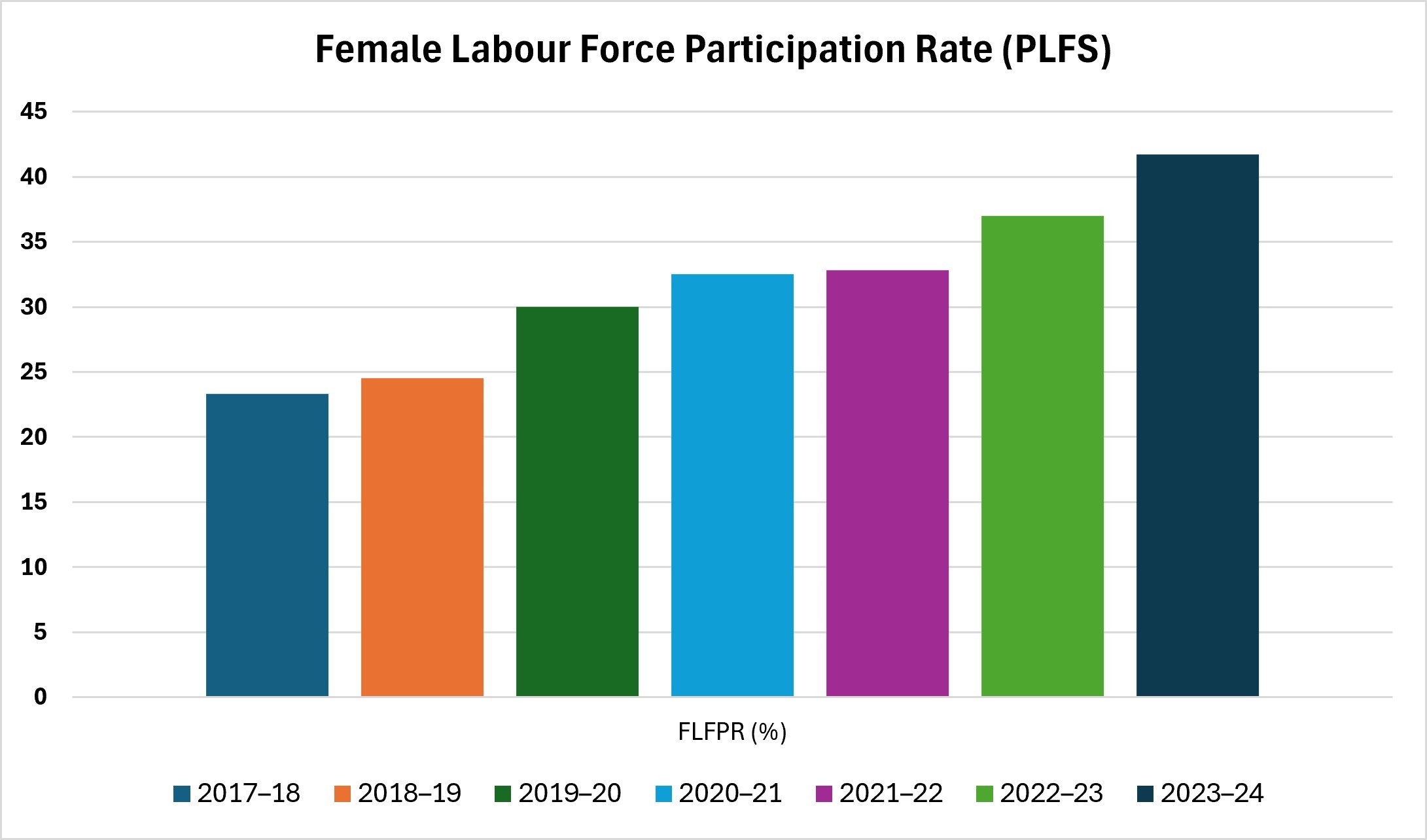
Low female labour force participation also limits India’s growth potential. Social norms, unpaid care responsibilities, workplace safety concerns, and limited access to quality jobs prevent many women from joining the workforce. Increasing women’s participation can boost household incomes and overall economic growth (World Bank, 2024).
India also faces regional disparities. States like Bihar and Uttar Pradesh have younger populations and higher fertility rates, while many southern states are ageing. Differences in education, healthcare, infrastructure, and employment opportunities require region-specific policy interventions (NITI Aayog, 2018).
The rapid growth of artificial intelligence, automation, and digital technologies is changing the nature of work. Young people need digital and technical skills to remain employable in the future.
Finally, while initiatives such as Skill India, NEP 2020, Digital India, and Make in India have strengthened human capital, uneven implementation and regional differences continue to limit their impact. As Bloom, Canning, and Sevilla (2003) note, a demographic dividend can only be achieved through effective policies and strong institutions.
Policy Responses and the Way Forward
India’s demographic dividend is a time-bound opportunity that is expected to remain favourable for the next two decades. To fully harness this opportunity, India needs a comprehensive and well-coordinated policy approach.
- Strengthen education and skill development: Improving the quality of education and aligning skills with industry demand should remain a national priority. Initiatives such as NEP 2020, Skill India Mission, Pradhan Mantri Kaushal Vikas Yojana (PMKVY), and the National Apprenticeship Promotion Scheme (NAPS) have expanded skilling opportunities, but greater industry participation and continuous reskilling are essential. According to the World Economic Forum (2025), nearly 39% of workers’ core skills are expected to change by 2030, highlighting the need for lifelong learning.
- Generate quality employment: India must create productive jobs in sectors such as manufacturing, healthcare, tourism, logistics, information technology, renewable energy, and electronics. Programmes like Make in India, the Production Linked Incentive (PLI) Scheme, and PM Gati Shakti can support employment-led growth. For example, India’s electronics manufacturing sector has expanded significantly under the PLI Scheme, generating thousands of direct and indirect jobs.
- Increase women’s labour force participation: Although female labour force participation has improved to 41.7% in 2023–24 (PLFS), it remains below the global average. Policies promoting safe workplaces, equal pay, affordable childcare, flexible work arrangements, financial inclusion, and support for women entrepreneurs can further increase women’s economic participation. The Self-Help Group (SHG) movement under the National Rural Livelihood Mission (NRLM) demonstrates how financial inclusion and entrepreneurship can improve women’s incomes and livelihoods.
- Invest in health and digital capabilities: Better healthcare, nutrition, and preventive care are essential for improving labour productivity. At the same time, expanding digital literacy and preparing young people for artificial intelligence, data analytics, cybersecurity, green technologies, and advanced manufacturing will help meet the demands of the future economy. According to the World Economic Forum (2025), technology-driven occupations will be among the fastest-growing jobs over the next decade.
- Reduce regional disparities: States such as Bihar, Uttar Pradesh, Madhya Pradesh, and Jharkhand, which have younger populations, require greater investment in education, healthcare, industrial development, and infrastructure. Tailoring policies to state-specific demographic conditions can help ensure more balanced and inclusive growth.
- Strengthen governance and policy implementation: Effective implementation, better coordination between the Union and State Governments, regular monitoring, and evidence-based policymaking are essential for maximising the demographic dividend. As Bloom, Canning, and Sevilla (2003) argue, demographic change becomes an economic advantage only when supported by strong institutions and sound public policies.
Overall, India’s demographic dividend has the potential to become a powerful driver of inclusive, sustainable, and globally competitive growth. However, this opportunity will only be realised through timely reforms, effective implementation, and continued investment in human capital.
India can learn valuable lessons from international experiences. South Korea transformed its demographic dividend through investments in education, manufacturing, and technology, while Singapore demonstrated the importance of lifelong learning and continuous skill development through its Skills Future programme. Vietnam successfully generated millions of jobs by promoting export-oriented manufacturing and attracting foreign investment, whereas Germany’s dual vocational training system effectively reduced youth unemployment by linking education with industry needs. These experiences highlight that a demographic dividend can be fully realised only through sustained investments in human capital, quality employment, innovation, and effective governance. By adapting these best practices to its own socio-economic context, India can convert its demographic advantage into long-term, inclusive, and sustainable economic growth.
Conclusion
India’s demographic dividend presents a rare opportunity to shape the country’s future. A young and growing workforce has the potential to drive economic growth, innovation, and social progress, but this advantage will not last forever. To make the most of this demographic window, India must focus on improving education, healthcare, skill development, quality employment, and women’s participation in the workforce. At the same time, reducing regional disparities and strengthening policy implementation will be equally important. If supported by timely reforms and effective governance, India’s demographic dividend can become a strong foundation for sustainable, inclusive, and globally competitive development in the years ahead.
Author

Make Tatvita one of your preferred sources
See more insights from Tatvita Analysts in your Google Search results.



Leave a Reply