
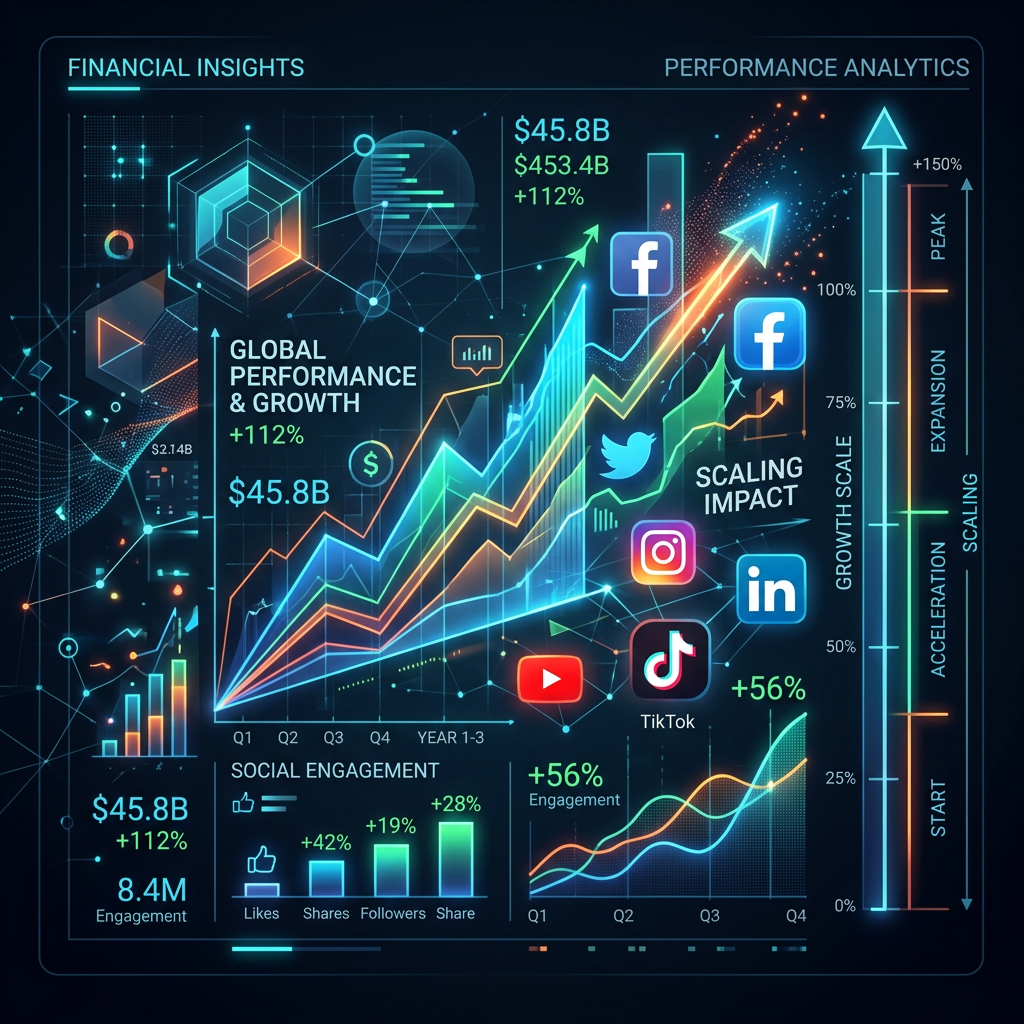
The digital era has fundamentally transformed the relationship between brand and consumer, moving from the static broadcast of television commercials to the dynamic, two-way dialogue of social media. At the heart of this revolution is influencer marketing a multibillion-dollar industry built entirely on the fragile currency of human attention.
However, as the market matures, the landscape is becoming increasingly bifurcated between the broad reach of macro-influencers and the surgical precision of micro-influencers.
Simultaneously, the integration of real-time commerce through livestream shopping is redefining ROI, all while creators grapple with an inherent systemic “uncertainty” where the distance between viral fame and digital obscurity is a single post away.
The Scale Paradox: Micro-influencers vs. Macro-influencers
In the early days of influencer marketing, “bigger was better.” Success was measured by follower counts, leading brands to flock toward macro-influencers (100k to 1M+ followers) and celebrities. These creators offer unparalleled reach and “top-of-funnel” awareness. For a global brand launching a new product line, a single post by a macro-influencer can generate millions of impressions in hours.
However, a “scale paradox” has emerged. As a creator’s follower count grows, their engagement rate typically declines. This is where the micro-influencer (1k to 100k followers) has found their edge. Micro-influencers often occupy specific niches be it sustainable fashion, hyper-local gastronomy, or technical skincare. Their audiences are not just spectators; they are a community.
Research consistently shows that micro-influencers boast engagement rates up to 60% higher than their macro counterparts. Because their following is smaller, the relationship feels personal. When a micro-influencer recommends a product, it carries the weight of a friend’s suggestion rather than a paid endorsement. For brands, this translates to higher conversion rates. While a macro-influencer provides the reach, the micro-influencer provides the resonance.
Measuring the Intangible: The ROI of Influencer Campaigns
The primary criticism of influencer marketing has long been the difficulty of calculating a precise Return on Investment (ROI). Unlike traditional digital ads (PPC), where the path from click to conversion is linear, influencer marketing operates on a more complex psychological plane.
To truly understand ROI, brands have moved beyond “vanity metrics” like likes and shares. Modern ROI analysis is categorized into three pillars:
- Earned Media Value (EMV): What would this level of exposure have cost if purchased through traditional advertising?
- Conversion Tracking: The use of unique affiliate links and promo codes allows brands to track direct sales.
- Brand Sentiment and Equity: Using AI-driven sentiment analysis to determine if the campaign improved the audience’s perception of the brand.
Interestingly, the highest ROI is often found in long-term partnerships rather than one-off “shoutouts.” When an influencer integrates a brand into their lifestyle over months, the “ad” fatigue diminishes, and the trust-building increases. The ROI of an influencer campaign is no longer just about the immediate sale; it is about the “Content Compound Interest” the long-term value of high-quality, reusable assets created by the influencer for the brand.
The Frontier: The Rise of Livestream Shopping
If micro-influencers provide trust and macro-influencers provide reach, livestream shopping provides the close. Originating in China with platforms like Taobao and Douyin, and now migrating to Amazon Live, Instagram, and TikTok, livestream shopping is the “QVC of the Gen Z era.”
Livestreaming collapses the marketing funnel. In a traditional campaign, a consumer sees a post, clicks a link, browses a site, and eventually buys. In a livestream, the journey from discovery to checkout happens in seconds. The effectiveness of this medium lies in two psychological triggers: FOMO (Fear of Missing Out) and Social Proof. When an influencer hosts a live session, viewers see hundreds of others commenting and buying in real-time. Limited-time “live-only” discounts create an urgency that static posts cannot replicate. This medium also allows for real-time Q&A, removing the friction of uncertainty. “Does this jacket fit true to size?” “Can you show the texture of this cream?” The influencer answers instantly, closing the trust gap and significantly lowering return rates, which boosts the overall ROI for retailers.
The Architecture of Uncertainty: The Viral Trap
Despite the growth of the industry, the life of a creator is defined by a profound, systemic uncertainty. The digital economy is governed by algorithms black-box formulas that determine who sees what. This has created a phenomenon where a creator can be “viral” one moment and “cancelled” or forgotten the next.
The Velocity of the Viral Moment:
In the current “Short-Form Video” era (TikTok/Reels), the algorithm prioritizes content over followers. This is a double-edged sword. It allows a newcomer to reach millions overnight, bypassing the years of “grind” previously required. However, this fame is often “hollow.” The audience is loyal to the video, not the creator. When the next trend surfaces, the viral star often finds that their million views do not translate into a loyal following.
The Fragility of the Following:
Conversely, established creators face the risk of “losing the thread.” The “Uncanny Valley” of influencer growth occurs when a creator becomes too polished or too “corporate.” In the pursuit of brand deals, many lose the raw authenticity that built their platform. A single perceived lapse in judgment, an insensitive comment, or even a shift in the platform’s algorithm can lead to a mass exodus of followers.
This volatility is known as “Algorithmic Systemic Fragility.” Creators are essentially building their houses on rented land. If the platform changes its preference from photos to videos, or from long-form to short-form, a creator’s reach can drop by 90% overnight. This leads to a state of constant “creator burnout,” as influencers feel forced to chase every trend to remain relevant.
The Paradox of Choice and the Future of Influence
As we look toward the future, the “influencer” is evolving into a “creator-entrepreneur.” Relying solely on platform ad revenue or sporadic brand deals is no longer a viable long-term strategy due to the aforementioned uncertainty. We are seeing a shift toward “owned” platforms newsletters, private communities, and their own D2C brands.
For companies, the strategy is shifting toward “Influence Portfolios.” A brand will no longer hire one celebrity; they will hire five macro-influencers for the “hype,” fifty micro-influencers for the “trust,” and ten livestreamers for the “conversion.”
Conclusion
Influencer marketing is not a fad; it is the professionalization of word-of-mouth. While the effectiveness of micro-influencers has proven that community beats celebrity, and livestream shopping has proven that immediacy beats imagery, the core of the industry remains human and, therefore, unpredictable.
The “uncertainty” of the influencer career the sudden spikes in fame and the equally sudden drops in engagement is a reflection of our own shortening attention spans. In this landscape, the only way for creators to survive, and for brands to see sustained ROI, is to move beyond the transaction. The winners will be those who prioritize genuine connection over algorithmic trends, understanding that while a viral moment is a gift of the algorithm, a loyal community is an asset that no platform can take away.




Leave a Reply