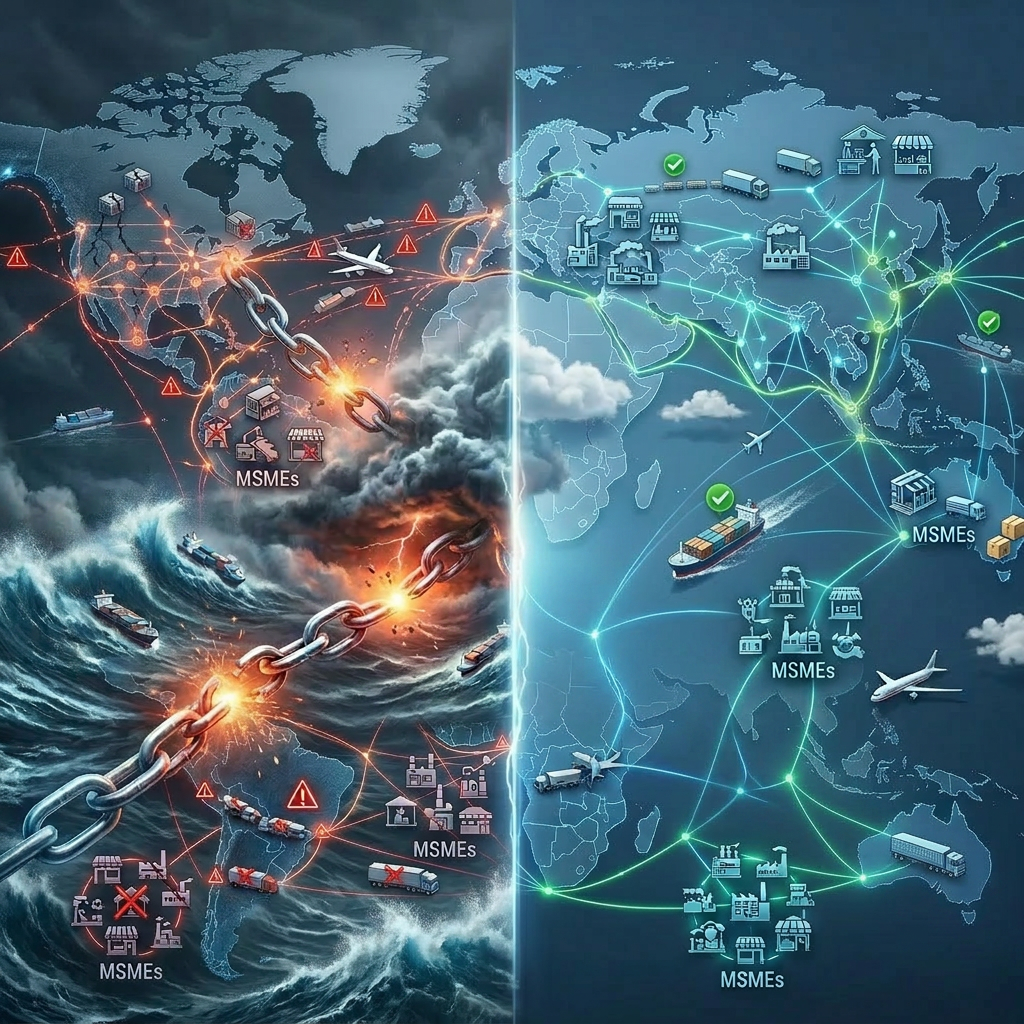
What Every MSME Must Learn from Global Conflict Shocks: Tatvita Analysts

What Every MSME Must Learn from Global Conflict Shocks

Wars are geopolitical events, but their economic consequences are deeply local. They reach factory floors, disrupt small workshops, delay shipments, and strain cash flows, long before they appear in macroeconomic data. For Micro, Small and Medium Enterprises (MSMEs), these disruptions are not abstract risks but immediate operational challenges.

Globally, MSMEs account for over 90% of businesses and 60–70% of employment, making them the backbone of economic systems. In India alone, MSMEs contribute over 30% to GDP and nearly 48% to exports, with a strong presence in manufacturing and labour-intensive sectors. This scale makes MSMEs critical not just for growth, but for economic stability.

Yet, the very features that make MSMEs dynamic—flexibility, cost efficiency, and integration into supply chains—also make them highly vulnerable. Unlike large firms, MSMEs lack buffers. They operate with limited capital, depend on predictable logistics, and often rely on a narrow set of suppliers or markets. When war disrupts global systems, MSMEs absorb the shock first and most intensely.

This article examines how wars impact MSMEs across production, employment, exports, and global contribution, and more importantly, how MSMEs have adapted and what practical strategies they must adopt to survive in an increasingly volatile world.

The Structural Importance of MSMEs in the Global Economy

Before analysing the impact, it is important to understand why MSMEs are central to this discussion.

MSME Contribution to Economy

(Source: UN MSME Report, Economic Survey)

This data highlights a crucial point:
MSMEs are not peripheral—they are the core of production networks.
When wars disrupt economies, MSMEs do not just get affected—they transmit shocks across the entire system.

How Wars Disrupt MSMEs: A Chain Reaction

War impacts MSMEs not through a single channel, but through a sequence of interconnected disruptions. These effects rarely occur in isolation—they cascade through the business system.

At the production level, the first impact is almost always cost-related. Wars tend to disrupt energy markets, particularly oil and gas, which are fundamental inputs for manufacturing, transport, and logistics. When fuel prices rise, transportation costs increase, raw materials become expensive, and production margins shrink.

During recent geopolitical tensions in West Asia, freight rates surged by 20–30%, while shipping delays extended up to 60 days. For large firms, such shocks can be absorbed or passed on. For MSMEs, they directly translate into delayed production, missed deadlines, and eroded profitability.

The second layer of disruption is export instability. MSMEs, particularly in manufacturing sectors like textiles, auto components, and light engineering, depend heavily on predictable export markets. War introduces uncertainty—orders get delayed, contracts are renegotiated, and buyers shift to alternative suppliers. Even when demand exists, logistics bottlenecks prevent timely delivery, weakening trust in MSME suppliers.

Employment is the third major channel of impact. When production slows or orders decline, MSMEs are forced to adjust their workforce. Unlike large corporations, which may have structured workforce strategies, MSMEs rely on flexible labour arrangements. This leads to immediate job losses or underemployment. In conflict zones such as Gaza, employment fell by over 60%, illustrating how quickly labour markets collapse under sustained disruption.

The fourth and most critical impact is financial stress. MSMEs operate on tight working capital cycles. Delayed shipments mean delayed payments. Rising input costs increase upfront expenditure. At the same time, access to credit becomes more constrained as financial institutions turn risk-averse during geopolitical instability. The result is a liquidity squeeze that can push otherwise viable businesses into distress.

First vs Second-Order War Effects

Why MSMEs Are More Vulnerable Than Large Firms

The disproportionate impact on MSMEs is not incidental—it is structural.

Large firms operate with diversified supply chains, global procurement networks, and stronger financial buffers. They can shift sourcing locations, renegotiate contracts, and absorb temporary losses. MSMEs, in contrast, often depend on:

  • Single suppliers or regions
  • Limited customer bases
  • Short-term financing cycles

Structural Differences in War Resilience

This creates a clear vulnerability gap. War does not create this gap—it exposes it.

Case Studies: How MSMEs Actually Responded

Ukraine: Labour Shock and Operational Adjustment

In Ukraine, MSMEs faced immediate labour shortages due to displacement and conscription. Production capacity declined sharply, forcing businesses to rethink operations. Many MSMEs responded by:

  • Automating repetitive processes
  • Shifting to local supply networks
  • Reducing product lines to focus on core output

The key lesson here was prioritisation. Survival depended on simplifying operations rather than expanding them.

India: Cost Pressures and Market Shifts

Indian MSMEs, particularly exporters, experienced sharp increases in logistics costs and delivery timelines. In response, many businesses adopted hybrid strategies:

  • Increased focus on domestic markets
  • Renegotiated pricing contracts with buyers
  • Maintained buffer inventory for critical inputs

This shift from export dependence to market diversification became a key resilience mechanism.

Global Supply Chains: Network Reconfiguration

Research on global production networks shows that even firms not directly involved in conflict suffer due to supply chain linkages. When one node in the network fails, the entire chain adjusts.

MSMEs responded by:

  • Reducing dependence on single-country sourcing
  • Building regional supplier networks
  • Shortening supply chains where possible

The Hidden Layer: Indirect and Long-Term Impacts

The most dangerous effects of war on MSMEs are often indirect.

Beyond immediate cost increases and supply disruptions, wars trigger broader economic changes:

  • Inflation reduces consumer demand
  • Credit markets tighten
  • Investment slows down

These indirect effects are often more damaging because they persist even after immediate disruptions ease.

What Successful MSMEs Did Differently

Not all MSMEs fail during crises. Some adapt—and emerge stronger.

Across case studies, successful MSMEs displayed a common pattern:

  • They diversified supply chains early
  • They avoided over-dependence on single markets
  • They maintained liquidity buffers
  • They adopted flexible production systems

These are not theoretical strategies—they are operational decisions.

Practical Strategies for MSME Owners

The real value of this analysis lies in actionable lessons.

Supply Chain Strategy

  • Build at least two alternative supplier networks
  • Prefer regional sourcing where possible
  • Maintain minimum inventory for critical inputs

Market Strategy

  • Balance export and domestic sales
  • Avoid dependence on a single buyer or region
  • Identify stable, “low-volatility” markets

Financial Strategy

  • Maintain 3–6 months of working capital buffer
  • Negotiate flexible payment cycles
  • Diversify financing sources

Production Strategy

  • Use modular production systems
  • Focus on high-margin products during crisis
  • Avoid over-expansion during uncertainty

Sectoral Impact: Not All MSMEs Are Equal

The impact of war varies across sectors.

  • Highly affected: Manufacturing MSMEs (textiles, auto components, metals)
  • Moderately affected: Agriculture-linked MSMEs
  • Least affected: Digital services, local retail

The key differentiator is exposure to global supply chains.

Future Outlook: Permanent Volatility

The global economic environment is shifting toward:

  • Persistent geopolitical tensions
  • Fragmented trade systems
  • Regional supply chains

For MSMEs, this means one thing: Stability is no longer the norm—volatility is.

Long-Term Trends

War as a Business Stress Test

Wars do not destroy MSMEs randomly. They test their structural resilience.

Businesses that fail are often those that:

  • depend on single supply chains
  • lack financial buffers
  • operate without risk awareness

The real lesson is not to avoid war impact—it is to design businesses that can survive it.

MSMEs that treat war as an exception fail.
MSMEs that treat uncertainty as a system—survive and scale.

Tatvita Insight

Author

Leave a Reply

This site uses Akismet to reduce spam. Learn how your comment data is processed.

← Back

Thank you for your response. ✨

Discover more from Tatvita Analysts

Subscribe now to keep reading and get access to the full archive.

Continue reading