
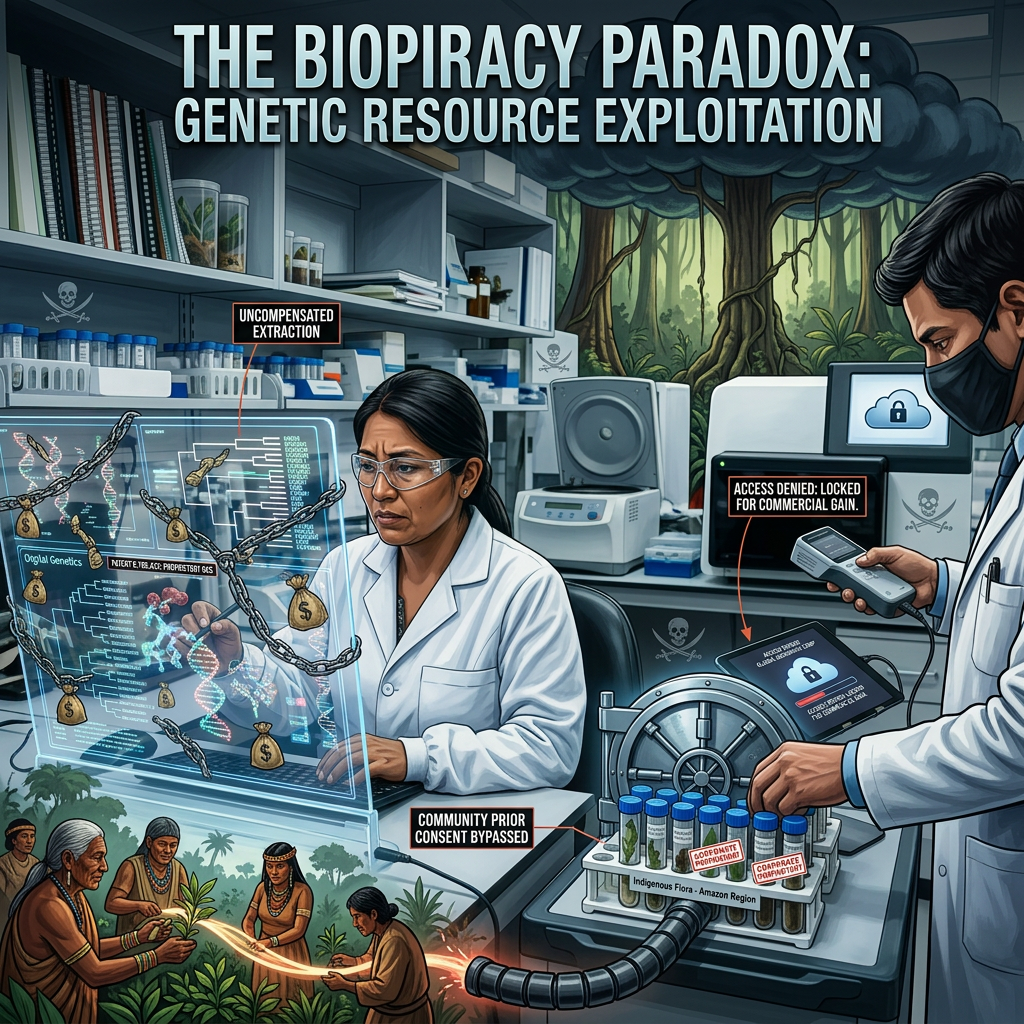
As foundational scholars like Vandana Shiva have extensively documented for decades, the global business of biology relied on a straightforward model of physical extraction. Traditional biopiracy was simple: corporations and researchers from wealthy, Western nations travelled to the developing world to harvest physical biological resources like seeds, plants, and soil alongside the indigenous knowledge that came with them. They regularly took these resources without asking for permission or offering fair payment, turning local heritage into patented corporate products.

They got away with this through a massive legal loophole regarding “prior art.” Legal analyses of international patent law show that Western patent offices historically only recognised existing knowledge if it was published in formal academic journals. Millennia of indigenous oral history and traditional farming practices were legally invisible, leaving them wide open for corporate theft.
The Indian Neem tree became the defining battleground for this flaw. Indian farmers and Ayurvedic healers had used Neem as a natural pesticide and antifungal medicine for over 2,000 years. Yet, according to European Patent Office (EPO) records, in the 1990s, a U.S. corporation, alongside the U.S. Department of Agriculture, isolated a Neem extract and successfully patented its fungicidal use in Europe as a brand-new invention. The patent was officially granted, giving a Western company legal control over a practice that had existed in India for centuries.
It took a gruelling, ten-year international legal war by the Indian government to finally prove that using Neem was common historical knowledge, not a corporate invention. This sustained legal pressure ultimately forced the EPO to completely revoke the patent.
The Neem victory was historic, but it proved just how vulnerable physical nature was to international patent laws. However, as contemporary research in journals like Third World Quarterly has highlighted, just as global treaties finally began adapting to protect physical seeds and the communities that grew them, the geopolitical battlefield shifted entirely. The extraction moved from the soil to the server, setting the stage for a new, invisible era of digital exploitation.
Biopiracy 2.0 and the Nagoya Loophole
To understand exactly how modern biological theft now widely termed “Biopiracy 2.0”, operates, we first have to examine the international law that was built to stop its predecessor: the Nagoya Protocol.
Adopted in 2010 under the UN Convention on Biological Diversity, the Nagoya Protocol was a landmark international treaty designed to enforce a framework known as Access and Benefit-Sharing (ABS). According to the official text of the UN treaty, if a corporation or researcher wanted to extract a genetic resource—like a rare medicinal plant from the Amazon or a drought-resistant seed from Sub-Saharan Africa—they had to secure prior informed consent and formally agree to share any resulting commercial profits with the source country. For a brief moment, it seemed the era of unchecked colonial extraction was finally over.
But the Nagoya Protocol had a fatal flaw built into its very definition of nature. As highlighted by legal analyses published via ResearchGate, the treaty’s legislative text strictly defines a regulated genetic resource as tangible “material of plant, animal, microbial or other origin containing functional units of heredity.” It was a law built entirely around physical customs checkpoints and physical matter.
This physical bias created a massive legal void when biology underwent what academic journals like Third World Quarterly call the “dematerialization of nature.” This transition is the exact engine driving Biopiracy 2.0. Today, corporate prospectors no longer need to smuggle physical seeds or vials of blood across international borders. Instead, researchers sequence the DNA of an organism locally and upload that genetic blueprint internationally recognised as Digital Sequence Information (DSI) to global, open-access databases.
Once that code is online, the physical organism becomes practically irrelevant. As detailed in a 2025 investigative report by Undark Magazine, bioengineers in Western laboratories can simply download the DSI of a resilient crop or a unique microbe for free. Because DSI is legally classified as intangible data rather than physical material, it exists entirely outside the Nagoya Protocol’s jurisdiction. Agrochemical and pharmaceutical conglomerates can synthesise the downloaded code, alter it, and patent the resulting biological products without ever setting foot in the Global South or signing a single benefit-sharing agreement.
The international community is now scrambling to close this digital loophole before the global bioeconomy is completely monopolised. During the late 2024 UN Biodiversity Conference (COP16) in Cali, Colombia, global negotiators established the “Cali Fund.” According to official UN frameworks, this multilateral fund is a desperate attempt to force major biotechnology and agricultural companies to pay a percentage of their DSI-derived profits back into a global reserve, hoping to finally enforce the spirit of Nagoya in a borderless digital world.

AgriTech and the Battle for Food Sovereignty
The consequences of this digital loophole are not theoretical they are actively reshaping global agriculture. The most aggressive frontier for Biopiracy 2.0 is the AgriTech sector, where the corporate control of Digital Sequence Information (DSI) directly threatens global food sovereignty.
According to policy reports from the UN Food and Agriculture Organization (FAO), the Global South holds the vast majority of the world’s in situ agrobiodiversity. For centuries, indigenous farmers across Africa, Asia, and Latin America have cultivated “landraces” traditional crops naturally adapted to extreme environments, such as flood-resistant rice or drought-tolerant wheat.
Under the old rules of classical biopiracy, a corporation would have to physically harvest those seeds to exploit them. Today, as agricultural researchers have documented in journals like Nature Biotechnology, they only need the data. Once the genome of a drought-resistant African sorghum plant is sequenced and uploaded to an open-access database, multinational agrochemical companies can download that genetic code from a laboratory in Europe or the United States.
Armed with this downloaded DSI, bio-engineers utilise advanced gene-editing tools like CRISPR. They isolate the specific sequence responsible for drought resistance and digitally map it before chemically splicing that trait into their own commercial crop lines, like corn or soybeans. The corporation then legally patents the resulting genetically modified seed.
As agricultural economists and food sovereignty advocates point out, this creates a devastating geopolitical irony. The indigenous communities that spent generations cultivating these climate-resilient traits receive zero compensation because a physical seed never technically crossed a border. Worse, as climate change accelerates and extreme weather devastates local harvests, these same developing nations are often forced to buy back the patented, climate-resilient commercial seeds that were engineered using their own digitised heritage.
The international agreements designed to prevent this are buckling under the weight of the technology. The primary treaty meant to protect global agricultural equity—the International Treaty on Plant Genetic Resources for Food and Agriculture (ITPGRFA), often referred to as the Plant Treaty—is suffering the exact same fate as the Nagoya Protocol. Legal analysts note that the Plant Treaty was meticulously built to regulate the multilateral exchange of physical seeds and agricultural matter, leaving it fundamentally unequipped to govern the invisible, downloaded data driving modern gene-editing.
From Fields to Servers: The Expanding Reach of Biopiracy 2.0
Ultimately, the dematerialisation of nature has fundamentally rewritten the rules of biological extraction. The transition from classical physical theft to Biopiracy 2.0 has allowed multinational corporations to enclose the genetic heritage of the Global South behind digital paywalls. The battle for global food sovereignty is no longer just being fought in the soil; it is being fought on corporate servers.
However, the agricultural sector is only the first casualty. In sterile laboratories, bio-engineers are already utilising downloaded Digital Sequence Information (DSI) to program microbes to artificially synthesise high-value crops like vanilla and stevia in vats, threatening traditional export economies entirely. Even more critically, this digital extraction is fueling a high-stakes geopolitical war over human pathogen data, where developing nations share viral codes only to be priced out of the resulting vaccines.
The digital code of life has been unlocked, and the true battle for its control has only just begun.
Author

Make Tatvita one of your preferred sources
See more insights from Tatvita Analysts in your Google Search results.


Leave a Reply