
The current war between the United States, Iran, and Israel is not merely a military conflict, but a disruption at the systems level. Military strikes are now accompanied by cyberattacks on energy infrastructure, communication disruptions, and pressure on international trade routes like the Strait of Hormuz, through which almost 20 percent of the world oil passes.
This reveals a deeper transformation: defence is no longer about owning weapons, but about ensuring continuous access, adaptability, and sustainment under disruption. Import-dependent countries can have sophisticated systems in peacetime, but in times of conflict, the breakdown of supply chains and geopolitical limitations can make these systems ineffective.
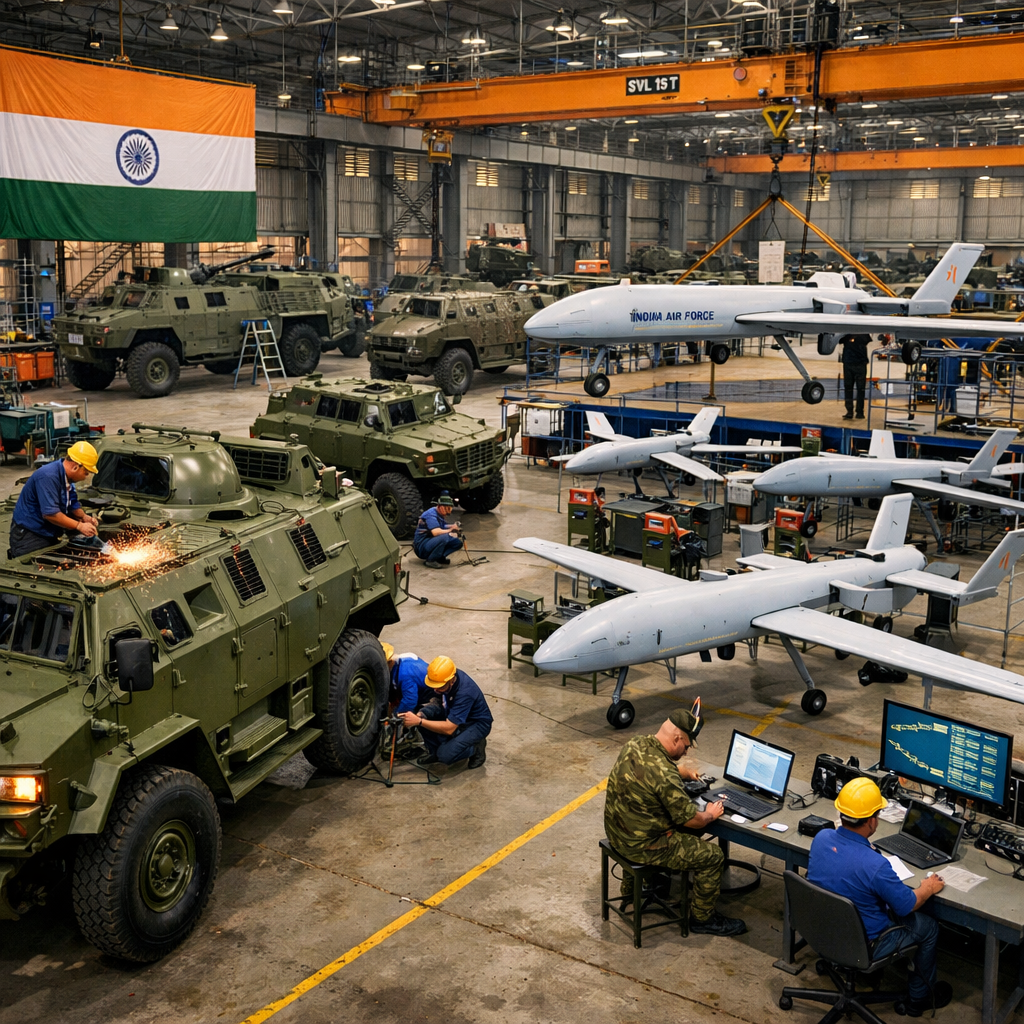
The defence manufacturing policy of India in the last ten years should be viewed in this context, not as industrial growth, but as an effort to develop deployable capability in the face of uncertainty.
Import Dependence to System Rewiring:
The initial position of India was structurally limited. It imported about 9-11 percent of the world arms imports in 2018-2022 (SIPRI), indicating a high reliance on foreign suppliers of sophisticated systems. The scale of domestic production was small, the involvement of the population was low, and the procurement was slow and fragmented. This model became unsustainable over time. Since 201415, defence production has grown to over 1.27 lakh crore in 2023-24, and is estimated to reach 1.5 lakh crore, according to the Press Information Bureau.
Exports demonstrate an even more dramatic change, increasing by 50 times, with ₹686 crore in 2014 to ₹38,424 crore in FY 2025-26, with India now exporting to more than 80 countries.
These changed were not just quantitative- It required a fundamental redesign of how procurement creates capability.
Procurement Reform: DAP 2020 to a Developing Framework:
The Defence Acquisition Procedure 2020 was a major policy change, focusing on domestic procurement with categories like Buy (Indian–IDDM) and requiring indigenous content of approximately 50-60%. It also made sure that almost three-fourths of capital procurement would be channelled to domestic industry. This was a solution to one of the major limitations, namely, absence of guaranteed demand, which had traditionally deterred private investment.
But DAP 2020 was mostly created in a fairly stable environment. Its operations were still sequential and time-consuming, with an emphasis on capacity building, as opposed to speedy deployment. Later reforms, sometimes referred to as a developing DAP 2026 framework, suggest a change of focus. Changes include:
- Multi-year procurement contracts (usually 3-5 years) to guarantee continuity in production
- Quick access to new technologies
- Less procedural layers and parallel testing mechanisms.
These changes are indicative of a shift in the policy objective of indigenisation to the strategic need of operational readiness. The topicality of this change is more evident in the Iran conflict.
The nature of modern warfare is dynamic and can easily surpass the conventional procurement processes. Systems have to be purchased, modified, and implemented within shortened periods. A procurement system that is mainly aimed at transparency and efficiency in the process might not work in such circumstances. The changing strategy of India tries to fill this gap. The question of whether it can always provide speed without affecting quality is still open.
Indigenisation as Strategy: Capability Creation or Constraint?
One of the most aggressive instruments in the defence manufacturing strategy of India is its Positive Indigenisation Lists, which include more than 400 defence items. The policy will limit imports in various categories to force local production and decrease reliance on foreign suppliers in the long term. Structurally, the process is straightforward: the elimination of imports compels companies to invest in domestic capacity, establish supply chains, and acquire technical skills in sectors that were once controlled by foreign actors. This is theoretically consistent with the larger goal of strategic autonomy. The success of such a strategy, however, is determined by the ability of domestic capacity to compete with the quality, scale, and technological sophistication of international options.
Practically, this shift is not even. Although India has grown in terms of volumes of production and involvement of suppliers, some of the high-technology sectors, including advanced electronics and propulsion systems, still depend on imported materials or foreign cooperation. This implies that indigenisation can be partial and not complete in certain instances. From an economic standpoint, this introduces a trade-off.
Import restrictions can hasten the formation of domestic capability, but they can also: increase procurement costs in the short term restrict the use of advanced technologies and exert pressure on local companies to grow fast.
The Iran war supports both sides of this argument. On the one hand, it shows the dangers of external dependence. On the other, it emphasizes the ongoing significance of technological integration in contemporary defence systems across the globe. A more measured strategy might thus be needed, one that differentiates between those areas where complete localisation is needed and those where strategic cooperation is still needed.
Innovation Systems: Is iDEX Able to Keep up with Modern Warfare?
The Innovations for Defence Excellence (iDEX) program in India is an effort to fill the historical innovation gap in the sector by engaging startups and MSMEs. The program has increased the scope of technological experimentation in defence with more than 300 startups involved. This change is especially applicable to the Iran conflict, where electronic systems, drones, and cyber warfare are at the center stage. These technologies are changing at a very fast rate and sometimes they are faster than the traditional development cycles. iDEX brings flexibility through decentralization of innovation and enabling several firms to develop parallel solutions. It improves flexibility by allowing multiple firms to develop solutions simultaneously. However, the key challenge lies in conversion:
- Can prototypes scale into production?
- Can innovations integrate with existing defence systems?
Without this transition, innovation risks remaining experimental rather than operational.
Industrial Expansion: Scale with Coordination Problems
The push in defence manufacturing in India is frequently presented as a narrative of scale-and to a great degree, that is the case. The industry has grown at a high rate and more than 16,000 MSMEs are now part of defence supply chains and investments in defence industrial corridors are projected to be more than 20,000 crore in Uttar Pradesh and Tamil Nadu (Press Information Bureau). This would appear to indicate a robust and diversified industrial base.
The broader network of companies means that it is more resilient, particularly in a conflict-based environment where supply chains are often broken, as is the case with the current US-Iran-Israel tensions. But scale does not necessarily equate to capability.
Where Scale Helps (Especially in War Conditions)
- Industrial expansion has obvious benefits in a war situation such as the Iran war:
- Supply chain redundancy : failure in one part does not stop the production completely
- Faster component sourcing reduced dependence on unstable global logistics
- Production scalability
- Ability to ramp up output when demand spikes
Where Constraints Emerge?
A distributed system presents coordination issues:
- Ensuring uniform quality in thousands of companies
- Aligning multi-level supply chains
- Delivery of components on time
There is evidence that most MSMEs are still concentrated in low-to-mid value segments, and there is little high-technology manufacturing. This creates a structural gap: scale has grown more rapidly than technological depth.
War Context: Why Coordination Matters
The Iran conflict demonstrates that defence capability is not just a matter of production, but also of maintenance and sustainment. In such conditions:
- slowdowns in one part can put whole systems on hold
- response time can be slowed by coordination failures
This means industrial scale must evolve into operational coherence under disruption.
Technology and FDI: Autonomy or Managed Dependence?
The FDI policy of India, which permits up to 74 percent foreign ownership, has facilitated the transfer of technology and joint production. This assists in closing capability gaps, but also creates a strategic issue: Does technology transfer bring about independence- or a new kind of dependence?
Even when the key elements or intellectual property are still under the control of others, local production can still be dependent on imports. This risk is evident in the Iran conflict. Technology may be limited in a geopolitical environment that is disrupted.
The long-term test is whether India can transition out of access to technology to ownership of technology.
Exports: Opportunity with Strategic Limits. The defence exports of India, which have increased by more than 20 percent per year, are a sign of enhanced capacity and increased demand in the world market. Exports provide:
- economies of scale
- cost competitiveness
- global market integration
Defence trade is not economic, however. It is shaped by geopolitical alignments, regulatory restrictions and strategic partnerships.
The comparatively neutral positioning of India in a fragmented global environment is an advantage. However, to maintain export growth, there will be a need to maintain quality and technological improvement.
India’s defence manufacturing shift must ultimately be evaluated not by output growth, but by strategic resilience under disruption. Despite policy momentum, India still imports a significant share of critical sub-systems, with estimates suggesting that over 30–35% of high-end defence components continue to rely on foreign inputs across advanced platforms.
This becomes particularly relevant in the context of the US–Iran–Israel conflict, where supply chains are not just disrupted they are increasingly weaponised through sanctions, alliances, and technological controls.
The real test, therefore, is not whether India can manufacture defence equipment, but whether it can sustain and adapt that capability when access to global inputs is constrained.
India’s trajectory suggests progress, but also highlights a structural tension between expanding domestic production and achieving genuine technological independence. How this tension is managed will determine whether India emerges as a resilient defence producer or remains embedded within fragile global dependencies.
Author

Make Tatvita one of your preferred sources
See more insights from Tatvita Analysts in your Google Search results.



Leave a Reply