
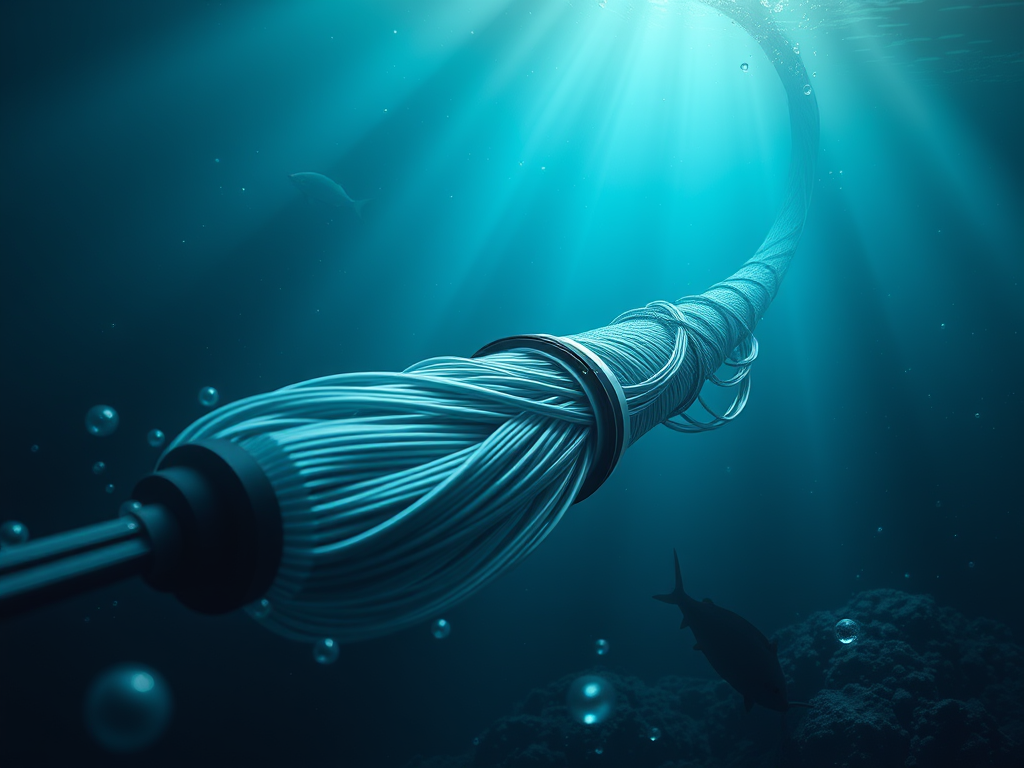
As per Science Direct, the Submarine Cable is defined as such: “A ‘Submarine Cable’ refers to a type of cable that is laid on the seabed and plays a vital role in our everyday life, ensuring data security at national levels. These cables are vulnerable and difficult to repair, making them relatively unknown to the general public.”
This article assesses the importance of submarine cables in preserving the integrity of the digital world while taking note of their inherent structural vulnerabilities. It investigates how geopolitical tensions affect these cables, highlighting the grey-zone warfare techniques. Furthermore, it applies the thoery of weaponised interdependence in terms of the submarine cable infrastructure, which threatens the data sovereignty of nations.
The Architecture of Global Connectivity
Submarine cables span over 1.48 million km in length; to put it in perspective, that is over 3 times the distance between the Earth and the Moon. In their paper “Submarine Cables and the Risks to Digital Sovereignty”, Abra Ganz et al. stated that over 99% of the internet traffic flows solely through the cables. In fact, if all the cables to the U.S. are to be cut, not even 10% of the internet traffic of the U.S. can be sustained by the alternative satellite links that are currently present. As of now, the subsea cables are not obsolete compared to the satellites because they can handle terabits of data in a world where fast data transfers are of prime importance. Satellites cannot handle vast quantities of data, nor can they do so at a fraction of the cost of subsea cables.
Each fibre in the cable can transfer as much data as 375 million phone calls, and each cable contains from 4 to 200 fibres. As per Rishi Sunak’s report to the Policy Exchange think tank (Undersea Cables Policy Exchange), over $10 trillion worth of financial transfers are made through the cables per day. Stephen Malphrus, the former Chief of Staff to the Federal Reserve Chairman, once famously stated, “When communication networks go down, the financial services sector does not grind to a halt, rather it snaps to a halt.” The fate of the abovementioned communication network is contingent upon these fragile submarine cables.

The Geopolitics of a Severed Line
As per the UNIDIR’s report, around 200 faults occur every year to cables, out of which over 70% are due to human error. This matter is further exacerbated by the grey-zone war tactics that are being employed by various parties. The war tactic of severing the communication by damaging the subsea cable has been in use for a long time. In 1914, the British Royal Navy quietly severed the five cables that the Germans used for transatlantic communication only hours after declaring war on them.
In early 2024, the Red Sea region became classified as a High Risk Area (HRA). This was because of the Houthis’ militant attacks that were occurring. It was during this same time that multiple subsea cables (AAE-1, EIG, SeaCom) were severed. Since it was already an HRA, repair ships would take even longer to arrive at the fault sites because of the astronomical surge in the insurance of these ships (up to 1% of the ship’s hull value). In 2025, there was a massive clustered failure of communication that occurred because of the simultaneous severing of subsea cables.
This immediately degraded internet connectivity across India, Pakistan, and the UAE, and spiked latency on major cloud providers like Microsoft Azure. This was attributed to the Houthis (the exact mechanisms of sabotage remain contested). A prime manifestation of a grey zone tactic that can be taken is how countries use civilian ships or shadow fleet ships to drag anchor and damage cables, as seen in the Baltic region by the Chinese ship Yi Peng 3 or the Russian shadow fleet Eagle S. This allows state actors “plausible deniability”, preventing any country from calling it an act of war.

The US-China Rivalry & The Splintering Internet
As per Henry Farrell and Abraham Newman, weaponised interdependence refers to how states exploit asymmetrical, networked relationships—such as finance, data, and trade hubs—to coerce others. In the 2019 International Security paper, Farrell and Newman argue that the states which act as hubs can use their influence on the global network to exert two primary forms of leverage: the “Panopticon effect” (surveillance/espionage) and the “Chokepoint effect” (denying access to adversaries), both of which affect the sovereignty of any nation. In the subsea cable market, the highest is currently with the US and allied nations (SubCom (US), Alcatel Submarine Networks (ASN)(France) and the NEC (Japan)). These organisations together have a combined market share of 75-85%
A prime example of the weaponisation of subsea infrastructure can be observed in the East Micronesia Cable System (EMCS). In 2021, the World Bank led a project to connect Nauru, Kiribati, and the Federated States of Micronesia (FSM), which received a bid from HMN Technologies of China that was 20% cheaper than Western rivals. The US government intervened, issuing diplomatic warnings that HMN Tech posed a severe espionage threat because the cable would eventually connect to Guam (a highly sensitive US military hub). This was a clear case of the chokepoint effect since after this, the US and its allies commandeered the project, awarding a $95 million contract to NEC to prevent any involvement of the Chinese state-backed vendors, as reported by a Reuters investigation.
China found a bypass to this by commissioning the PEACE cable, a $425 million Chinese-owned cable that bypasses the traditional U.S.-centric hubs by running overland through Pakistan (a staunch Chinese ally), down the coast of East Africa, through the Red Sea, and landing directly in Marseille, France. This physical divergence actively splits the internet into two major geopolitical grids.

Sovereignty at the Bottom of the Sea
A late 2024 report by Finabel argues that current international laws, such as UNCLOS, are hopelessly outdated for peacetime infrastructure protection. This prevents grey-zone tactics of war from being prosecuted as acts of war. The UK Parliament Joint Committee on the National Security Strategy (September 2025) reports that 70-80% of the faults are non-malicious in nature. Yet, several states use proxy actors and civilian vessels to cause damage.
In a world where knowledge is strength and power, where data can help develop the global village, we need to take action to protect the undersea cables. The University of Pennsylvania Law Review (2025) called these subsea cables “undersea arteries”. Data should not be monopolised or threatened. A chain is only as strong as its weakest link. The chain that binds us to a promising future for the digital age has its weakest link in the underwater arteries. Global economies, data flows, and international communications are all tethered to those fibres that are deep in the dark, vulnerable waters of the oceans.
Out of sight, maybe out of mind, but that doesn’t mean it ceases to exist. We cannot protect the future of the digital world without first securing the physical depths of the earth.
Author

Make Tatvita one of your preferred sources
See more insights from Tatvita Analysts in your Google Search results.



Leave a Reply