
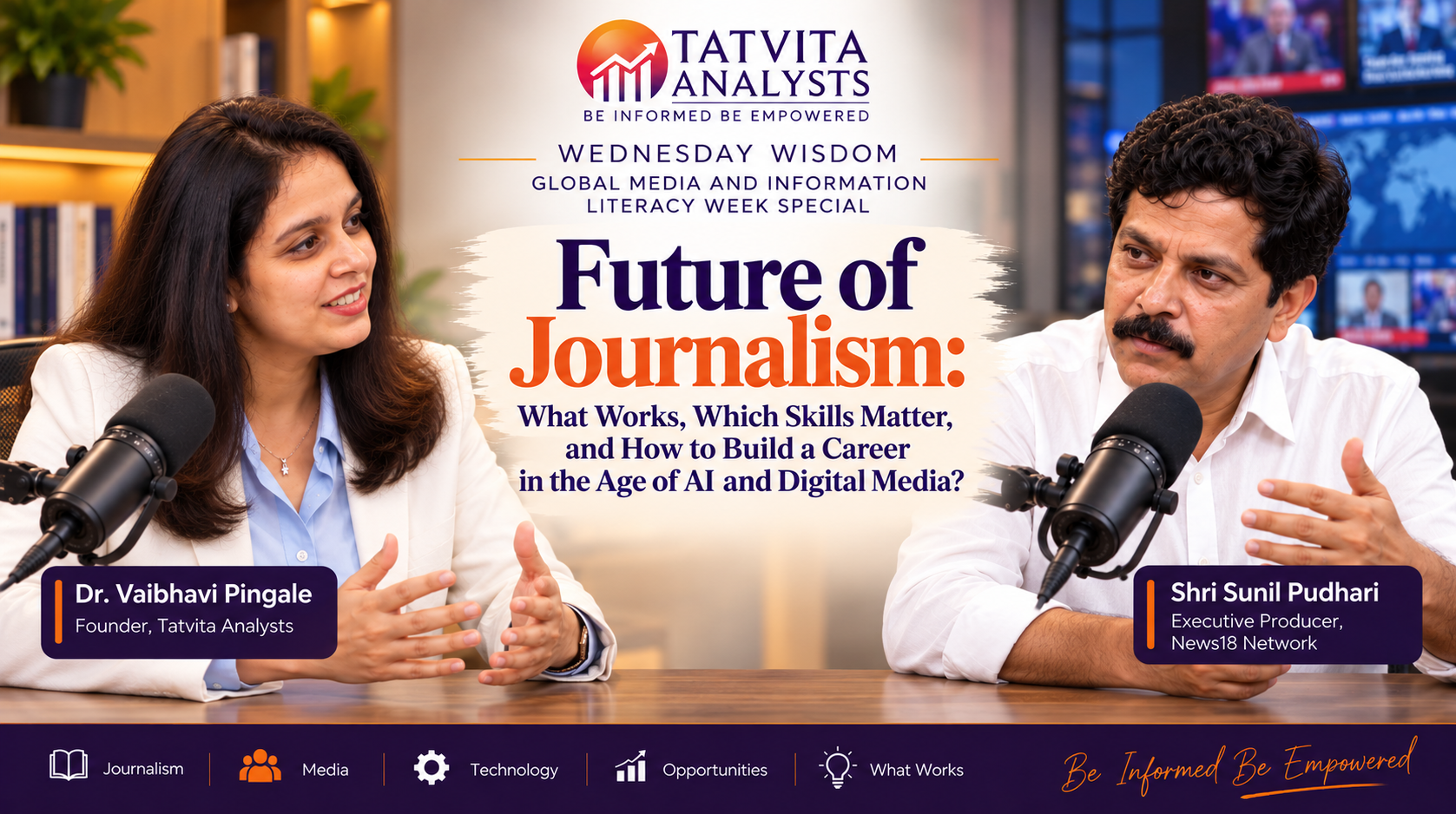
Future of Journalism: What Works, Which Skills Matter, and How to Build a Career in the Age of AI and Digital Media?
Journalism has undergone a remarkable transformation over the past few decades. From newspapers and radio to television, digital news platforms, social media, podcasts and artificial intelligence, the ways in which information is produced, distributed and consumed have fundamentally changed.
Today, information travels across geographical boundaries almost instantly. Readers are no longer passive recipients of news; they can question, comment, share opinions and participate in public discussions. Digital platforms have created opportunities for journalists to reach wider audiences, but they have also introduced challenges relating to credibility, competition, advertising revenues and changing consumer preferences.
In an era when information is available in abundance, the question is no longer simply how quickly news can reach people, but what value professional journalism can add to the information people already receive.
On the occasion of Global Media and Information Literacy Week (24–31 October), Tatvita Analysts’ Wednesday Wisdom – Expert & Practitioner Interview Series speaks with Shri Sunil Pudhari, Executive Producer, News18 Network, about the changing landscape of journalism and media. Drawing on his professional experience, he shares insights into the evolution of audience engagement, the economics of traditional and digital media, the growing role of artificial intelligence, the importance of credible reporting and the skills that will define the next generation of journalists. The conversation explores what makes journalism relevant and sustainable in an increasingly digital, interconnected and information-rich world.
1. Journalism has evolved from newspapers and radio to television, digital news platforms, social media and now AI-generated content. Having witnessed or studied these changes, what do you consider the most significant transformation in journalism, and how has it changed the relationship between journalists and their audiences?
In my experience, one of the most significant transformations in journalism has been the shift from one-way communication to two-way interaction between journalists and their audiences.
Traditionally, newspapers and other conventional media primarily communicated information to readers and viewers. Journalists reported events, and audiences consumed the information. There were limited opportunities for immediate dialogue or feedback.
The emergence of digital media, particularly social media, has fundamentally changed this relationship.
Today, readers can respond directly to journalists, express their opinions, question reporting, share experiences and participate in discussions. Journalism is no longer confined to communicating information; it increasingly involves engaging with the people for whom that information is intended.
Another important transformation is the ability to understand audiences more precisely.
Earlier, newspapers could estimate circulation, but it was difficult to determine exactly who read particular stories, which subjects interested them, or how they responded to specific content.
Digital platforms now provide information about readership, viewership, engagement, comments and audience preferences. Journalists and media organisations can understand which subjects attract attention, what questions people are asking and how different audiences respond to information.
This has also encouraged the growth of participatory journalism, where citizens contribute their experiences, observations, opinions and perspectives to public discussions.
In my opinion, the most important change is that journalism has become more interactive and audience-responsive. The relationship between journalists and readers is increasingly developing into a continuous dialogue rather than a one-directional flow of information.
2. Today, people receive information through news websites, social media, podcasts, newsletters, video platforms and even AI assistants. With so many competing sources of information, what makes journalism relevant and valuable to audiences today?
I believe the relevance of journalism lies not merely in providing information but in helping people understand its meaning, context and significance.
Today, information is available through numerous sources. People can receive updates about events almost immediately, often without waiting for a newspaper, television bulletin or news website.
However, receiving information and understanding its implications are two different things. A particular event may be widely reported, but readers may still want to know why it happened, whether it represents a positive or negative development, how it relates to other events and what consequences it may have for their lives.
This is where professional journalism continues to play an important role. For example, reporting that a new metro line has been developed provides information about an infrastructure project. However, journalism can go further by examining whether adequate connecting transportation is available, how commuters will reach metro stations, and whether the project will genuinely improve everyday mobility. Such reporting helps people understand the practical relevance of a development rather than simply knowing that it has occurred.
In my view, journalists contribute by examining events from different perspectives, providing context, analysing their consequences and helping audiences form informed opinions. Information tells people what has happened; journalism helps them understand why it matters. That distinction will continue to make professional journalism relevant, even as the number of information sources increases.
3. The growth of digital platforms has made information more accessible, but it has also created intense competition for audience attention. How can journalists and media organisations balance the pressure for speed, views and engagement with the responsibility to provide accurate, meaningful and well-researched information?
In today’s media environment, information travels extremely quickly. Digital platforms continuously compete to attract readers and viewers, and audiences have become accustomed to receiving updates almost immediately.
However, I believe journalists must recognise that being the first to report something is not necessarily the same as providing the most valuable information.
A journalist’s responsibility extends beyond communicating an event. It involves examining the background, understanding different perspectives and explaining the possible consequences. For example, when a major infrastructure project, government decision or economic development is announced, audiences may receive the basic information from several sources simultaneously. What distinguishes meaningful journalism is the ability to explain how that development affects people, what opportunities or challenges it creates and whether the expected benefits are likely to reach the intended beneficiaries.
In my opinion, journalists should therefore focus on the relevance and quality of their reporting rather than relying entirely on speed or popularity. Audience interests are important, and digital platforms help journalists understand which subjects people want to know more about. However, this understanding should guide journalists towards producing more useful and meaningful content. Journalists must also examine information carefully before presenting their interpretations. Their analysis and opinions should be based on a sound understanding of the subject.
Ultimately, the objective should be to provide information that is not only timely but also accurate, relevant and useful to readers.
4. Advertising has historically been an important source of revenue for media organisations, but digital platforms and changing consumer behaviour have transformed media economics. Which business models advertising, subscriptions, memberships, sponsored content or other approaches, do you believe can support financially sustainable and editorially independent journalism?
Advertising has traditionally been one of the most important sources of revenue for media organisations, particularly newspapers. However, over the past 10–15 years, I have observed considerable changes in the advertising business.
In my assessment, the Indian newspaper industry has experienced stagnation or pressure on traditional advertising revenues, while advertising opportunities across electronic and digital media have expanded. One important difference is the pricing structure. For example, depending on the publication and advertising format, a full-page newspaper advertisement may cost approximately ₹10–16 lakh, whereas certain short-duration digital advertisements may begin at much lower rates, sometimes around ₹1,500. These are illustrative examples from my observations, and actual rates vary considerably across publications, platforms and audiences.
Consequently, even when the volume of digital advertisements increases, the revenue generated from individual advertisements may be substantially lower than that from premium print advertising.
Another important change concerns audience behaviour. In my observation, younger audiences increasingly prefer digital media, while newspaper readership remains relatively stronger among people aged 40 and above. Media organisations must therefore adapt their revenue strategies to changing audience preferences. I believe a 360-degree media business model, involving multiple platforms and revenue sources, offers an important direction. Several approaches are being adopted.
- First, integrated advertising packages. Media organisations with newspapers, television channels, radio stations and digital platforms can offer advertisers combined packages. For example, an advertiser purchasing print advertising may also receive digital advertising opportunities as part of a broader media package.
- Second, advertorials and sponsored content. These have emerged as additional sources of advertising revenue for media organisations.
- Third, events and exhibitions. Media houses are increasingly organising sector-specific exhibitions, real-estate events, cultural programmes and other activities that attract sponsorships and generate additional business opportunities. Such initiatives often require dedicated teams for planning, marketing and implementation.
- Fourth, digital content monetisation. Digital-first media organisations can generate revenue through podcasts, video content, news programmes and other formats. Platforms such as YouTube also provide monetisation opportunities when creators meet the applicable eligibility and performance requirements.
In my opinion, the future financial sustainability of media organisations will increasingly depend on their ability to diversify revenue sources rather than rely exclusively on traditional newspaper advertising. Media businesses must understand where their audiences are moving and develop suitable commercial models across different platforms.
5. Globalisation and digital connectivity have enabled local events to reach international audiences almost instantly. How has this changed the role of journalism, and what opportunities do you see for Indian journalists and media organisations to build a global readership while remaining relevant to local communities?
Globalisation and digital connectivity have created significant opportunities for Indian journalism to reach audiences beyond geographical boundaries.
Earlier, local and regional news organisations primarily served readers within their immediate markets. Today, digital platforms allow the same content to reach people living in different countries.
One important audience consists of Non-Resident Indians (NRIs) who wish to remain connected with their hometowns, states and cultural roots. For these audiences, local news is not merely information. It provides a connection with their homeland. They may be interested in regional developments, political events, festivals, cultural activities and changes taking place in the communities to which they belong.
At the same time, international audiences who do not have Indian origins may be interested in India’s culture, traditions, history, mythology, tourism and social developments. This creates opportunities for Indian journalists and media organisations to develop content for different international audiences. However, I believe success requires a clear understanding of the target audience.
Journalists must consider who their readers or viewers are, what interests them, what information they are seeking and how the content can be presented in a relevant and engaging manner. Imagination and creativity are important in identifying these opportunities.
For example, content about Indian festivals may interest different audiences for different reasons. For some, it represents a connection with their cultural identity. For others, it offers an opportunity to understand Indian traditions. The same subject can therefore be presented through different perspectives depending on the audience.
In my opinion, journalism should avoid becoming repetitive or restricted to a single type of audience. Media organisations should develop the ability to connect with different generations, communities and sections of society. The opportunity lies in understanding diverse audiences and creating content that connects local experiences with wider interests.
6. Artificial intelligence is increasingly being used for research, transcription, translation, content creation, personalisation and news distribution. Which applications of AI do you believe can genuinely strengthen journalism, and where must human editorial judgement, verification and accountability remain indispensable?
Artificial intelligence is undoubtedly becoming an important tool for journalists.
In my opinion, AI can be particularly useful for gathering background information, identifying references, accessing relevant data and developing an initial understanding of a subject. It can provide a starting point for research and help journalists explore information more efficiently. However, I strongly believe that AI-generated information should serve as a reference or foundation, not as the final journalistic output.
The real contribution of a journalist lies in analysing that information, interpreting its meaning and presenting an informed perspective. A journalist’s experience, observations, understanding of society and ability to connect different developments contribute to the quality of reporting. These are important aspects of human judgement.
Another area where I see limitations in AI-generated content is language. Although AI can produce text quickly, it may not always select the most appropriate words, expressions or tone for a particular situation. An experienced journalist understands the nuances of language and can choose expressions that communicate meaning more effectively.
There is also a creative dimension to journalism. The satisfaction of developing an original interpretation, presenting a distinctive perspective or explaining a complex subject in one’s own words is an important part of the profession.
In my view, journalists should certainly learn to use AI and benefit from its capabilities. However, they should not follow AI-generated information blindly. AI can assist journalists in gathering information, but interpretation, creativity, verification and editorial responsibility must remain with human professionals.
7. Misinformation, disinformation, deepfakes and algorithm-driven content are making it increasingly difficult for audiences to distinguish credible information from misleading narratives. What journalistic practices are most effective in building and maintaining public trust, and how can media literacy help citizens become more discerning consumers of information?
One of the greatest challenges in today’s information environment is that information can be presented selectively or interpreted in ways that influence public understanding.
As we often say, statistics can be used as well as abused. A particular statistic may be factually correct, but presenting it without sufficient context or selecting only certain data points can create a misleading impression.
For this reason, I believe journalists must examine information carefully, verify the underlying data and consider different perspectives before concluding. Maintaining impartiality is particularly important. Journalists should not simply accept information at face value. They must question its source, examine its relevance and consider whether other interpretations are possible.
Another concern is the influence of algorithm-driven content. Digital platforms frequently recommend information based on users’ previous interests and engagement patterns. As a result, individuals may repeatedly encounter similar viewpoints while remaining unaware of other perspectives. Over time, this can create the impression that the information appearing on their screens represents the complete reality. In my opinion, this can influence people’s understanding, interests and decisions.
The responsibility therefore lies with both journalists and audiences. Journalists must make efforts to present balanced information, examine different sides of an issue and encourage informed discussion. Media organisations should also spread awareness about responsible information consumption. At the same time, readers and viewers should develop the habit of questioning information rather than accepting everything they encounter. They should ask whether a claim is supported by evidence, whether relevant facts have been omitted and whether alternative perspectives exist.
Media literacy begins with the willingness to question, verify and understand information from more than one perspective.
8. Audiences today often prefer short videos, visual explainers, podcasts and interactive formats over lengthy traditional news reports. How should journalism adapt its storytelling and presentation to changing audience preferences without compromising depth, context and analytical quality?
The way people consume information has changed considerably, and journalism must adapt accordingly.
In my observation, audiences today have less time and are exposed to a much larger volume of content than in the past. Traditional methods of presenting news may therefore not always attract the same level of attention. However, this does not necessarily mean that people are no longer interested in meaningful information. The challenge is how journalists present information in a manner that encourages audiences to engage with it.
I believe the headline and opening paragraph have become particularly important.
A headline should communicate the relevance of a story and encourage readers to explore it further. Similarly, the opening paragraph should quickly establish why the subject matters. If readers do not find the initial presentation interesting or relevant, they may move to another source of information.
Storytelling is therefore becoming an increasingly important professional skill. Journalists should identify the most interesting aspect of a development and present it in a way that connects with the audience.
Different formats can also be used depending on the subject and the target audience. A short video may introduce an issue, while a longer article or discussion may explain its background and implications.
In my opinion, the form of presentation should evolve with audience preferences, but the substance of journalism should remain meaningful.
The objective is not merely to attract attention but to encourage people to understand the subject.
9. Looking towards the next decade, how do you envision the future of journalism? Will the journalist primarily remain a reporter of events, or will the profession increasingly move towards verification, investigation, interpretation, specialised analysis and helping audiences understand complex issues?
The fundamental principles of journalism have traditionally been to inform, to educate and to entertain.
I believe these principles will remain relevant in the future, although the ways in which journalists fulfil them will continue to change.
Today, electronic and digital media can provide first-hand information about events almost immediately. People can learn what has happened through television, social media and other digital platforms without waiting for detailed reports. However, after receiving the initial information, they often want to understand something more important. Was the development beneficial or harmful? Why did it happen? What are its likely consequences? How will it affect their personal, professional or social lives? These questions create opportunities for professional journalism.
In my opinion, the future journalist will increasingly need to move beyond reporting events towards verification, investigation, interpretation and specialised analysis.
For example, announcing a new policy is only the beginning of a story.
Readers may also want to understand who will benefit, what challenges may arise during implementation and how the policy could influence their everyday lives. Journalists who can provide such explanations will continue to remain relevant.
I also believe that journalism must become more closely connected with the interests and concerns of its audiences. People are more likely to engage with information when they understand its relevance to their own circumstances. Over the coming decade, I expect the value of journalism to depend increasingly on the ability to transform information into meaningful understanding.
The future of journalism will not be determined only by who reports an event first, but also by who can explain its significance most effectively.
10. For students and young professionals aspiring to become journalists, what skills, ethical principles and practical experiences will be most valuable in the coming years? What three lessons would you share with the next generation of journalists preparing to work in an AI-enabled, digitally connected and globally competitive media environment?
My first recommendation to aspiring journalists is to develop a strong habit of reading. Journalists must remain informed about developments at the local, state, national and international levels.
They should read newspapers regularly, follow current affairs and explore subjects beyond their immediate areas of interest. A journalist cannot understand society by following only one subject or relying on a limited number of information sources. However, I also believe the traditional understanding of journalistic knowledge needs to evolve.
Earlier, journalists were often described as a “jack of all trades but master of none.” Over time, this expectation has changed. Today, journalists need broad knowledge across different subjects while developing expertise in particular areas.
Looking towards the future, I believe journalists should become a jack of all trades with deep specialisation in at least one field.
A journalist covering economics, for example, should understand general social and political developments but also develop substantial expertise in economic issues. Similarly, someone covering technology, healthcare, education or public policy should build specialised knowledge that enables meaningful analysis.
My second recommendation is to develop strong connections with society. Journalism cannot be practised effectively by remaining confined to an office or depending entirely on digital information. Journalists must interact with people from different backgrounds, understand their concerns and build reliable networks of information sources. They should know the important individuals, institutions and organisations associated with their areas of reporting.
Fieldwork, personal interactions and direct observations remain essential.
My third recommendation is to become comfortable with new technologies and communication platforms. Journalists must learn to use digital tools, understand emerging media formats and adapt to technological developments, including artificial intelligence. However, technology should strengthen their professional capabilities rather than replace independent thinking.
Tatvita’s Takeaway: What Will Make Journalism Valuable in the Future?
The interview highlights a fundamental transformation in journalism. As information becomes increasingly accessible through digital platforms and artificial intelligence, the profession’s value is shifting towards understanding audiences, interpreting developments, maintaining credibility and delivering specialised knowledge.
Five lessons emerge from the conversation.

Author

Make Tatvita one of your preferred sources
See more insights from Tatvita Analysts in your Google Search results.


Leave a Reply