
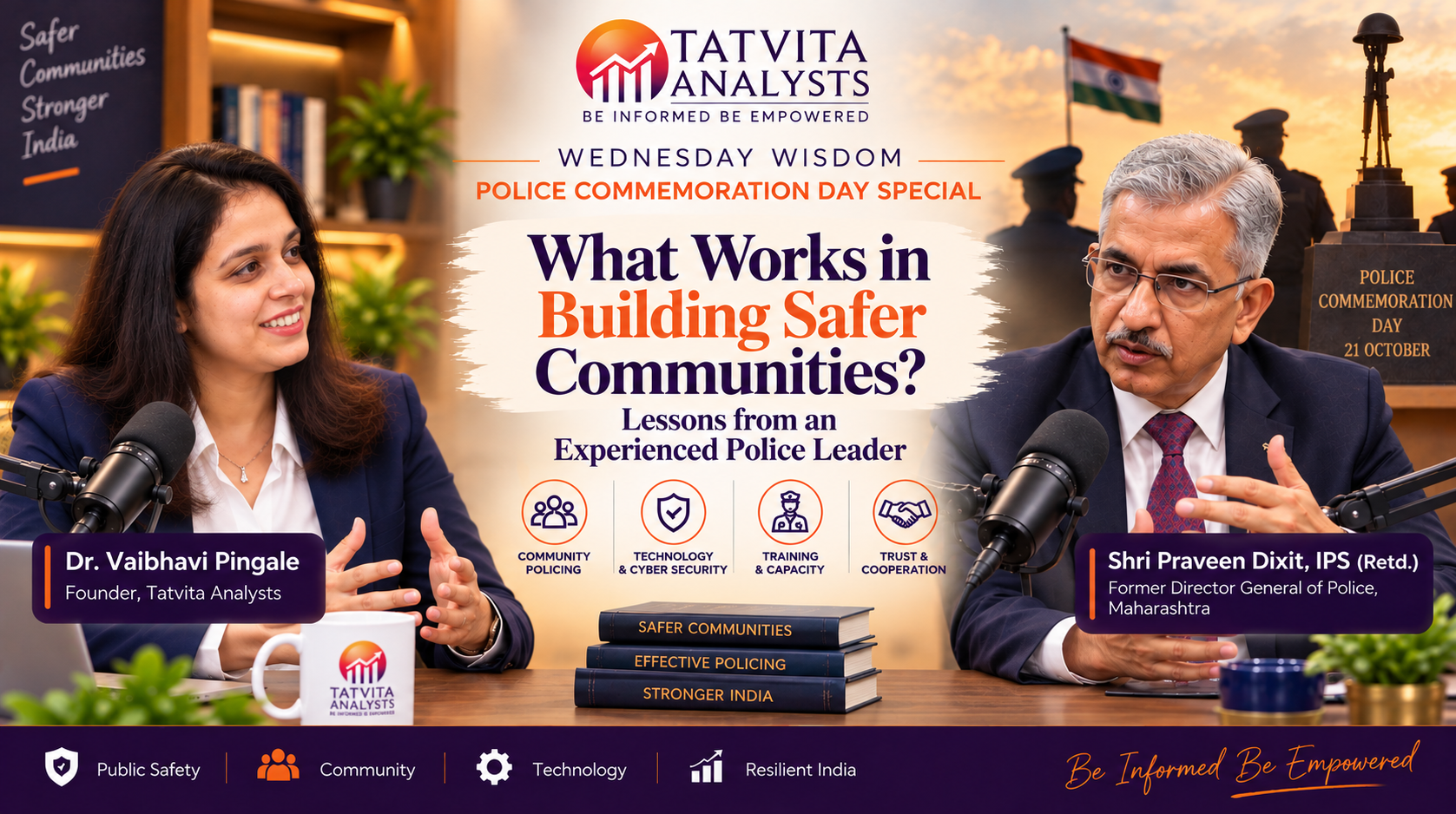
What Works in Building Safer Communities and More Effective Policing?
From community policing and crime prevention to cybersecurity, technology and public trust: lessons from an experienced police leader.
Every year on 21 October, India observes Police Commemoration Day to honour the courage, dedication and sacrifices of police personnel who have laid down their lives in the line of duty. The occasion commemorates the ten police personnel who lost their lives at Hot Springs in Ladakh in 1959 and recognises the continuing commitment of police forces to safeguarding citizens and maintaining public order.
Policing today extends far beyond conventional law enforcement. The emergence of cybercrime, digital fraud, online misinformation, evolving security threats and increasingly connected communities has transformed the responsibilities of police organisations. At the same time, public trust, citizen participation, professional training and technological preparedness remain essential to effective policing.
On the occasion of Police Commemoration Day, Tatvita Analysts, through its Wednesday Wisdom – Expert & Practitioner Interview Series, brings perspectives from Shri Praveen Dixit, IPS (Retd.), Former Director General of Police, Maharashtra, on what works in building safer communities and strengthening policing practices.
Drawing upon his extensive professional experience, Shri Dixit discusses community policing initiatives, the importance of preventive awareness, technological developments in crime detection, cybersecurity precautions, police training and the need for stronger cooperation between citizens and law-enforcement agencies.
The conversation explores how India’s policing system can combine human intelligence, modern technology, professional preparedness and public participation to address emerging challenges while remaining responsive to the communities it serves.
1. Police Commemoration Day honours the courage, dedication and sacrifices of police personnel in serving the nation. From your experience, what does this day signify for the police fraternity, and what should citizens understand about the responsibilities and challenges of policing?
Police Commemoration Day is observed every year on 21 October in memory of ten brave police personnel who made the supreme sacrifice while performing patrolling duties at Hot Springs in Ladakh, near the India–China border, in 1959.
On this day, police forces across the country pay tribute to personnel who have laid down their lives in the line of duty, including those who made the ultimate sacrifice during the preceding year.
In my view, this occasion is also an important reminder to citizens of the responsibilities undertaken by police personnel. The safety and security that people experience in their everyday lives are supported by the continuous alertness, vigilance and commitment of police forces.
Police personnel remain responsible for protecting citizens’ lives, liberty and security, often under challenging circumstances. Police Commemoration Day offers an opportunity to recognise their service and sacrifices and to appreciate the dedication required to maintain public safety.
Shri. Praveen Dixit Laying wreath at Hot Springs, Ladakh


2. Indian policing has evolved considerably over the decades, alongside changes in society, technology and the nature of crime. What are the most significant transformations you have witnessed in policing, and which changes have made the greatest difference in improving public safety?
Over the years, I have observed that while traditional forms of crime continue to exist, several new and increasingly complex security challenges have emerged. Many of these threats are no longer confined by geographical boundaries.
In my assessment, terrorism, illegal cross-border activities, drug trafficking, weapons smuggling and cybercrime present significant challenges for law-enforcement agencies.
Social media and digital communication platforms have also introduced new dimensions to these concerns. In my experience, such platforms can be misused for radicalisation, recruitment into criminal or extremist activities, the circulation of misleading information and the mobilisation of individuals for unlawful purposes.
I also believe that certain external groups and hostile elements attempt to exploit these vulnerabilities to create instability and undermine national security.
These developments have changed the environment in which police organisations operate. Policing today requires greater awareness of emerging threats, continuous technological adaptation and the ability to respond to activities that may extend beyond local or national jurisdictions.
3. Policing involves much more than responding to crime; it includes prevention, maintaining public order, assisting citizens and building safer communities. From your experience, which preventive policing practices have been particularly effective in reducing crime and improving public safety?
In my experience, creating awareness among citizens is one of the most important aspects of preventive policing.
Crime prevention is a continuous process, and people need to remain informed about emerging risks and the precautions they can take to protect themselves.
Awareness programmes should reach different sections of society, including schoolchildren, women, senior citizens and other groups who may face particular vulnerabilities.
Citizens should regularly follow safety advisories issued by police departments through their official websites and communication channels.
It is equally important to know how to seek assistance during emergencies or report suspicious activities. For example, citizens can use the national emergency response number 112 and the cybercrime reporting helpline 1930.
In my opinion, an informed and alert community can play a significant role in preventing crime. When citizens understand potential risks and know how to respond appropriately, they become active participants in maintaining public safety rather than relying entirely on police intervention after an incident has occurred.
4. Public trust and cooperation are essential for effective policing. What initiatives or approaches have you seen work particularly well in strengthening police–citizen relationships and encouraging communities to participate in maintaining safety and security?
During my tenure as Commissioner of Police and later as Director General of Police, I introduced the Police Mitra initiative, which was designed to encourage citizens to participate actively in promoting community safety.
Nearly five lakh men and women, representing different age groups, religions and linguistic backgrounds, joined the initiative with considerable enthusiasm.
Participants received regular briefings on measures to improve safety and security. They worked alongside local police personnel and served as ambassadors for promoting awareness and community safety.
From my experience, such initiatives demonstrate the importance of building partnerships between police organisations and citizens.
When people are encouraged to participate in maintaining safety, they develop a greater understanding of policing responsibilities and become more willing to cooperate with law-enforcement agencies.
I believe community participation can strengthen preventive policing and help create a more informed, alert and cooperative society.
5. Technology is transforming policing through CCTV surveillance, digital forensics, cybercrime investigation, data analytics, artificial intelligence and predictive tools. Which technological innovations are proving most useful in Indian policing, and how can technology be used responsibly while protecting citizens’ rights and privacy?
Technological tools are evolving rapidly and have become increasingly important in modern policing.
In my experience, CCTV surveillance systems installed on streets and within residential premises have been particularly useful in identifying suspects and supporting criminal investigations.
Some surveillance systems are now being enhanced with artificial intelligence capabilities that can generate alerts and support quicker responses to potential security incidents.
Digital forensic techniques have also strengthened investigative capabilities. These include the analysis of electronic devices, call detail records, audio recordings, digitised fingerprints and relevant social media information.
Such tools can assist police agencies in detecting criminal activities, investigating incidents and, in certain circumstances, identifying risks before they escalate.
However, I believe technology must be accompanied by responsible behaviour among citizens.
One important concern is the growing circulation of manipulated or fabricated videos. In my observation, misleading digital content can spread rapidly and may sometimes be used to provoke hostility or mobilise people towards violence.
Citizens should therefore verify the authenticity of videos and other digital information before forwarding them.
In my opinion, technological advancement is valuable, but its effectiveness also depends on informed and responsible use.
6. Cyber fraud, online financial scams, identity theft and other digital crimes are increasingly affecting individuals and businesses. What practical measures can help police agencies prevent and investigate such crimes more effectively, and what should citizens and businesses do to protect themselves?
In my opinion, the growing dependence on digital platforms has made awareness about personal information and cybersecurity extremely important.
Many widely used digital and social media platforms operate internationally, and users often share substantial amounts of personal information through these services.
I believe citizens should be particularly careful about the personal details, photographs and other sensitive information they make available online, as such information may be misused by cybercriminals.
Young people must be encouraged to become digitally responsible citizens. They should learn to question the authenticity and purpose of information they receive, particularly videos and messages generated or manipulated using artificial intelligence.
In my experience, cybercriminals increasingly use deceptive techniques to gain people’s confidence. They may impersonate relatives or acquaintances, exploit emotional vulnerabilities or create misleading investment and employment opportunities.
People seeking matrimonial relationships, employment or investment opportunities, as well as senior citizens, should exercise particular caution when dealing with unfamiliar individuals online.
I would recommend several precautions: avoid responding to suspicious calls or video calls, do not click on unfamiliar links, never disclose one-time passwords (OTPs), and maintain strong passwords that are changed when necessary.
Businesses must also take cybersecurity seriously. In my view, organisations should use appropriate security measures, including firewalls, and regularly update their software to address vulnerabilities.
The most important principle is to remain alert. Digital convenience should always be accompanied by responsible digital behaviour.
7. India’s police personnel often work under demanding conditions, handling emergencies, investigations, public events and diverse responsibilities. What practices can help strengthen police training, professional development, mental well-being and operational efficiency so that personnel are better equipped to serve the public?
From my experience, case-study-based learning is particularly valuable in police training.
Studying actual incidents and understanding how different situations were handled can help personnel improve their decision-making and prepare for similar challenges in the future.
I also believe artificial intelligence can be useful in identifying gaps in training and helping institutions design more effective professional development programmes.
Policing frequently involves situations where mistakes can have serious consequences. Continuous learning and preparedness are therefore essential.
Equally important is the ability to remain calm and balanced under pressure.
In my opinion, spiritual intelligence and emotional discipline can help police personnel respond thoughtfully, particularly during provocative or stressful incidents.
Regular yoga, physical exercise, outdoor sports, nutritious home-cooked food and avoiding addictions can contribute to maintaining physical and mental well-being.
Family support is another important factor. A supportive family that understands the demanding nature of police duties can provide considerable motivation and emotional strength.
I believe effective policing requires a combination of professional competence, physical fitness, emotional balance and a strong support system.
8. Different Indian states and countries have introduced innovations in community policing, emergency response, crime prevention and public safety. Are there any Indian or international policing practices that you believe are particularly successful and could be adapted or replicated more widely?
Policing practices evolve according to the history, culture and social conditions of different societies.
For this reason, I believe approaches that work successfully in one region or country should be understood within their local context before being adopted elsewhere.
At the same time, international cooperation and professional exchanges provide valuable opportunities to learn from policing experiences in different parts of the world.
Regular conferences and discussions involving police organisations from different Indian states and countries help professionals exchange information about emerging challenges, technological developments and effective practices.
However, in my opinion, technology alone cannot make policing successful.
Police organisations must also cultivate strong human intelligence capabilities and maintain a thorough understanding of local communities and circumstances.
The combination of human intelligence and technological knowledge is particularly important.
Another essential aspect is implementation. Learning about successful practices is useful, but their value is realised only when appropriate measures are adopted, followed up and monitored.
I believe that continuous learning, local adaptation and effective implementation are fundamental to improving policing practices.
9. As Indian cities expand and society becomes increasingly digital, policing requirements are also changing. What new skills, institutional capabilities and partnerships will be most important for police forces over the next decade?
In an increasingly digital world, continuous skill development is absolutely necessary for police personnel.
Technology and the nature of crime are changing rapidly. Police organisations must therefore ensure that their personnel remain updated through regular training and professional learning.
Government initiatives such as the iGOT Karmayogi digital learning platform can support this process by providing opportunities for continuous learning and capacity building.
In my opinion, leadership skills will become increasingly important in the coming years.
Police personnel must also remain sensitive to people’s grievances. Listening carefully to citizens and responding appropriately to their concerns helps build public confidence and trust.
Regular interaction with students, women and senior citizens should receive particular attention. Such engagement can help these groups recognise potential threats and avoid becoming victims of criminal activities.
I believe the future of policing will require a combination of digital skills, strong leadership, continuous learning and meaningful community engagement.
10. Drawing from your professional experience, what three priorities would you recommend for strengthening India’s policing system over the coming years, while ensuring that policing remains effective, accessible and trusted by the communities it serves?
Based on my professional experience, I would emphasise three priorities.
First, build and maintain trust between police and citizens. Effective policing requires mutual confidence, cooperation and an understanding that public safety is a shared responsibility.
Second, continuously educate citizens about emerging forms of crime. Police organisations should regularly communicate new criminal methods, potential risks and practical precautions so that people can protect themselves.
Third, adopt new technologies while continuously upgrading professional skills. Police personnel must remain familiar with technological developments and understand how these tools can support their responsibilities.
Beyond these three priorities, I would particularly emphasise the importance of integrity. Police personnel must say no to corruption under all circumstances.
I also believe spiritual intelligence, emotional balance and sensitivity towards citizens can strengthen professional conduct.
Anticipating crises, remaining prepared to respond and maintaining constant vigilance are essential qualities of effective policing.
Ultimately, the principle of “सदैव सतर्क” — remaining ever vigilant — should guide police personnel in serving and protecting society.
Tatvita’s Takeaway: What Can Strengthen Safer Communities?
Shri Praveen Dixit’s professional experiences highlight an important aspect of public safety: effective policing depends not only on the capabilities of law-enforcement agencies but also on the relationship between police organisations, citizens and the communities they serve. His insights point towards five interconnected areas that deserve attention.

Author

Make Tatvita one of your preferred sources
See more insights from Tatvita Analysts in your Google Search results.


Leave a Reply