
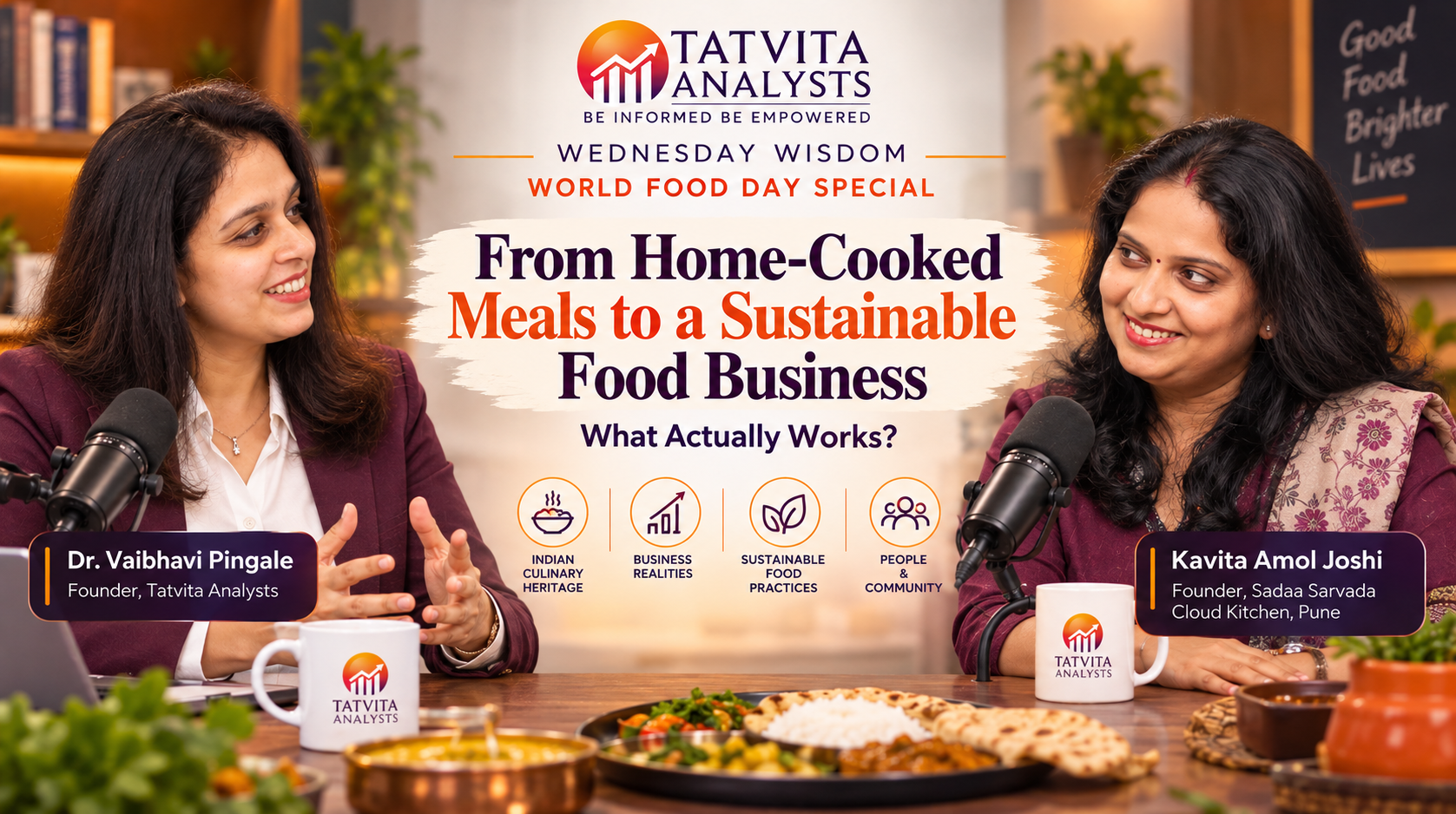
From Home-Cooked Meals to a Sustainable Food Business: What Actually Works?
India’s rich culinary heritage is finding new expressions through restaurants, cafés, cloud kitchens and home-based food ventures. While the growing popularity of food entrepreneurship has created opportunities for aspiring business owners, establishing a food venture and sustaining it are two very different challenges. Rising ingredient prices, changing consumer preferences, delivery-platform costs, operational efficiency and the need to maintain consistent taste and quality make the business increasingly demanding.
On the occasion of World Food Day, observed on 16 October, Tatvita Analysts’ Wednesday Wisdom – Expert & Practitioner Interview Series explores what actually works in building and sustaining a food business.
Our guest, Kavita Amol Joshi, is the founder of Sadaa Sarvada Cloud Kitchen, a Pune-based venture offering fresh, hygienic, home-style vegetarian meals. What began as an initiative to provide food during the COVID-19 lockdown eventually developed into a business, formally established on 6 April 2023. Her venture serves customers seeking dependable, home-cooked meals, including senior citizens, working professionals and people living away from their families.
In this conversation, she shares her entrepreneurial journey, experiences in managing food costs, maintaining quality, adapting to changing customer preferences, using digital platforms and preserving India’s traditional culinary knowledge. Her experiences offer practical lessons for aspiring food entrepreneurs and existing food-service businesses.
1. India has a remarkable culinary heritage, with diverse regional cuisines, traditional recipes and evolving food cultures. What inspired you to enter the food business, and how has your entrepreneurial journey shaped your understanding of what customers truly value?
India’s culinary heritage is deeply connected to our traditions, emotions and cultural identity. Every region has its distinctive flavours, and Maharashtra’s home-style cooking and seasonal delicacies have always held a special place in my life.
The inspiration behind Sadaa Sarvada comes from the Marathi verse, “सदा सर्वदा योग तुझा घडावा…”, which expresses the wish to remain connected with what is good and meaningful in life. I wanted to create a similar connection through food.
My journey began during the COVID-19 lockdown. I initially started preparing meals for people who were struggling to arrange their daily food, following a no-profit, no-loss approach. It was simply my way of contributing to society through something I knew and loved.
Even after the lockdown ended, people continued appreciating my cooking and encouraged me to carry on. Their response inspired me to establish Sadaa Sarvada Cloud Kitchen as a business.
Today, we focus on fresh, hygienic, home-style vegetarian meals, particularly for senior citizens, working professionals and households where cooking every day may be difficult.
This journey has taught me that customers seek much more than a meal. They value comfort, reliability, familiar flavours and the feeling that their food has been prepared with care.
For me, taste attracts customers, quality satisfies them, and trust gives them a reason to return.
2. Starting a restaurant, café or cloud kitchen and sustaining it successfully are two different challenges. From your experience, what separates food businesses that sustain themselves from those that struggle after the initial excitement?
I believe sustainability begins with remembering why the business was started.
For Sadaa Sarvada, the purpose has always been to make wholesome, home-style food accessible to people who may not be able to cook for themselves every day.
Businesses sometimes focus heavily on expansion or immediate financial returns without building a strong foundation. In the food industry, that foundation includes understanding customers, managing resources wisely, maintaining standards and adapting without losing sight of core values.
Growth does not necessarily mean becoming bigger overnight. It can mean reaching more people while preserving what makes the business meaningful.
If a senior citizen can depend on our meals or someone living away from home can find comfort in our food, I consider that meaningful progress.
A food business becomes sustainable when it creates value beyond the transaction. When the intention to serve is supported by responsible business practices, customer relationships strengthen and the business develops the ability to sustain itself.
3. Food inflation and rising operating expenses create considerable pressure on restaurant businesses. How can entrepreneurs manage costs without compromising taste, quality and affordability?
Managing rising costs requires careful planning and efficient use of available resources.
At Sadaa Sarvada, affordability should never come at the cost of quality. Instead of compromising on ingredients or changing the essence of a recipe, we focus on thoughtful menu planning, careful purchasing, reducing food wastage and preparing quantities according to actual demand.
Seasonal and locally available ingredients can also help manage costs while bringing freshness and variety to the menu.
One important lesson is understanding the difference between cutting costs and using resources efficiently. Savings should never undermine hygiene, nutrition or the taste customers expect.
Entrepreneurs must regularly review ingredient prices, calculate the actual cost of preparing each meal and set prices that are fair to customers while allowing the business to operate responsibly.
My approach is to be economical in operations, but never careless about quality.
4. Taste and quality are among the strongest reasons customers return. As a food business grows, how can entrepreneurs maintain consistency without becoming entirely dependent on one chef or individual?
Consistency comes from making quality part of the business’s operating practices rather than depending entirely on one person’s skills.
As a business grows, it becomes important to establish clear processes for ingredient selection, measurements, preparation, storage and hygiene.
Documenting recipes and standardising basic procedures help maintain the intended taste and quality, even when different people are involved in preparing the food.
However, systems alone are not enough. Food is also an expression of personal care, and that understanding must be passed on to everyone involved.
Training, communication and regular quality checks help ensure that people understand not only how food should be prepared but also the values behind it.
For a home-style food business, consistency does not mean making food mechanically. It means preserving the familiar taste and dependable quality customers associate with us.
Our aim is for Sadaa Sarvada’s quality to be defined by its standards and values, not by the presence of any one individual.
5. Pricing food involves more than ingredient costs. How do you approach menu planning and pricing so that customers perceive value while the business remains financially sustainable?
Menu planning requires balancing variety, practicality and customer preferences.
We focus on meals that people can enjoy as part of their everyday routine, using seasonal ingredients and locally available produce wherever suitable.
When deciding prices, I consider the complete cost of preparing and delivering a meal, including ingredients, packaging, utilities and other operating expenses.
Portion size is equally important. Customers should feel satisfied with the quantity and quality they receive.
Menus must also remain responsive to changing ingredient prices, seasonal availability and customer preferences.
Not every popular dish needs to be the most profitable item. A well-planned menu should balance customer favourites with the overall economics of the business.
For me, affordability does not mean offering food at the lowest possible price. It means making thoughtful choices that allow customers to enjoy good food without feeling that it is an unnecessary expense.
6. Social media, changing lifestyles and exposure to global cuisines are influencing Indian food preferences. What changes have you observed in customer expectations, and how can food businesses adapt without losing their identity?
Customers today are more exposed to different cuisines and food experiences. Convenience, variety and presentation have become important considerations.
However, despite changing trends, people continue to appreciate familiar, comforting food.
There is something timeless about “माँ के हाथ का खाना”—food that reminds you of home.
One interesting observation from our experience is that food preferences are not always divided by age.
Trending café-style dishes, when prepared at home, can become favourites among senior citizens. Similarly, traditional dishes prepared authentically can appeal strongly to younger customers.
This shows that people across generations are willing to explore different foods when they are prepared with care.
At Sadaa Sarvada, we remain open to changing preferences while preserving our identity as a home-style food provider.
Businesses should listen to customers, but they do not necessarily need to follow every emerging trend.
Trends may influence what people want to try, but comfort and authenticity often give them a reason to return.
7. Digital platforms have transformed food delivery, marketing and customer relationships. Which digital tools genuinely help small food businesses, and how can entrepreneurs balance online visibility with profitability?
Digital platforms have made it easier for small food businesses to reach customers beyond their immediate neighbourhoods.
For a cloud kitchen like ours, social media helps people discover our food and understand the effort behind the business.
WhatsApp is particularly useful for sharing menus, communicating directly with customers, receiving orders and understanding individual preferences.
Digital payments make transactions convenient, while online reviews provide feedback and help build credibility.
However, visibility does not always translate into profitability.
Food-delivery platforms may introduce a business to new customers, but commissions, discounts, packaging and delivery-related expenses must be considered when calculating the actual return from each order.
Entrepreneurs should not judge success simply by the number of orders received.
Direct customer relationships are equally important. Personal communication helps us understand preferences, respond to concerns and build long-term trust.
Repeat customers who genuinely appreciate the food can be just as valuable as acquiring new customers.
Technology may bring a customer to your doorstep, but the experience you provide is what gives them a reason to return.
8. India’s culinary heritage offers opportunities to build distinctive food brands. How can entrepreneurs commercialise traditional recipes and regional cuisines while preserving their authenticity?
India’s culinary heritage is one of our greatest strengths. Food carries the stories of families, regions, seasons and generations.
Traditional recipes are not merely combinations of ingredients. They represent knowledge and practices preserved over time.
The entrepreneurial opportunity lies in making this heritage accessible to contemporary customers without losing what makes it special.
This could involve introducing regional dishes to new audiences, using traditional ingredients thoughtfully or presenting familiar recipes in formats suited to modern lifestyles.
At Sadaa Sarvada, when customers request a traditional preparation that is not part of our regular menu, we try to learn from people who specialise in preparing that particular dish authentically.
This allows us to expand our offerings while respecting the knowledge of those who have mastered these recipes.
Commercialisation should also involve understanding a dish’s origins and cultural context.
Entrepreneurs do not always need to invent something entirely new. Sometimes, the opportunity lies in recognising the value of what already exists and finding meaningful ways to share it.
For us, the essence is “आईच्या हातचं जेवण”—the comfort of home-cooked food, even when someone is far from home.
9. Healthier menus, sustainable sourcing, reduced food waste and technology-enabled kitchens are influencing the global food industry. Which trends do you believe will shape Indian food businesses over the coming decade?
I believe healthier food choices, sustainable sourcing, food-waste reduction and technology will become increasingly important.
Interestingly, many of these practices have long been part of Indian culinary traditions.
Our traditional food culture emphasises seasonal ingredients, locally available produce, balanced meals, thoughtful preparation and efficient use of ingredients.
At Sadaa Sarvada, careful menu planning, preparing appropriate quantities and using ingredients efficiently help us maintain quality while minimising waste.
Technology can strengthen these practices by improving order management, quantity planning, customer understanding and kitchen efficiency.
In my view, the future of the Indian food-service industry lies in combining the wisdom of our culinary heritage with modern technology.
We do not always need entirely new approaches. We can build on traditional practices and use technology to make them more efficient and effective.
10. What should aspiring entrepreneurs understand before opening a restaurant, café or cloud kitchen? Based on your experience, what three principles would you recommend for building a sustainable food business?
Starting a food business requires much more than having a good product.
Initial investment must account for equipment, raw materials, packaging, licences, marketing and other setup costs. Maintaining sufficient working capital is equally important, particularly during the early months when sales may be unpredictable.
Location should be selected based on the target audience, accessibility, competition and operating costs.
For a cloud kitchen, delivery radius, surrounding demand, packaging and online visibility become especially important.
Entrepreneurs must also prepare for fluctuating ingredient prices, food wastage, staff management, hygiene requirements and maintaining consistency during busy periods.
Based on my journey, I would recommend three principles:
First: “अन्न हे पूर्णब्रह्म.” — Quality and consistency come first.
Food should always be prepared with care and respect. Quality is the foundation of customer satisfaction and lasting relationships.
Second: “शुद्ध विचार, शुद्ध आचार.” — Honesty and discipline are essential.
From sourcing ingredients and maintaining hygiene to pricing fairly and managing resources, integrity should guide everyday business decisions.
Third: “सदा सर्वदा योग तुझा घडावा.” — Build a lasting connection with every customer.
Such a connection cannot be created overnight. It develops through trust, consistent quality, authentic taste and genuine care.
Ultimately, a sustainable food business requires patience, financial discipline and a commitment to serving people well.
Starting small, learning from experience and growing at a manageable pace can be more valuable than expanding too quickly.
Tatvita’s Takeaway: What Can Food Entrepreneurs Learn?
Kavita Joshi’s entrepreneurial journey offers a useful perspective on the realities of building a food business. While her experience comes from a home-style cloud kitchen, several lessons are relevant to aspiring restaurant owners, café entrepreneurs and small food-service operators.

Author

Make Tatvita one of your preferred sources
See more insights from Tatvita Analysts in your Google Search results.



Leave a Reply