
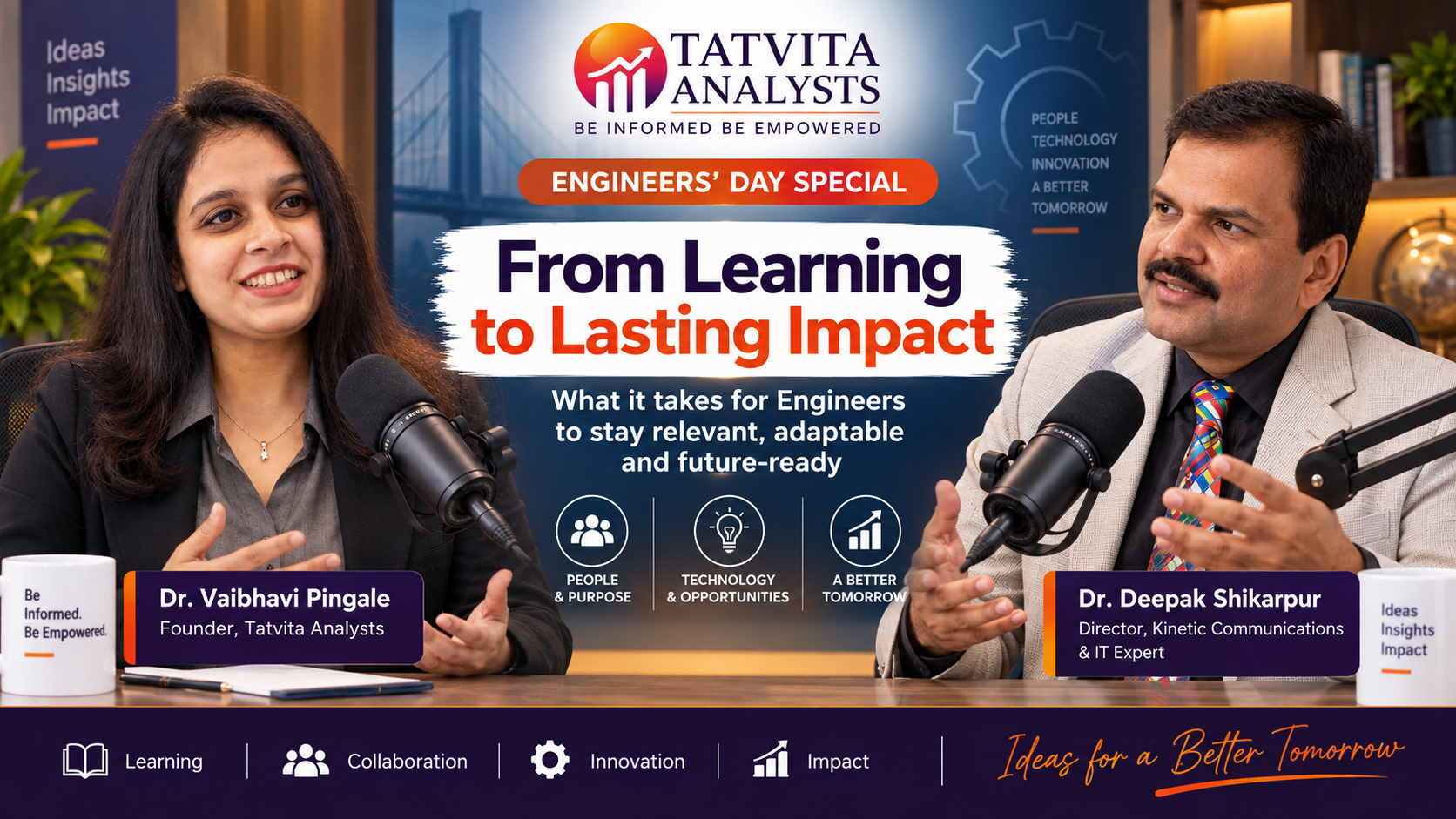
From Engineer to Innovator: Building a Future-Ready Career in the Age of AI
1. You began your career as a mechanical engineer in the 1980s, when computing was only beginning to transform industry. Looking back, which technological shifts most fundamentally changed engineering, and how did you adapt to them?
I graduated in 1985 as a mechanical engineer from Walchand College of Engineering, Sangli. At that time, there were relatively few engineering colleges in Maharashtra, and the principal options were mechanical, civil and electrical engineering. I was selected by TELCO, now Tata Motors. Soon after joining, I moved into the computer department because there was a shortage of programmers and the company had advanced Burroughs computers. I received strong training there, and my journey in IT began as a computer programmer.
The 1980s were a major transition point. Industry 2.0 was moving towards computer-driven automation. Factories were beginning to adopt industrial robots, programmable logic controllers, computer-aided design and computerised production systems. Computers were shifting from specialised machines to essential business and engineering tools. In India, this period also laid the foundation for the software and electronics sectors.
The larger lesson from that transition has stayed with me throughout my career: technology can automate processes, augment human capability and fundamentally transform industries. My own career changed because I was willing to accept a new environment, learn something outside my original discipline and adapt rather than remain confined to the qualification with which I had graduated.
2. Technology now evolves faster than ever. What does it take for an engineer to remain future-ready throughout a 30-40 year career?
To remain relevant over four decades, an engineer must continuously evolve with technology, industry and society. Learnability is the most powerful asset – the ability to unlearn outdated approaches and quickly learn new ones. Continuous upskilling keeps knowledge aligned with emerging technologies such as AI, automation, cloud computing and cybersecurity.
A global outlook is equally important because engineers increasingly work within international standards, markets, supply chains and multicultural teams. They must be willing to experiment, adapt and embrace change rather than resist it. Technical expertise may open doors, but curiosity, communication, leadership and problem-solving sustain a career.
I have gone through several career transitions myself. I could cope with them because I accepted changing circumstances and adapted to them. The engineer who keeps learning does not become obsolete.
3. Which engineering fundamentals and capabilities remain valuable regardless of how technologies and tools change?
Tools will change, but some engineering capabilities remain timeless. Attitude determines how we respond to challenges, learn from failure and embrace change. Teamwork converts individual expertise into collective achievement, particularly because complex problems increasingly require multidisciplinary collaboration.
Relevance also matters. Engineers must continuously understand what industry, customers and society need. Customer focus ensures that a solution creates real value rather than merely demonstrating technical sophistication. I also believe strongly in an organisation-first mindset: engineers must understand their responsibility to the larger institution and not only to their individual role.
Integrity, problem-solving, adaptability, collaboration and commitment to a larger purpose therefore remain powerful across technological cycles. These are the capabilities that allow engineers to create value over decades.
4. When it is impossible to master every emerging technology, how should an engineer decide what to learn deeply and what simply to remain aware of?
Learning has to be strategic rather than exhaustive. Begin with career planning: identify your longer-term professional direction and the capabilities that are likely to remain valuable in that field. Then create a short-term strategy for skills that can deliver immediate value and a long-term strategy for technologies that may shape your future.
Go deep where a technology aligns with your core expertise, career goals and industry demand. For other emerging technologies, maintain enough awareness to understand their concepts, applications and likely impact.
Mentorship is particularly valuable. An experienced mentor can provide perspective, challenge assumptions and help an engineer prioritise. At the same time, never assume that learning flows only from senior to junior. Learn from peers, subordinates, mentors and, especially today, young engineers. The objective is not to know everything; it is to know what matters, when it matters and why it matters.
5. What should continuous learning practically look like for a working engineer beyond degrees, courses and certifications?
Continuous learning should be career-driven, practical and visible. It should begin with the individual’s career plan and the capabilities required for future opportunities, rather than with the objective of simply collecting degrees or certificates.
Engineers should learn through real projects, experiments, industry problems, mentoring, professional networks and hands-on experience. Learning becomes valuable when it is applied. At the same time, engineers should document measurable achievements and build a credible professional profile that reflects what they have actually contributed.
Professional networks, knowledge sharing, participation in engineering bodies, conferences and industry forums can broaden exposure. Recognition from credible professional institutions can further strengthen professional standing. A thoughtful LinkedIn presence can also help an engineer share knowledge and demonstrate professional credibility.
Continuous learning therefore means more than consuming content. It is a cycle of learning, applying, contributing, sharing and earning trust throughout one’s career.
6. With AI increasingly assisting design, coding, analysis, simulation and problem-solving, which human capabilities will become more valuable for engineers?
As AI takes on more technical tasks, distinctly human capabilities will become even more important. Empathy, emotional intelligence and the human touch matter when understanding customers, colleagues and society. Trust, communication and the ability to build meaningful relationships cannot be fully replaced by machines.
Engineers will also need creativity, ethical judgement, leadership and the wisdom to understand the consequences of technological decisions. AI may generate multiple solutions, but humans still have to decide which solution is meaningful, responsible and appropriate.
We are not robots. The future engineer will combine technological capability with humanity, compassion and personal connection. AI should be treated as a powerful partner, not as a substitute for human values.
7. What separates an engineer who uses technology effectively from one who creates, improves or innovates technology?
Both are important. Some engineers use existing technology exceptionally well, while others create, improve or extend it. The more important distinction is the outcome that engineering creates.
Effective engineers translate technology into practical solutions. Innovators push boundaries and create new possibilities. But technical novelty alone is not enough. Value creation and customer satisfaction are the real measures of success. A technically brilliant innovation that solves no meaningful problem, creates no value or fails to gain customer acceptance cannot be considered a complete success.
Great engineering connects innovation with real-world impact. The best engineers therefore ask not only, “What can this technology do?” but also, “What value does it create, for whom, and how will it improve lives or business?”
8. How does an engineer learn to identify problems worth solving, rather than starting with a technology and searching for its application?
Engineers are solution providers, so the starting point should be a genuine need or problem – not a technology searching for an application. Engineers must learn to observe customers, understand pain points, study market gaps and listen carefully to real-world requirements.
Need is more important than technology. Before building a product or solution, validate whether the problem is significant, whether customers are likely to adopt the solution and, where relevant, whether they are willing to pay for it. Never build products “in the air” on the assumption that a market will automatically appear.
Many startups struggle because they begin with technology rather than customer need. Successful engineering starts with a problem, validates the need, defines the value to be created and then selects the appropriate technology.
9. How can an engineer working in an operational or execution-oriented role progressively move towards R&D, product development and innovation?
The transition begins with developing a deep understanding of customer needs and real-world problems. Study the organisation’s future technology roadmap and identify areas where emerging technologies could create value. Build practical and, where useful, certified skills in the chosen domain, and actively seek opportunities to participate in pilots, prototypes and improvement projects.
Innovation also requires looking beyond one’s immediate job description and developing a broader business perspective. Engineers need to understand why an organisation would invest in an idea, what problem it solves and how success would be measured.
Communication is crucial. A good idea succeeds only when the engineer can explain its value, build confidence and persuade customers, management and other stakeholders. Moving into innovation is therefore a journey combining technical depth, customer understanding, experimentation, business awareness and communication.
10. If you were graduating as an engineer in 2026, what three things would you do during your first five years to build a future-ready career and eventually become an innovator?
I would focus on three priorities.
First, I would build global capability. That means developing strong communication and cross-cultural skills and understanding technology and work cultures beyond India. I would also consider learning a foreign language such as Japanese and studying markets where Indian engineers may find growing opportunities.
Second, I would build character and relationships. Maintain a positive attitude, become a dependable team player and earn the trust of colleagues, customers and society. Technical skills may open the first door, but people skills and credibility build lasting careers.
Third, I would think far beyond the first job. Careers will become longer and more varied, and many people will experience multiple professional identities during their lifetime. Engineers should therefore continuously reskill, reinvent themselves and explore new domains. The goal should not merely be employment. It should be a lifelong journey from engineer to problem-solver, innovator, mentor and leader.
Author

Make Tatvita one of your preferred sources
See more insights from Tatvita Analysts in your Google Search results.


Leave a Reply