
The architecture of the decarbonised grid is built upon a fundamental deception. Western governments market the renewable transition as the ultimate escape from the petroleum cartels that engineered twentieth-century geopolitics. The math proves otherwise. Shifting a planetary energy system from fuel-intensive combustion to material-intensive infrastructure does not sever dependency. It merely relocates the extraction nodes into the shadows. Lurking at the dead centre of this vulnerability is antimony. A toxic, silvery-white metalloid.
A solar module is functionally dead if its protective glass cannot transmit light. To eliminate microscopic oxygen bubbles that violently scatter incoming photons and to prevent long-term ultraviolet degradation from turning the panels an opaque brown, manufacturers inject antimony trioxide directly into the high-temperature glass melt.
The chemical reaction is mandatory for commercial viability.
This fining process chemically forces clarity, extracting a 10% to 20% relative improvement in energy yield that dictates profit margins across the highly consolidated solar market (InvestorNews, 2025). The embedded volume is massive. Standard crystalline silicon photovoltaic front glass is loaded with roughly 0.1% to 1% antimony by weight, translating to a heavy 32 to 48 grams per individual module (Smart Energy Council, 2026).
Procurement operates as a hostage situation. While Western policymakers subsidise aggressive domestic climate mandates, the absolute baseline chemistry required to manufacture those arrays remains locked behind foreign borders. The leverage is absolute. Chinese state-backed entities exercise dominant control over raw ore extraction and monopolise the downstream chemical refining required to produce solar-grade antimonate compounds. Western nations are aggressively trading carbon dependency for heavy metal subservience. You swap OPEC for Beijing. The trap closes.
The Photovoltaic Bottleneck
Solar module efficiency is dictated by glass clarity. Microscopic oxygen bubbles violently scatter incoming photons, killing energy yield. Standard silica carries iron impurities that tint the glass green and trap these gas pockets. To force optical perfection, manufacturers execute a high-temperature chemical intervention: they inject sodium antimonate directly into the molten matrix. The chemistry is brutal and effective. The antimonate compound chemically decomposes under extreme heat, generating massive, fast-moving gas bubbles that aggressively scavenge the micro-bubbles and homogenise the glass batch, while simultaneously neutralising the iron tint. This fining process prevents long-term ultraviolet solarisation and locks in maximum light transmission.
The industry is addicted to the yield. While high-purity, antimony-free float glass exists, the global crystalline-silicon market overwhelmingly relies on cheaper, textured solar glass where antimony injection is standard. The scale of consumption is catastrophic for supply chains. According to data from the global pricing agency Fastmarkets, the photovoltaic sector now consumes approximately 50,000 tonnes of antimony annually consuming roughly one-third of total global output. This single application has fundamentally shattered the historical supply-demand balance of the metalloid.
The European Solar Manufacturing Council (ESMC) actively flags this dependency as a critical bottleneck. The European market relies on millions of imported panels loaded with an opaque, untracked volume of toxic fining agents. Engineering a “clean” energy grid currently requires pumping unprecedented tonnage of a hazardous, geostrategic metalloid into the manufacturing baseline. If the glass does not clear, the panel fails. If the panel fails, the grid starves. The bottleneck remains absolutely fixed on chemical supply.
The Molten Metal Horizon
Intermittency fractures the renewable grid. Solar and wind arrays do not generate reliable baseload power; they vomit chaotic, localised voltage spikes dictated entirely by atmospheric patterns. Stabilisation demands a massive, multi-megawatt energy storage architecture. Lithium-ion chemistry degrades. Conventional solid-state batteries suffer immediate structural fatigue under grid-scale cycling, developing membrane micro-fractures, internal dendrites, and rapid thermal capacity decay. Grid infrastructure requires permanence.
The engineered solution is the Liquid Metal Battery (LMB). Pioneered by researchers at the Massachusetts Institute of Technology and commercialised by specialised grid-storage firms, this framework completely abandons solid-state fragility. Thermodynamics dictate the architecture. Operating at extreme thermal thresholds approaching 500 degrees Celsius, the electrochemical cell sustains a self-segregating, three-layer molten stack: a light liquid calcium anode floating at the apex, a molten salt electrolyte, and a dense, liquefied antimony-lead cathode pooling at the absolute base. Solid separators do not exist. Therefore, they cannot shatter. Because all internal components remain perpetually fluid, the battery physically bypasses mechanical degradation. Cycling is infinite. Operational telemetry demonstrates extreme durability, projecting over 85% capacity retention across decades of deep, daily electrochemical discharging without structural failure.
Yet, the applied physics mandates the geopolitical trap. The massive liquid density required to anchor the heavy cathode pool strictly demands antimony alloys. Deploying terawatt-scale LMB infrastructure technically solves the renewable intermittency deficit while simultaneously transferring the electrical grid’s operational sovereignty directly to foreign extraction monopolies. The engineering is flawless. The procurement is fatal. Utilities stabilise the grid. Beijing controls the storage.
The environmental paradox of the decarbonized grid is mathematically staggering. Western regulatory mandates aggressively legislate the eradication of atmospheric carbon emissions, yet the physical infrastructure required to capture solar radiation mandates the mass extraction of a severe, unregulated toxicant. Antimony trioxide is a poison. The U.S. National Toxicology Program explicitly classifies the compound as a reasonably anticipated human carcinogen. Industrial exposure triggers extreme respiratory degradation. The inhalation of airborne antimony particulate within processing facilities induces chronic bronchitis, irreversible pulmonary inflammation, and documented lung tumours in sustained exposure models. We trade carbon for poison.
Toxic Procurement and Geopolitical Irony
The geographic footprint of this extraction reveals the hypocrisy of green procurement. Because Western environmental frameworks strictly prohibit the localised processing of heavy metals, the ecological devastation is entirely outsourced to geopolitical adversaries.
China’s Xikuangshan mine in Hunan province, the largest antimony extraction node on the planet operates as a biosphere dead zone. Aggressive smelting of raw stibnite ore directly releases lethal concentrations of elemental antimony and arsenic into the surrounding topography. Heavy metal contamination saturates the agricultural soil. Watershed ecosystems collapse. The regional surface water exhibits catastrophic toxicity profiles, recording extreme ecological risk levels driven by systemic arsenic and antimony runoff that fundamentally annihilates aquatic life. The contamination is permanent.
Policymakers deliberately ignore the origin. The West subsidises terawatt-scale solar installations under the banner of ecological preservation while simultaneously bankrolling the catastrophic heavy-metal poisoning of the Asian continent. Supply chain opacity enables this fiction. The localised environmental destruction occurring at Chinese and Russian extraction sites is a mathematical prerequisite for manufacturing the high-yield, chemically clarified glass installed on Western residential rooftops. The green transition does not eliminate toxic extraction. It relocates it.
The Circularity Illusion
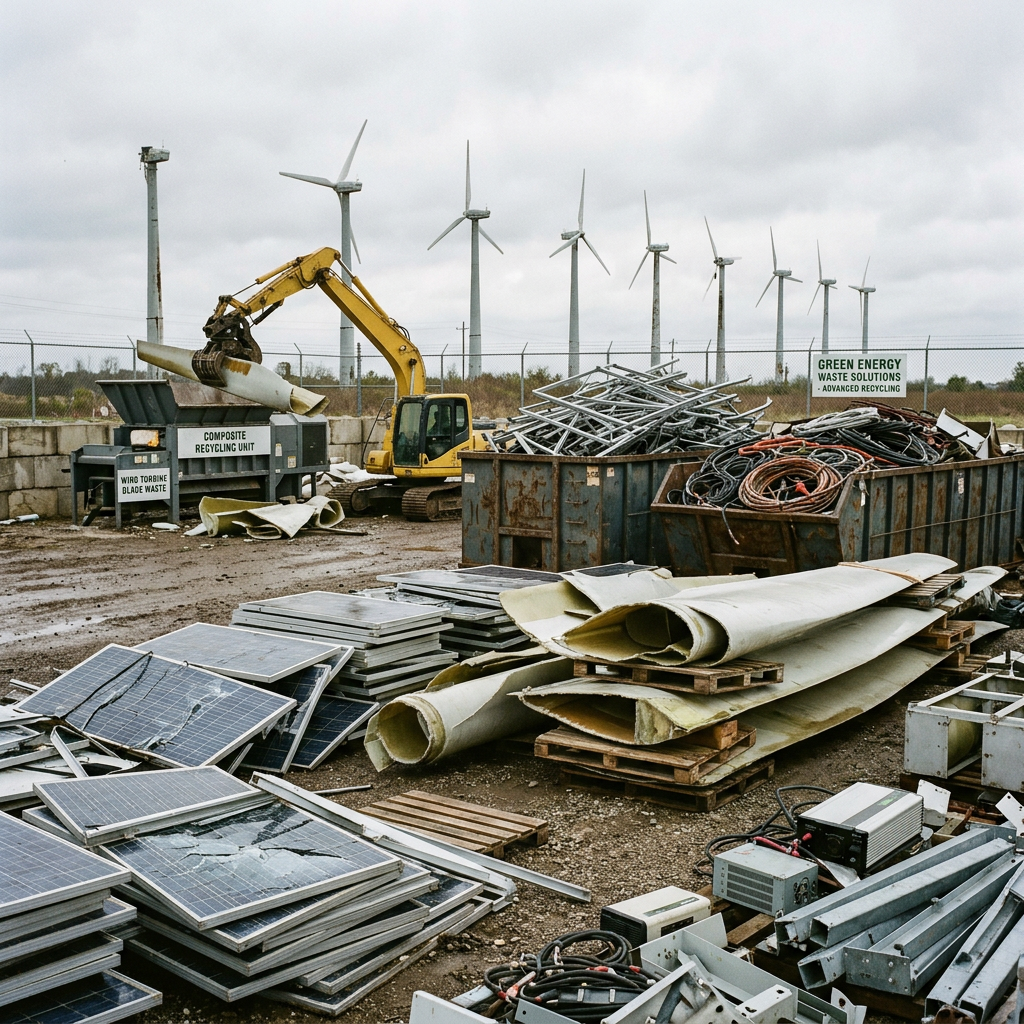
The end of a solar module’s operational lifespan triggers an immediate e-waste detonation. Millions of photovoltaic arrays deployed during the early millennium are simultaneously reaching their 25-year structural expiration dates, dumping unprecedented tonnage into global waste pipelines. Standard recycling fails. Because photovoltaic front glass is permanently saturated with sodium antimonate fining agents to guarantee initial optical clarity, it functions as a lethal chemical contaminant within conventional glass recovery infrastructure. It ruins the batch. Introducing antimony-laced solar cullet into standard silica melts immediately alters the thermal thresholds and refractive architecture of the secondary material, rendering the industrial output commercially worthless.
The separation infrastructure does not exist. Isolating embedded antimony from a solid-state glass matrix requires high-velocity X-ray fluorescence (XRF) spectral sorting and aggressive chemical leaching protocols that currently operate at a statistical zero globally. Mechanical crushing guarantees exposure. When waste processors industrially pulverise decommissioned panels without absolute atmospheric containment, the physical friction violently releases carcinogenic antimony particulate into the ambient biosphere. Inhalation induces immediate toxicity.
The International Renewable Energy Agency (IRENA) projects a catastrophic accumulation of up to 78 million metric tons of unrecyclable solar e-waste by 2050. Despite this mathematical certainty, the legislative framework required to enforce extended producer responsibility and mandate chemical circularity remains a bureaucratic fiction.
The circular economy is a myth. Western grid operators are aggressively stockpiling millions of tons of highly toxic, unprocessable heavy metal liabilities under the absolute guise of renewable sustainability. The dependency cycle remains unbroken. From raw extraction monopolised by geopolitical adversaries to the irreversible contamination of domestic waste streams, the green transition is locked in a material stranglehold. The trap closes.
Author

Make Tatvita one of your preferred sources
See more insights from Tatvita Analysts in your Google Search results.



Leave a Reply