
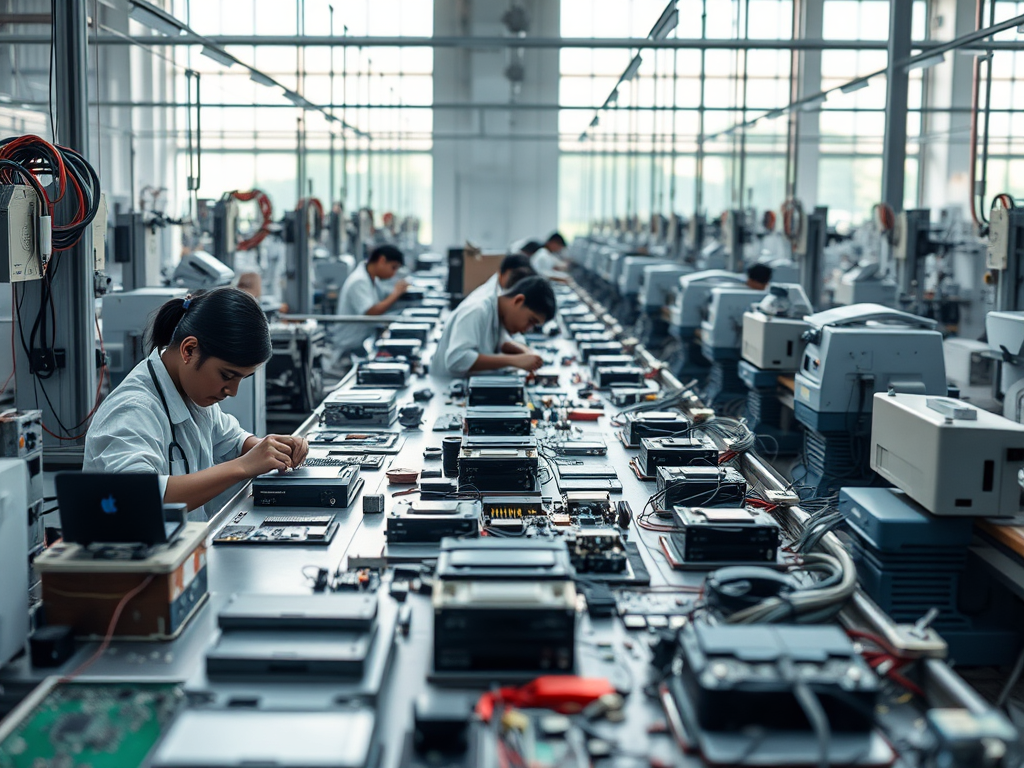
India’s Production-Linked Incentive (PLI) scheme, launched in 2020 with an outlay of ₹1.97 lakh crore across 14 sectors, represents the country’s most ambitious industrial policy intervention since liberalisation. Electronics production has more than doubled, smartphone exports have surged nearly eightfold, and mobile phones have become one of India’s top export categories within five years. By headline metrics, PLI appears transformative.
Yet industrial policy must be evaluated not by output alone, but by capability formation. The central question is not whether PLI has increased production. It has. The real question is whether India is building the structural foundations domestic value addition, supplier ecosystems, technology depth, and competitive resilience that survive once subsidies end.
Using the electronics and textiles sectors as case studies, this article assesses whether PLI is compounding long-term manufacturing capability or merely incentivising assembly-led growth.
Electronics: Production Scale Without Structural Depth
The Large-Scale Electronics Manufacturing (LSEM) PLI has delivered striking numbers. Annual electronics production rose from ₹2.13 lakh crore in FY2020-21 to ₹5.45 lakh crore by FY2024-25, a 146% increase (MeitY). Smartphone exports grew 775% in the same period. India now accounts for roughly 16% of global smartphone output and has become a leading exporter to the United States.

Investment figures are equally compelling. Approximately ₹2 lakh crore in cumulative investment has generated ₹18.7 lakh crore in incremental output, approaching a 1:9 output-to-investment ratio. Government incentive disbursements have yielded nearly 19 times their fiscal outlay in gross output terms (ICEA).
However, output growth masks a structural caveat. A July 2025 India Forum study finds domestic value addition in smartphones remains between 15–20%. In practical terms, ₹80–85 of every ₹100 in output represents imported content. Key components — display panels (16% of bill of materials), processors (15–20%), memory, camera systems — are almost entirely imported. Of the $52 billion in components required for $121 billion in electronics production in FY2022-23, only $3 billion (5.8%) were domestically produced (ELCINA).
As a result, rising production mechanically increases imports. India’s electronics trade deficit has widened to approximately $60 billion in FY2024-25. The 4–6% PLI incentive roughly matches assembly margins, meaning the subsidy effectively covers value-added assembly while imported components dominate cost structure.
Moreover, domestic firm participation remains weak. Four of the five Indian mobile PLI beneficiaries failed to meet thresholds. Foreign firms invested nearly nine times more than domestic firms between FY2021–FY2024. The ecosystem remains anchored around global players such as Foxconn and Samsung. Samsung’s smartphone exports declined nearly 20% in Q1 FY2026 following the end of its PLI cycle, highlighting subsidy-contingent competitiveness.

The pattern is clear: India assembles at scale, but component ecosystems remain shallow.
The China Comparison: Capability Compounds Over Decades
China’s electronics ascent offers a structural benchmark. In the early 1990s, China’s domestic value addition in electronics was comparable to India’s current 15–20%. It crossed 30% around 2005 and approached 50% by 2015, after sustained localisation, supplier ecosystem formation, and technology investment.
China’s path unfolded in four phases: low-wage assembly, localisation of low-value components, expansion into mid-value manufacturing, and eventually semiconductor design and foundry investment. The transition spanned three decades.
India is four years into its PLI experiment. The Electronics Component Manufacturing Scheme (ECMS), approved in 2025 with a ₹22,919 crore outlay, represents a necessary second-generation push. With 249 applications and ₹1.15 lakh crore in committed investment, momentum exists. Yet localisation requires sustained policy continuity. China’s advantage was not only strategy — it was consistency across political cycles.
India’s industrial challenge is not starting position. It is compounding discipline.

The China Lesson
Capability takes decades, not years. Every country with deep electronics manufacturing capability today started exactly where India is: as an assembly hub. Shenzhen in 1985 was structurally not so different from Noida in 2024, a cluster of CKD assembly operations for foreign brands. The difference was not the starting point. It was what compounded over the next 25 years.

China’s ascent was built on three sustained commitments: state-directed investment in technology infrastructure tied to production, localisation policies that required foreign firms to source components domestically, and a consistent national priority on moving up the value chain across multiple government cycles. China’s DVA in electronics was 10 to 15% in the early 1990s, comparable to India’s today. It crossed 30% only around 2005 and approached 50% by 2015 when Huawei, SMIC, and BOE had become globally competitive. That is a 30-year arc. China never stopped compounding.
China’s Manufacturing Phases: A Template for India
- Phase 1 (1980s to 1990s): Low-wage final assembly of foreign brands. High import dependency. Structurally identical to India’s current position.
- Phase 2 (1995 to 2005): Progressive localisation of low-value components: cables, casings, batteries, PCBs. The domestic supplier ecosystem begins forming.
- Phase 3 (2005 to 2015): Mid-value component manufacturing: displays (BOE), memory (YMTC), camera modules. Huawei and Lenovo emerge as global brands.
- Phase 4 (2015 onward): High-end semiconductor design (HiSilicon), foundry investment (SMIC), full indigenous value chain. China exports components, not just devices.
India is entering Phase 1 with early signals of Phase 2. The Electronics Component Manufacturing Scheme (ECMS), approved in March 2025 with a Rs 22,919 crore outlay, already has 249 applications with committed investment of Rs 1.15 lakh crore, nearly double the target. This is the right push. But Vietnam’s experience is instructive: it took 12 to 15 years of sustained government localisation pressure after Samsung’s arrival before domestic content in Vietnamese electronics began rising meaningfully. India is 4 years in.

What China had, and what India risks not having, is policy consistency. China did not redesign its electronics strategy every five years. A firm deciding whether to invest in component manufacturing needs confidence that a coherent industrial policy will persist for the 8 to 10 years that factory-level capability formation requires. India’s tendency to lower thresholds, redirect priorities, and restructure schemes mid-cycle is precisely the discontinuity that prevents compounding.
Textiles: A Structural Misfit
If electronics reflects assembly-led scale without depth, textiles represent policy misalignment. The Textile PLI, approved in 2021 with ₹10,683 crore targeting MMF apparel and technical textiles, has delivered limited results.
Of ₹28,711 crore in approved investment, only ₹7,343 crore (25.6%) has materialised. Incentive disbursement stands at ₹54 crore — just 0.5% of the total outlay. Only five companies met thresholds by FY2024-25.

The government has responded by repeatedly lowering the bar: thresholds halved, turnover requirements relaxed from 25% to 10%, 17 new HSN codes added, and deadlines extended to March 2026. A Cabinet Secretary-led committee flagged the scheme’s significantly slow progress. These are not minor adjustments. They are an acknowledgement that the original design was mismatched to the industry it was targeting. PLI works where large anchor firms can absorb high capital thresholds and generate massive incremental output. Electronics had Apple, Samsung, and Foxconn. India’s MMF and technical textile segment had neither the capital nor the expertise. India’s textile and apparel exports have been stagnant for a decade at $35 to $38 billion, roughly equal to FY2015-16 levels. Bangladesh and Vietnam have both grown far faster over the same period.

Repeated threshold reductions, relaxed turnover requirements, and deadline extensions signal structural mismatch between scheme design and industry realities. Unlike electronics, textiles lacked anchor global firms capable of absorbing large capital thresholds.
Ironically, India’s structural position in textiles is stronger than in electronics. The country maintains near-complete fibre-to-garment integration. Yet exports have stagnated between $35–38 billion for nearly a decade, while Bangladesh and Vietnam expanded rapidly. The issue is competitive scale and shift toward MMF dominance, not value-chain absence.
PLI in textiles targeted the correct segments but excluded firms with realistic execution capacity.
The Core Structural Question
Across both sectors, one issue emerges: PLI rewards sales output, not capability formation. It is an industrial attraction mechanism rather than a technology-deepening framework.
Manufacturing’s share of GDP declined from 15.4% in 2020 to 14.3% in 2023 during the PLI period. R&D spending remains 0.7% of GDP compared to China’s 2.4%. Export concentration — particularly Apple’s ecosystem accounting for roughly 65–70% of mobile exports — introduces vulnerability.
Subsidy-driven scale is not equivalent to structural competitiveness.
Constructive Path Forward: From Output to Capability
India’s PLI experiment should not be dismissed. It has successfully attracted anchor investment and integrated India into global value chains. However, the next phase must prioritise depth over scale.
First, incentive design should evolve from output-linked to capability-linked metrics. Higher incentive tiers could reward domestic value addition, component localisation, and R&D expenditure rather than gross sales alone.
Second, domestic firms must be central to industrial strategy. China built Huawei alongside attracting Samsung. Capability formation requires national champions that move up the value chain.
Third, policy continuity is critical. Manufacturing ecosystems mature over 15–20 years. Frequent redesigns, threshold relaxations, and signalling uncertainty undermine investor confidence in long-term localisation.
Fourth, supplier ecosystem financing and technology partnerships should receive greater focus than assembly expansion. Without upstream ecosystem development, trade deficits will persist despite rising exports.
PLI has delivered Phase 1 — assembly-led expansion. Phase 2 must institutionalise localisation, supplier depth, and technology acquisition.
An Industrial Project in Mid-Transition
India’s PLI scheme is neither a failure nor a completed success. It represents an early-stage industrial experiment that has generated scale but not yet structural autonomy.
The electronics sector demonstrates production power without component sovereignty. The textile sector reveals the limits of one-size-fits-all incentive design.
Industrial transformation is generational. China required 30 years to build deep electronics capability. India is four years in.
The strategic choice ahead is clear: continue using subsidies to attract output, or redesign them to compound domestic capability. The former generates headline growth. The latter builds enduring competitiveness.
India has achieved the first milestone. The second remains unfinished — and far more consequential.





Leave a Reply