

The global transition to clean energy is often framed as a cooperative effort to address climate change. Yet beneath the rhetoric of decarbonisation lies a far more contested reality. As demand surges for lithium, nickel, rare earths, and other critical minerals essential to batteries, electric vehicles, and renewable technologies, governments are reasserting control over natural resources with renewed intensity.
This article examines the rise of Resource Nationalism 2.0, a more sophisticated form of state intervention focused not on outright nationalisation, but on securing value-chain sovereignty in the green transition. By analysing the strategies of China, Indonesia, the lithium-rich countries of South America, and the Democratic Republic of the Congo, the article explores how control over processing, refining, and downstream manufacturing has become central to the new political economy of clean energy and why this shift is reshaping global trade, investment, and industrial power.
Resource Nationalism 2.0
The world transition into clean energy can generally be seen as a feel-good story on planet-saving. However, when you glance beyond the brochures of electric cars and wind farms, it becomes obvious that we are currently observing one of the most brutal power dynamics in the history of geo-economy. The ancient energy sector was based on oil fields pipelines and key trade routes such as Strait of Hormuz. The new one is being built around mineral processing centres, chemical factories, battery gigafactories and something much more political than geology: sovereignty of value chains.
We are now squarely in the era of Resource Nationalism 2.0. This is no longer the crude nationalization of the 1970s, the seizure of oil wells by the states and the chasing out of foreign firms. The present-day version is more advanced and much more decisive. Governments are monetizing their geological resources not only to make a rent, but also to climb the ladder of technological and industrial superiority by force. It is no longer about being the prey of the world. It is to turn into the factory of the world, or at least a necessary connection between the world production apparatus.
At the core of this shift lies a hard-earned lesson from the past half-century: countries that rely on exporting raw materials often go into long-term dependency. The green transition, rather than breaking this cycle, risks reinforcing it; unless governments step in decisively. This is the reason why export bans, local process demands, state equity injections, and industrial subsidies are not considered distortions of the market, but rather as a necessity for the survival of the economy.
Why China still wins?
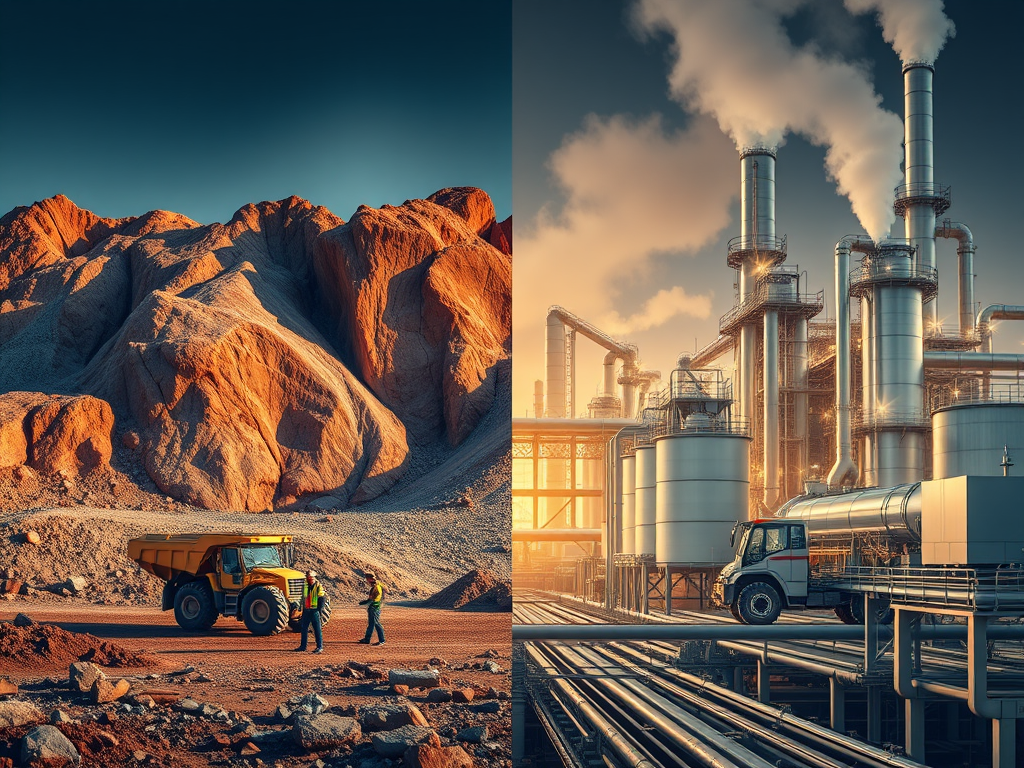
The biggest analytical failure in Western policymaking over the last decade was the fixation on mining. Who owns the rocks seemed like the key strategic question. In reality, power in 2026 resides in the midstream: the complex, capital-intensive, environmentally ugly processes of refining, separation, chemical conversion, and component manufacturing.
China’s dominance in this layer of the value chain amounts to a structural chokehold. As of 2025, Beijing controlled roughly 91 percent of global rare earth separation and refining capacity and nearly 94 percent of permanent magnet production. This is not an abstract statistic. It means that rare earths mined in California, Australia, or Africa almost invariably still have to pass through Chinese facilities before they can be turned into magnets, motors, or defence components.
This is what gives China real leverage. Mining can be diversified. Processing cannot be replaced quickly. Decades of accumulated expertise, sunk capital, permissive environmental regulation, and state coordination have created a barrier that is extraordinarily difficult to breach. Western governments are discovering that you cannot simply subsidize your way into chemical-processing dominance.
Beijing understands this position perfectly. Its strength isn’t in big trade bans, but in carefully planned interference. In April 2025, when China expanded export controls on heavy rare earths such as dysprosium and terbium, the move was deliberately restrained. There was no outright ban. Instead, the government tightened administrative licensing and compliance procedures. The result was immediate uncertainty across the global tech, automotive, and defence sectors. Supply chains slowed. Prices jumped. And the message was unmistakable, in the green economy, China does not need to block access. It only needs to manage it.
Indonesia’s nickel strategy: coercion as industrial policy
If China demonstrates how value-chain dominance is built over decades, Indonesia shows how it can be forced in real time. Jakarta’s nickel strategy is perhaps the clearest example of Resource Nationalism 2.0 working exactly as intended.
Indonesia did not request the world market to kindly invest in the local processing. It compelled it. Through the prohibition of unprocessed nickel ore exports, the government left foreign companies with a very simple option: either construct smelters and refineries within Indonesia or lose the supply of one of the most important battery metals in the world. First the, industry protested, but then the capital adjusted just as predictively
The results have been dramatic. Indonesia now accounts for roughly 58 percent of global mined nickel production and has rapidly developed domestic smelting and stainless steel industries. More importantly, it is moving beyond basic processing into battery-grade materials and EV supply chains. What once looked like a risky gamble increasingly resembles a structural transformation.
Jakarta has also demonstrated a growing sophistication in market management. For 2026, the government signalled a sharp reduction in mining quotas, cutting output from around 379 million tonnes to approximately 250 million. Officially, this is framed as an environmental measure. In practice, it is also a price-management strategy designed to tighten global supply, support margins, and protect the economics of domestic downstream projects. Indonesia is no longer just a producer. It is behaving like a market-maker.
The lithium triangle
In South America’s lithium triangle Argentina, Chile, and Bolivia the struggle over value-chain sovereignty is playing out in slower, more politically contested ways. Each country has adopted a different model, reflecting its institutional capacity, political ideology, and tolerance for risk.
Bolivia has chosen the most uncompromising path. By keeping lithium under strict state control, it has prioritized sovereignty and long-term national ownership over speed. The problem is execution. Without sufficient domestic technology or capital, progress has been slow. This has created openings for foreign partners willing to accept long time horizons. Chinese firms, accustomed to operating under state-led frameworks, have proven particularly compatible with this approach, trading infrastructure investment and technical assistance for long-term access.
Chile is attempting a more delicate balancing act. Its emerging 50+1 model gives the state a controlling stake in new projects while still relying on private capital and expertise. In theory, this preserves sovereignty while maintaining competitiveness. In practice, it introduces uncertainty. Investors worry about political interference, while the state faces pressure to deliver production growth quickly enough to remain relevant in fast-moving battery markets.
Argentina remains the outlier. Its relatively liberalized framework has attracted rapid investment and production growth, but at the cost of limited domestic value addition. The risk is familiar: becoming a supplier of raw inputs while the industrial rents accrue elsewhere.
What unites all three countries is a shared realization that exporting lithium brine or carbonate alone is a dead end. Each is now talking about down streaming, local battery manufacturing, and industrial clusters. Whether they succeed is another matter. Battery production requires scale, stable power, skilled labour, and integration into global market ,conditions that are far harder to create than policy documents suggest.
The DRC: a warning on imbalance
The Democratic Republic of the Congo offers the most sobering lesson in the limits of resource nationalism without value-chain control. The country produces more than 70 percent of the world’s cobalt, yet remains largely powerless over its price and destiny.
Through infrastructure-for-minerals agreements and joint ventures over the past decade, Chinese companies have secured ownership or significant stakes in 15 of the 19 largest cobalt mines in the country. Mining revenues flow, but refining, cathode production, and battery manufacturing occur elsewhere. The DRC captures volume, not leverage.
Even attempts at assertiveness have fallen flat. When the government moved to restrict exports in early 2025 in an effort to stabilize collapsing cobalt prices, the impact was limited. With China controlling most refining capacity and end-use demand, the DRC remained a price taker. The episode underscored a harsh reality: sovereignty over resources means little if sovereignty over processing and markets is absent.
Conclusion
The era of frictionless, politically neutral global trade is over. Every decision in the green economy now carries strategic weight. Choosing a battery chemistry, a processing partner, or a sourcing country is no longer just a cost calculation. It is a geopolitical alignment.
What is emerging is a bifurcated global system. On one side sits a Chinese-centered vertically integrated, state-backed, and dominant in midstream processing. On the other is a Western friend-shoring model, built on subsidies, trade agreements, and shared political values, but constrained by high costs, slow permitting, and fragmented industrial policy.
Neither system is fully self-sufficient. Both are vulnerable. But the direction of travel is clear. The green transition is not simply an environmental project. It is the central arena in which industrial power, technological leadership, and geopolitical influence are being renegotiated.
For investors, policymakers, and companies alike, the lesson is stark. Without a strategy for value-chain sovereignty, you are not a player in this transition. You are a customer. And in a world where supply chains are weapons, customers do not set the rules.




Leave a Reply